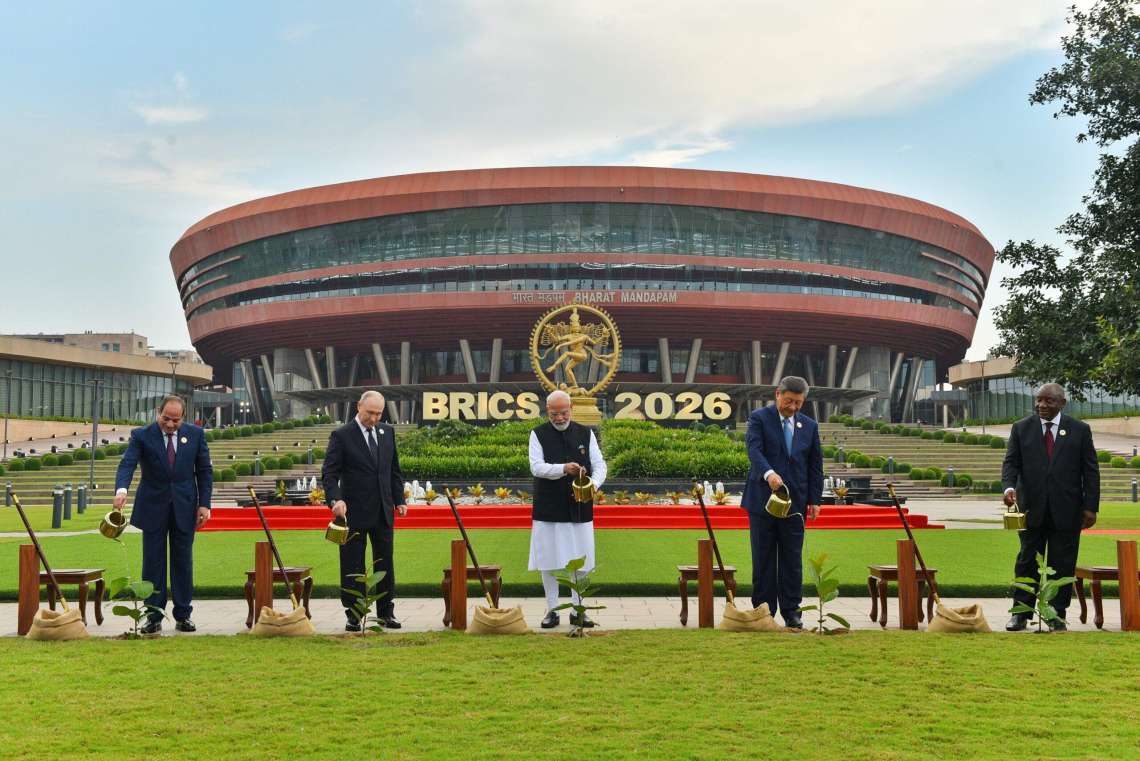

BRICS is gaining economic weight, but business confidence hinges on distinguishing diplomatic ambition from commercial reality, writes Ishan Jasuja, Founder & Director, Geoeconomic Strategy Unit
BRICS is becoming too economically important for businesses to treat it as a diplomatic talking shop. The expanded grouping now represents roughly 40% of global output in purchasing-power terms and close to half of the world’s population. Yet those headline numbers tell businesses surprisingly little about where they should invest, which supply chains are resilient, or whether a government agreement will translate into a commercially viable opportunity.
That gap between summit diplomacy and business reality was the central theme of a recent roundtable co-hosted by the Geoeconomic Strategy Unit (GSU) and London-based KGCP. The discussion titled, “The New Geography of Cross-Border Growth: Geoeconomic Strategy, Commercial Intelligence, and Strategic Capital in the BRICS Era” brought together diplomats, business leaders, and analysts from Africa, Asia, Europe, and Latin America. The recurring message across all represented regions was that BRICS can create real economic opportunity, but only if companies look beyond declarations and understand the conditions on the ground.
Critical minerals offer a clear example. GSU analysis presented at the roundtable, drawing on International Energy Agency data, showed that China accounted for 91% of global refining of magnet rare earths in 2024. Indonesia, a recent full-member of the bloc, now contributes more than 60% of global nickel output, but around three-quarters of its refining capacity remains linked to Chinese companies. A business may therefore diversify where it buys a mineral without translating that diversification into the processing technology or ownership behind it. Hence, geography alone can give a false sense of resilience.
Finance tells a similar story. India’s imports from Russia have recently been more than 12 times the value of its exports to Russia. That imbalance hinders efforts to promote settlement in local currencies: Russian exporters receiving rupees need credible ways to spend, invest, or convert them. Ambassador Ashok Sajjanhar noted during the roundtable that 96% of India-Russia trade is now conducted in local currencies. The progress is significant, but the commercial mechanics still tell more than the headlines.
The New Development Bank, created by BRICS members, illustrates the same tension. Its cumulative approvals had reached about $43 billion by the end of 2025, yet almost 60% of its active portfolio remained denominated in US dollars. The lesson is that economic transition is incremental, mixed, and often more complicated than summit outcomes suggest.
This disconnects between ground realities and international deal-making has made strategic insights into markets a prerequisite for success. Businesses large and small need to learn how to identify where growth, stability, infrastructure, financing, and market access align strongly enough to support a business decision. This will enable them to avoid speculative decisions in today’s ever-changing geopolitical climate, bringing benefits like a strong first-movers’ advantage. Effective risk-mitigation allows companies to not only avoid downsides but also take advantage of upsides they otherwise would not be able to.
The roundtable also highlighted where the opportunity can be most tangible. Ethiopia’s Ambassador to India, H.E Nebiyu Tedla, argued that African economies should move from exporting raw materials to processing, manufacturing, and value creation. This was further operationalized by political-risk analyst Victor Bruno, who made a complementary point from Brazil: BRICS should be judged not by the number of declarations it produces, but by whether more projects are financed, more companies invest across borders, and more goods move through functioning corridors.
That is where platforms convened by strategic advisory firms can add practical value. Governments can establish frameworks, and multilateral institutions can provide finance, but businesses still need to know which partner is credible, which regulation is changing, where the bottleneck sits in a supply chain, and whether an opportunity remains attractive after political and financial risks are priced in.
The geopolitical reality companies operate in is moving faster than the official data and summit language used to describe it. Hence, business confidence today increasingly depends on the ability to separate political ambition from commercial readiness. BRICS may be opening a new geography of cross-border growth, but the firms that benefit will be those that understand what truly lies on the other side.