Bangladesh must also consider the US, its largest export market, which imports over $9 billion worth of its products. A major digital deal with China could strain ties with Washington and potentially affect trade….writes Dr SaKariya Kareem
The hesitation is natural on the part of Dhaka as China is the largest source of imported goods of Bangladesh, accounting for over 30 percent of total imports..reports A
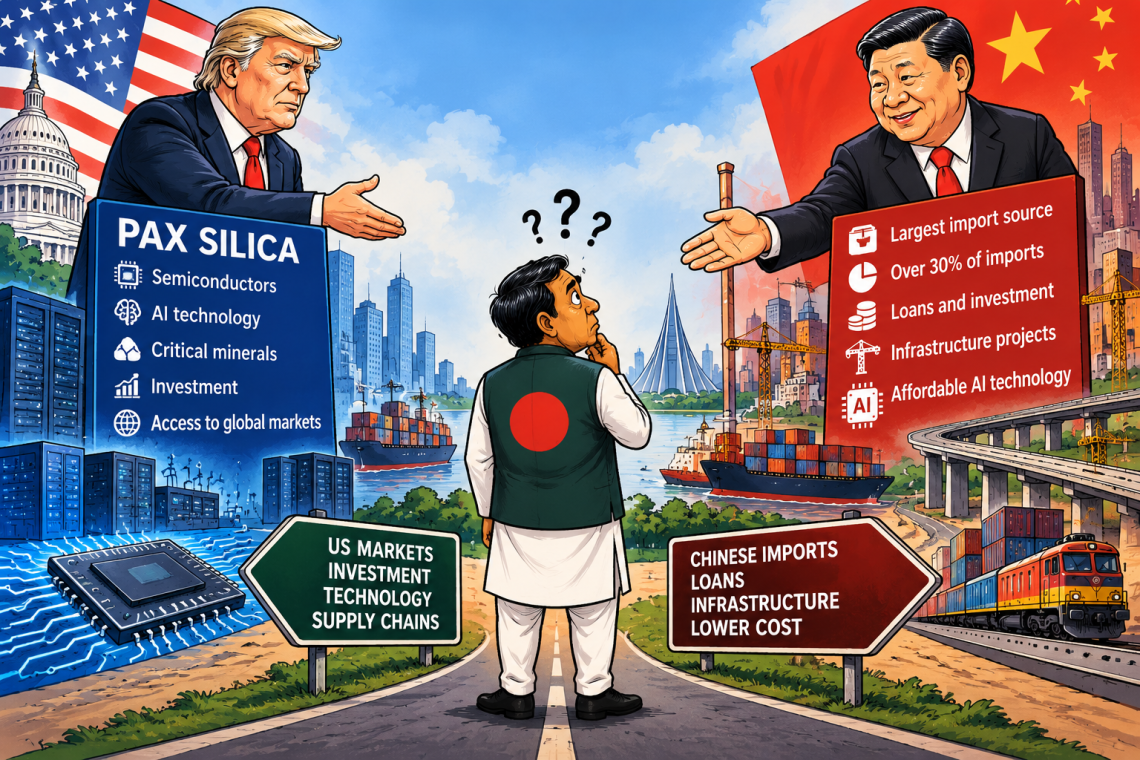
Bangladesh is now paying the price of overdependence on China for economic and financial support. For fear of antagonizing Beijing which remains a major lender, project contractor and trading partner of Bangladesh, Dhaka is hesitant to join the US-led Pax Silica Initiative that offers it many advantages.
According to recent reports, Dhaka is still reviewing the proposal of the United States to join Pax Silica, as it weighs the potential benefits and geopolitical implications of joining the US-led initiative.
Joining Pax Silica will bring obvious benefits to Bangladesh. It will ensure the country a secure global chain for semiconductors and chips, artificial intelligence hardware like data processing units and critical minerals — the rare earth elements — and also attract greater inflow of foreign investment in areas like data centres, advanced manufacturing and digital services. Pax Silica has been described as a US-led strategic initiative to build a “secure, prosperous and innovation driven silicon supply chain; from critical minerals and energy inputs to advanced manufacturing, semiconductors, Artificial Intelligence infrastructure and logistics.”
The stated aims of the Initiative – to reduce overconcentration in global supply chains, prevent economic coercion and to ensure that emerging technologies are developed and governed by open democratic societies — make it clear that Pax Silica is not a conventional free-trade agreement but a framework designed to ensure economic security among the participating countries by building a new supply chain for trade and investment in the area of critical minerals and Artificial Intelligence; in which China will not play a role.
Such an initiative has become imperative for the democratic societies as China, with control of over 70 percent of the supply of critical minerals, has become a major choke point for these elements essential for green energy and defence technology. Since 2023, China has been imposing export controls on these rare earth elements to several countries.
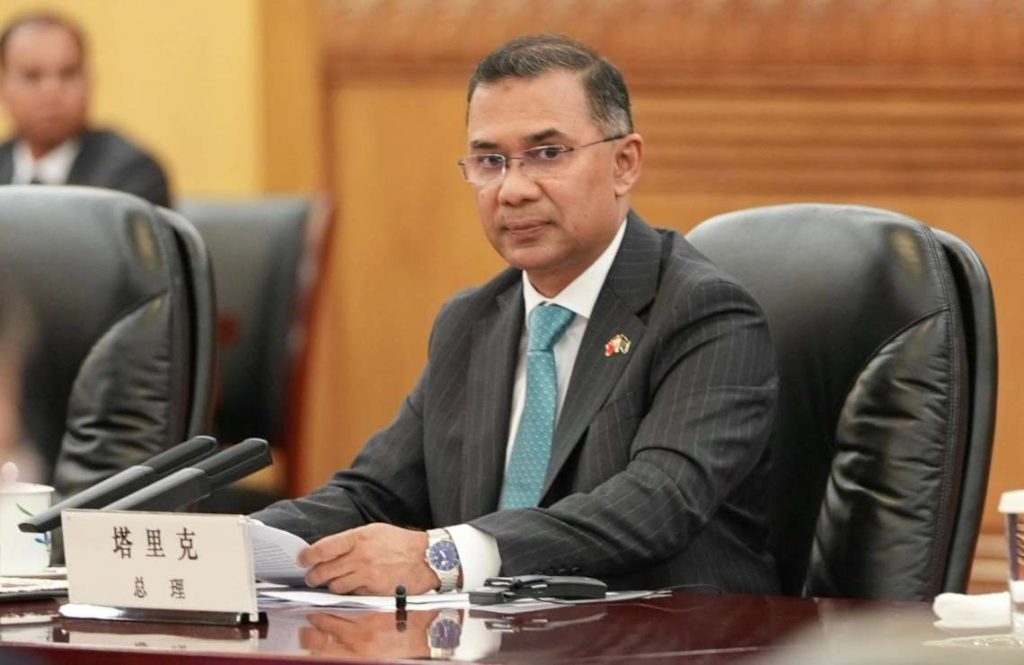
On a visit to Bangladesh in August, US special envoy for South and Central Asia Sergio Gor conveyed to Dhaka the proposal to join Pax Silica. In his meeting with the US envoy, Prime Minister of Bangladesh Tarique Rahman sought greater American investments; particularly in the IT sector. Sergio Gor said Bangladesh had a significant potential in technology and could eventually become a partner in the Pax Silica Initiative.
According to reports, while the Information and Communication Technology Ministry of Bangladesh is reviewing the technical aspects of the US proposal, the Foreign Ministry is assessing the political implications. The Foreign Ministry has asked the Bangladesh embassy in Washington to identify the requirements for joining Pax Silica Initiative; meaning thereby if it would require Dhaka to scale down its associations with China.
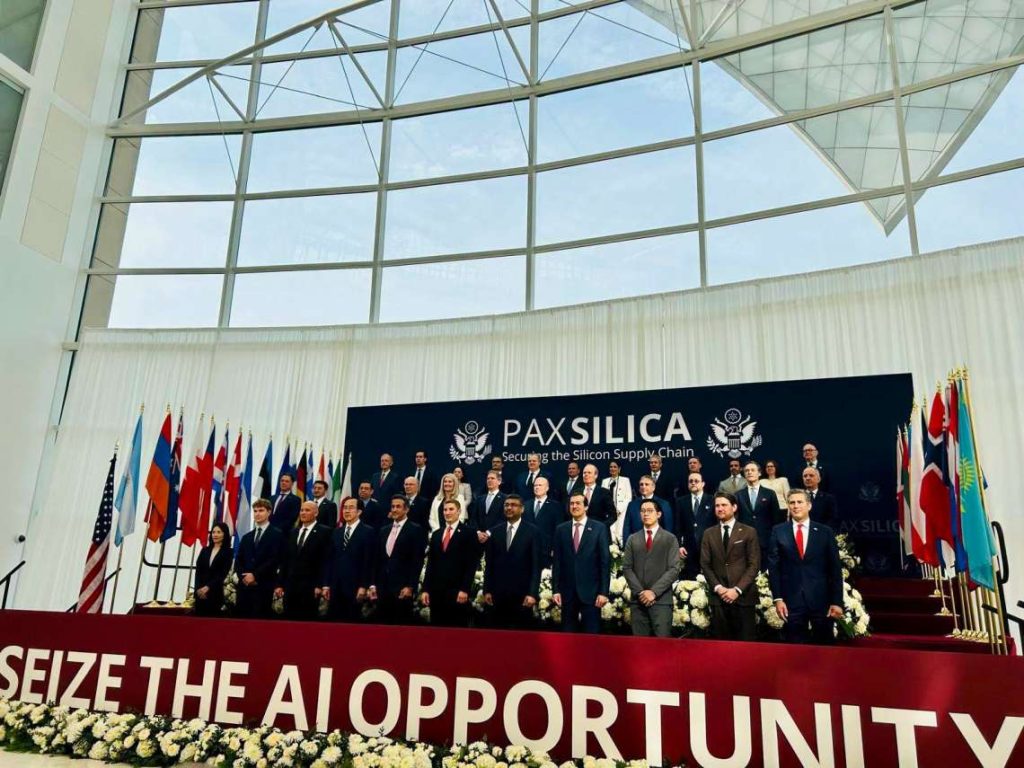
The Pax Silica Initiative was launched by the US in 2025 with Japan, South Korea, Singapore, Netherlands, the United Kingdom, Israel, United Arab Emirates and Australia as members. India joined the Pax Silica coalition in February 2026. The Philippines, too, joined the coalition in April. Taiwan is a non-signatory member of the Initiative; enough reason by itself for China to keep out of it. The partner countries host key information technology firms that control the global Artificial Intelligence supply chain.
AI models can be an essential tool to help in advance demand prediction and better inventory control. For Bangladesh, this can help in increasing the efficiency of production, bringing down costs and making products more competitive in the international market. Besides strengthening the Artificial Intelligence ecosystem in the country, ties with Pax Silica Initiative could mean for Bangladesh easy access to American and Indian markets which are vital for Bangladeshi exports and access to capital and technology from multilateral institutions controlled by the west.
Port facilities being developed by global port operators in Bangladesh can facilitate the supply of critical minerals. With a semiconductor unit coming up in the neighbouring Indian state of Assam, there is scope in Bangladesh for upstream industries like chip design and of downstream industries like consumer electronics and telecommunication, analysts have said. Participation in Pax Silica will also bring in foreign investments in the IT sector. Access to technology will help in developing the semiconductor industry in the country and in diversifying an economy still heavily dependent on the export of readymade garments.
What puts Dhaka in a predicament is that joining Pax Silica is viewed by Beijing as a vote against a China-led world economic order; a techno-economic containment strategy to reshape critical supply chains in Artificial Intelligence, semiconductors and critical minerals away from the dominance of Beijing. In view of the economic dependence of Bangladesh on China, Dhaka is hesitant to embrace the Pax Silica Initiative. But, the Americans have subtly tied the continuation of preferential tariff on the import of textile products from Bangladesh to the participation of Dhaka in pacts related to defence and other non-trade issues.
The hesitation is natural on the part of Dhaka as China is the largest source of imported goods of Bangladesh, accounting for over 30 percent of total imports. In 2024-25, Bangladesh imported goods worth over $20 billion from China. Chinese firms are heavily involved in the power, transport and telecommunication sectors in Bangladesh and thus have a control over the commanding heights of the economy of the country.
Ironically, on the same day Ambassador Sergei Gor made his offer to Dhaka to become a member of Pax Silica Initiative, Bangladesh and joined as an observer the World Artificial Intelligence Cooperation Organization which is led by China. Headquartered in Shanghai, WAICO is an intergovernmental organization seeking to promote international cooperation on Artificial Intelligence innovation.
Dhaka may be tempted that Chinese firms now offer affordable AI models and technologies, but experts have warned that Bangladesh should look beyond the cost. The initial price of an AI service is only part of the calculation. The long-term cost of becoming dependent on a particular producer must also be taken into calculation; issues like cybersecurity, data protection and dependence on foreign cloud infrastructure. Beijing could put pressure on Dhaka to adopt Chinese vendors, standards and data rules, leaving Bangladesh with little bargaining power.
Over-dependence on the Chinese technology ecosystem would also expose Bangladesh to risks involving the technical standards. The western countries have traditionally dominated global technological norms. China is merely trying to create an alternative framework. Bangladesh cannot miss out on access to Western capital and markets.
Dhaka must also keep in mind that the US is the largest export market of Bangladesh, importing over $9 billion of Bangladeshi products, followed by other European countries like Germany, the UK, Spain and Netherlands. Thus, a large government-to-government digital arrangement with China that Washington considers harmful to US interests may trigger diplomatic friction and potentially affect bilateral trade.