Bangladesh’s economic growth has fallen to 3.2 per cent amid rising inflation, weak investment and industrial disruption….reports Asian Lite News Desk
Bangladesh is facing mounting economic challenges as economic growth slows, inflation rises and industrial production struggles to recover. Weak investment, declining revenue collection, banking sector difficulties and concerns over corruption are adding to pressure on the country’s financial outlook.
The country’s gross domestic product (GDP) growth has fallen to 3.2 per cent, reportedly its lowest level in more than 25 years, amid rising inflation and disruptions to industrial production, according to an article published in Dhaka-based The Daily Star.
The article highlights several warning signs, including unimpressive remittance inflows from non-resident Bangladeshis (NRBs), slower-than-expected export growth and concerns over the costs of major infrastructure projects.
The banking sector is also facing significant challenges, with high levels of non-performing loans (NPLs) and limited access to credit for industrial businesses. Meanwhile, foreign direct investment (FDI) remains insignificant, restricting employment opportunities, industrial investment and export growth.
The country’s economic outlook in the near term remains uncertain, with weak investment and a challenging business environment affecting prospects for recovery.
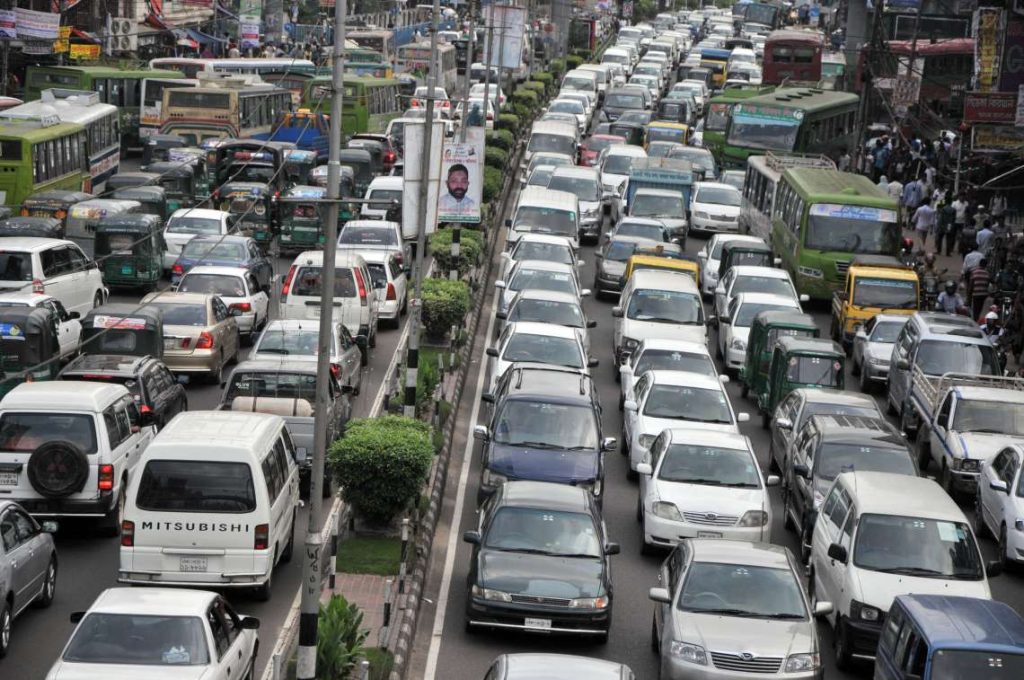
Caption : DHAKA, July 10, 2014 (Xinhua) — Vehicles are stuck in a traffic jam on a road in the rush hour during the Islamic holy month of Ramadan in central Dhaka, Bangladesh, July 10, 2014. (Photo: Xinhua/Shariful Islam/IANS)
Revenue shortfall adds to budget pressure
Mass tax evasion has emerged as another major obstacle to economic growth. Revenue collection during the first quarter of the current financial year reportedly recorded a shortfall of Tk 42,000 crore.
The national budget for 2026-27 had already projected a substantial deficit of Tk 200,000 crore. The article warns that the revenue shortfall could make it increasingly difficult for the government to meet its fiscal targets.
It also points to weaknesses in the capacity and functioning of the National Board of Revenue (NBR), raising concerns about the government’s ability to bridge the growing financial gap.
With the current revenue trend, the budget deficit could widen further, adding pressure to public finances.
The wider business environment is also under strain, with challenging economic conditions at national, regional and global levels making it difficult to stimulate activity through short-term measures.
High fixed costs, ongoing mega projects and mandatory economic and social spending commitments are adding to government expenditure, while the country faces what the article describes as a severe cash crunch.
Governance and spending reforms under scrutiny
Governance failures, lack of transparency and weak accountability have contributed to corruption over several years, according to the article. It questions whether sufficient progress has been made in addressing these longstanding problems.
The article also notes that the Prime Minister has reduced personal expenditure, describing the move as an apparent demonstration of political will.
However, it argues that individual spending cuts alone will not be enough to address the country’s economic difficulties.
Keeping capital project costs realistic, reducing unproductive and revenue expenditure, and strengthening governance are identified as essential steps towards restoring economic stability.
The article concludes that without meaningful reforms in public spending and administration, Bangladesh will struggle to emerge from its current economic difficulties.