November 17, 2021
4 mins read

UAE-Russia non-oil trade records 80% growth

UAE-Russia relations continue to flourish as non-oil trade exchange between the two countries witnesses 80% growth in H1 2021…reports Asian Lite News

The 10th Session of the Intergovernmental Russia-Emirate Committee on Trade, Economic, and Technical Cooperation was held in Dubai, chaired by Abdullah bin Touq Al Marri, Minister of Economy; and Dr. Denis Manturov Russian Minister of Trade and Industry.
UAE FLAG

During the session, Bin Touq underlined the strength of the UAE-Russian relations, which represents a unique model of bilateral relations, and pointed out the two countries’ shared aspirations to develop existing partnership in a sustainable manner in line with their respective development visions and objectives. The minister further noted that the ties binding the UAE and Russia today have broad development potentials and promising prospects as they are based on solid historical foundations of mutual respect and common interests.

The ties binding the two friendly countries were consolidated over the last five decades, said Bin Touq, adding that they continue to flourish through strong strategic partnership that spans multiple areas of cooperation, development, and common interests, especially on the economic front.

Bin Touq added: “The economic relations between the UAE and Russia are witnessing progress in various fields, especially in new economic sectors such as 4IR, Artificial Intelligence, innovation, circular economy and various other vital fields. We will continue to intensify joint efforts with our partners in Russia to further strengthen cooperation and economic integration in accordance with a clear vision and new paths that serve the development aspirations of the two countries.”

During the session, both parties set a new framework for economic cooperation that includes 12 vital and future sectors and areas, in addition to outlining a roadmap for cooperation between the two countries in the next stage. It covers trade and investments, energy, industry and innovation, financial and banking services, customs, food security and agriculture, education and transportation, information and communication technology, media and culture, tourism and sports, environmental protection and natural resource management, circular economy, the Industry 4.0, and space.

Abdulla bin Touq briefed the Russian side on the latest trends and achievements the UAE economy has witnessed, elaborating on the initiatives launched by the UAE recently in line with its futuristic vision. He reviewed the ‘Projects of the Fifty’ and the UAE’s efforts to fast-track the transformation towards new economic model that is more sustainable and flexible by liberalizing investments, enabling 100% foreign ownership of companies, conclusively developing economic legislations to facilitate doing business, and fostering the UAE’s attractiveness for pioneering projects, prominent international companies and outstanding talents and innovations.

Furthermore, invited Russian corporations to leverage these economic developments in the UAE to explore more partnership and business opportunities in the country’s markets and expand into regional and global markets.

Meanwhile, Denis Manturov affirmed his country’s keenness to enhance collaboration with the UAE and build on the achievements made in recent years in terms of mutual economic relations, which has seen a tenfold growth since the year 1997 – the year in which the first Intergovernmental Committee session was held.

Al Zeyoudi noted that the economic cooperation between the UAE and Russia has reached new milestones in terms of volume and diversity in recent years, encompassing multiple vital sectors, such as renewable energy, space, modern technology and Industry 4.0, in addition to the successful projects and investments in the two countries’ companies in real estate, food security, infrastructure, petrochemicals, ports and aviation.
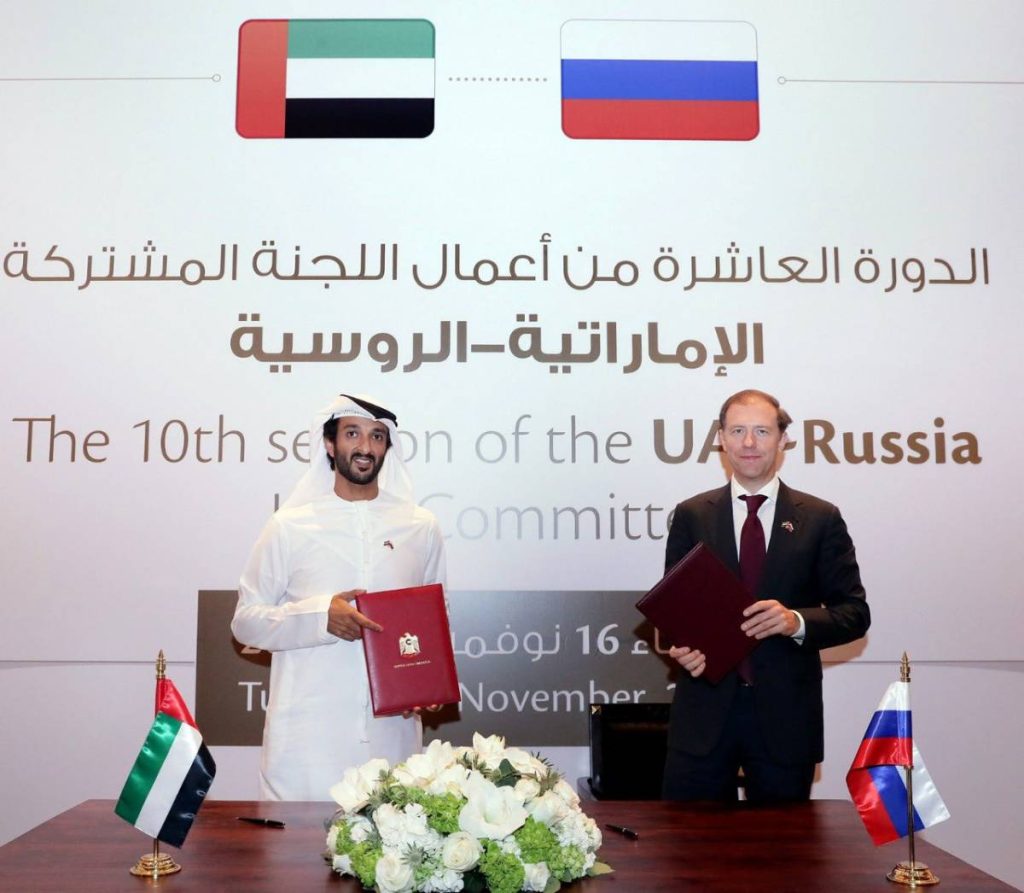
UAE-Russia non-oil trade records 80% growth

“The UAE markets are home to more than 4,000 Russian companies, which are considered major contributors to the growth of commercial ecosystem in UAE and the enhancement of opportunities and partnerships for both countries’ markets. We will move forward with joint efforts with our Russian partners to further strengthen the ties between our business communities and facilitate their access to promising opportunities in both countries’ markets,” Al Zeyoudi added.

DR. MOHAMMED AHMED AL JABER: “Next December marks the 50th anniversary of the establishment of bilateral relations between UAE and Russia. Our relations have always been friendly, stable, and built on the pillars of mutual respect and understanding. The dynamic nature of UAE-Russia Intergovernmental Committee is a testament to the significance of economic diplomacy’s role in shaping the UAE’s foreign policy, enhancing cooperation between the two countries, and promoting the relations in all areas. The Committee’s outputs present important collaborative programs in the sectors of the new economy that serve both countries’ futuristic visions and pave the way for a more sustainable and diversified development partnership between UAE and Russia.”

The UAE is Russia’s largest economic partner in GCC, accounting for 55 percent of the total trade between Russia and GCC region.

During the session, the two countries agreed on a plan to develop the volume of trade exchange, increase the contribution of the private sector in mutual trade and investment activities, enhance cooperation through the UAE-Russia Business Council, and expand the scope of communication to create new opportunities.

ALSO READ: UAE, Israel begin FTA talks

The two sides approved to take practical steps to support cooperation in the areas of the circular economy and the green economy, as well as to encourage the UAE business community to invest in Russia in various vital and future sectors, including industry, renewable energy, logistics, aerospace, automobiles, medicine, medical technology, transportation, agriculture, food, real estate, infrastructure, minerals and mining.

Previous Story

Armed forces sign Dh20bn deals

Next Story

Six people killed in twin bomb blasts in Ugandan capital

Previous Story

Armed forces sign Dh20bn deals

Next Story

Six people killed in twin bomb blasts in Ugandan capital

Latest from -Top News

Pakistan Risks Overstretching Itself in Yemen War

Pakistan’s expanding military role in Saudi Arabia amid the Yemen conflict could strain its defence resources and fragile finances…reports Asian Lite News Desk Pakistan’s military involvement in the war in Yemen may prove unsustainable because of mounting financial pressures and competing security demands, according to a new report. Islamabad’s growing military presence in Saudi Arabia risks stretching its defence resources while exposing the country to greater strategic and economic challenges. An article by Andrew Wilson in One World Outlook describes Pakistan’s involvement as a case of “fiscal and strategic overreach”, arguing that the country lacks the financial flexibility to sustain an expanded military commitment. Pakistan’s external finances depend heavily on an International Monetary Fund (IMF) programme, financial support from Gulf countries and remittances from Pakistani workers in the region. The report argues that deeper military involvement in the conflict could place additional pressure on these sources of financial stability. It also warns that deploying troops and military equipment abroad could weaken Pakistan’s capacity to address security challenges along its eastern border and deal with two domestic insurgencies. The move could also draw Islamabad into a conflict it has sought to approach cautiously. A Reuters report in May, citing Pakistani security and government sources, said Islamabad had deployed around 8,000 troops, a squadron of approximately 16 aircraft, mostly JF-17 fighter jets, two drone squadrons and a Chinese HQ-9 air-defence battery to Saudi Arabia. According to those sources, Riyadh was financing the deployment, with Pakistani personnel operating the equipment. The sources also said a confidential agreement contemplated the possibility of deploying up to 80,000 troops. Islamabad has not confirmed those figures, although it has acknowledged its military presence in Saudi Arabia, including the deployment of fighter jets at King Abdulaziz Air Base from April. The One World Outlook article argues that Saudi financial support can cover allowances and operating expenses but cannot easily replace military equipment needed elsewhere or resolve the political and strategic challenges of participating in the Yemen conflict. Pakistan’s defence budget is another concern. For the 2026-27 financial year, the federal government allocated PKR 3 trillion, or approximately $10.8 billion, to defence services. The allocation represents an 18 per cent increase from the original PKR 2.55 trillion provision and amounts to around 2.1 per cent of projected gross domestic product (GDP). Defence spending accounts for approximately 16 per cent of the federal government’s PKR 18.8 trillion expenditure. Military pensions are budgeted separately at PKR 822 billion, while debt servicing costs stand at approximately PKR 8 trillion, more than two-and-a-half times the defence allocation. The report argues that these competing financial obligations leave little room for additional military expenditure without placing further pressure on public finances. Pakistan’s reliance on IMF assistance also limits its fiscal flexibility. The country must meet the conditions attached to the programme, including a primary budget surplus target of 2 per cent of GDP and continued restraint on development spending. According to the article, these requirements make it difficult for Islamabad to finance an additional military commitment without compromising other budgetary priorities. Pakistan’s economic indicators offer limited reassurance. Economic growth for the 2025-26 financial year is estimated at between 3.6 and 3.7 per cent, while inflation reached approximately 10.3 per cent in September following an energy price shock. Foreign exchange reserves stood at around $21.5 billion at the end of September. Although this marks an improvement from the low levels recorded in 2023, the report notes that the reserves cover only a few months of imports. Financial assistance from Gulf partners remains central to Pakistan’s external stability. The article says Islamabad holds approximately $8 billion in Saudi deposits at its central bank. In July, the State Bank of Pakistan said Riyadh had extended the maturity of $5 billion in deposits to December 2028, easing the country’s immediate external financing requirements. A further $3 billion deposit was also extended in the spring. However, the article argues that these arrangements provide temporary relief rather than long-term financial independence, particularly as regional conflict threatens the stability of the Gulf economies on which Pakistan relies. The report concludes that Pakistan faces a difficult balance between supporting Saudi Arabia militarily and preserving the financial and military resources needed to address its domestic and regional challenges.

UK and Germany Ratify Kensington Treaty

Britain and Germany ratify the Kensington Treaty, agreeing new cooperation on AI, quantum research, defence and security while targeting investment, jobs and Russian hybrid threats…reports Asian Lite News Desk Britain and Germany

Economic tide is turning in Bangladesh

If there is one thing that can bring some comfort to the struggling Bangladeshi economy, it is good relations with India. Bangladesh should remember that Delhi’s backing, through easy supplies of essentials

DP World Lands 15-Year Bangladesh Port Deal

The agreement between the Chittagong Port Authority (CPA) and DP World covers the New Mooring Container Terminal…reports Asian Lite News Desk Bangladesh has signed a 15-year concession agreement with global ports operator
Go toTop

Don't Miss

Gargash heads UAE delegation in 3rd Govt Forum in Saudi

Gargash highlighted the importance of similar regional and international forums

Hotpack Global sets up largest manufacturing plant in UAE

Hotpack Global is the largest food packaging products manufacturer in