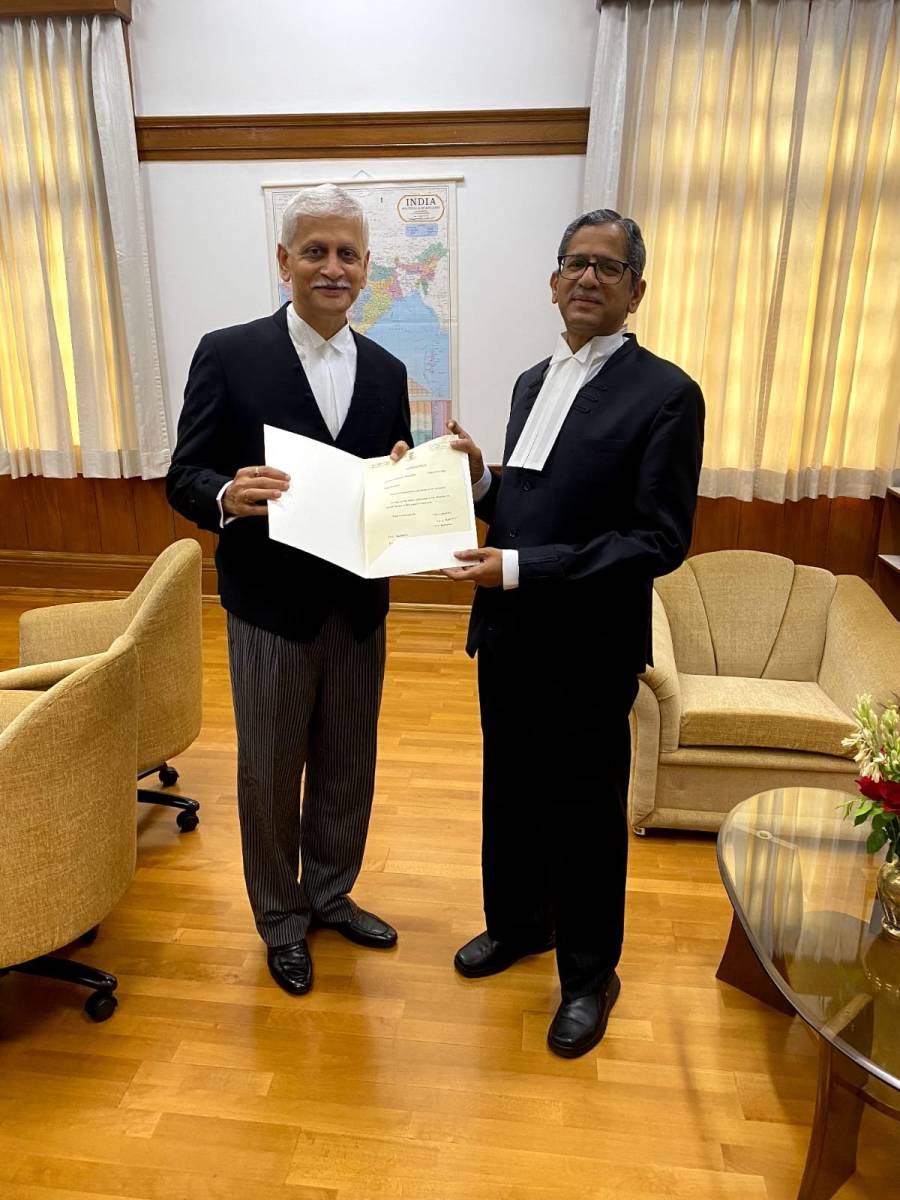
Chief Justice Ramana, said it is the solemn duty of the courts below to consider the defence of the accused, and the court may accept or reject the same, however it cannot be done cursorily….reports Asian Lite News
The Supreme Court on Thursday said that it is the court’s duty to “extract the truth from the mass of evidence”, as it set aside the conviction and sentence of an accused convicted for attempt to murder and various sections of Arms Act in a 2003 case.
A bench, headed by Chief Justice N.V. Ramana and comprising justices Krishna Murari and Hima Kohli said: “It is the duty of the court to separate the grain from the chaff and to extract the truth from the mass of evidence. In our opinion, the case of the prosecution is based on mere conjectures and surmises. The high court and the trial court failed to consider the above mentioned circumstances while rendering the judgment convicting the accused.”
Chief Justice Ramana, who authored the judgment on behalf of the bench, said it is the solemn duty of the courts below to consider the defence of the accused, and the court may accept or reject the same, however it cannot be done cursorily.
“If all the circumstances are bundled together and a single opportunity is provided to the accused to explain himself, he may not be able to put forth a rational and intelligible explanation. Such exercises which defeat fair opportunity are nothing but empty formality,” the bench said.
The top court noted that non fulfillment of the true spirit of Section 313 of the CrPC may ultimately cause grave prejudice to the accused and the court may not have the benefit of all the necessary facts and circumstances to arrive at a fair conclusion.
The purpose of Section 313 is to provide the accused a reasonable opportunity to explain the adverse circumstances which have emerged against him during the course of trial, it said.
According to the prosecution, in February 2003, Jay Prakash Tiwari and another person had gone to the house of the complainant and called him outside, and later fired at him with a country-made pistol. The complainant ran into the house and escaped injury.
Tiwari claimed that owing to the animosity pertaining to the elections, he was falsely implicated in the matter, and also produced two witnesses to prove his alibi, who said Tiwari was in his village as his mother was unwell. Tiwari also pointed out that the father, sister and brother of the complainant were all part of the Police Department.
In May 2017, the Madhya Pradesh High Court dismissed his appeal against sessions court judgment confirming his conviction under Section 307 of IPC (attempt to murder) and various sections of Arms Act. Tiwari challenged the high court judgment in the apex court.
“It is clear that the courts below have failed to undertake this solemn duty. Rather, the evidence of the accused has been dealt by the Court in a casual manner,” said the top court.