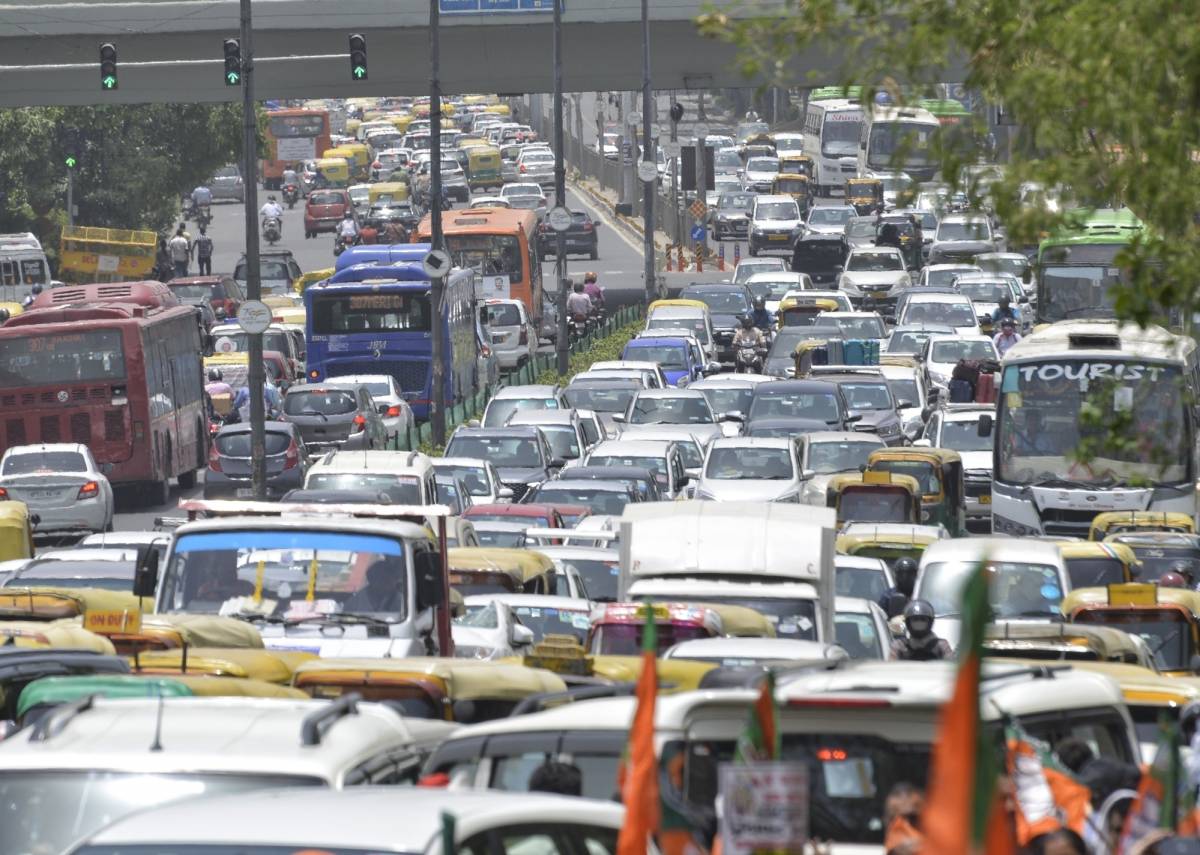
The Delhi government on Thursday announced a ban on entry of medium and heavy vehicles in the city from October 1 to February 28 next year, to keep a check on pollution levels in this winter.
The Delhi government had also written on June 15 to its neighbouring states, including Haryana and Uttar Pradesh, urging them to allow only BS VI-compliant buses to enter the city from October 1 in order to help control air pollution.
The letter written by Special Commissioner, Transport, O.P. Mishra said that the situation of air pollution in the national capital has attracted the attention of the Supreme Court and the CAQM (Commission of Air Quality Management in Delhi and NCR), both of which have issued directions for effective regulation of air pollution and vehicular pollution.
Every year, the capital city witnesses high levels of air pollution in the winter months from October due to a multitude of factors, including stubble burning and vehicular traffic leading to the breathing and other problems.
Forecast systems helped in winter
Stating that forecasting systems along with supporting local actions helped prevent extremely severe air pollution episodes in Delhi in the winter of 2021, a study released on Thursday suggested that to further reduce air pollution episodes next winter, the forecasting systems would need to provide more accurate predictions.
The independent study — �Improving Air Quality Management Through Forecasts: A Case Study of Delhi’s Air Pollution of Winter 2021′ — by the Council on Energy, Environment and Water (CEEW), a non-profit think-tank, said that short-term emergency measures such as halting operations of power plants, construction activities and plying of trucks were introduced based on the forecasts, which are basically early warning systems.
Further, the CEEW study said the implementation of the Graded Response Action Plan (GRAP) must be based strictly on modelled source contributions obtained from forecasts and timed accordingly.
“This would eliminate the need for ad-hoc emergency directions to restrict various activities,” the study pointed out.
The findings of the study reinforce the need for strengthening both long-term and emergency actions aimed at curbing emissions from these sectors.