About half the people sleeping in underground shelters without food, water, power and heating in Mariupol were supposed to be evacuated on Sunday, but the ceasefire arrangement collapsed….write Ashish Ray
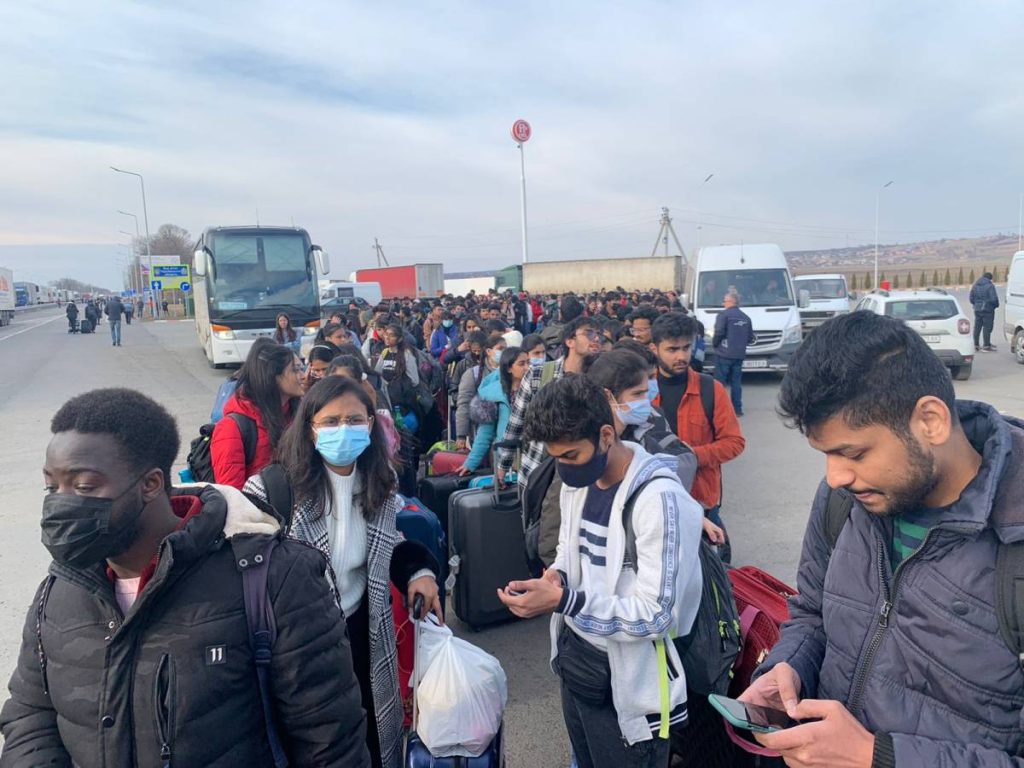
Beleagured Indian citizens in the south-eastern Ukrainian Mariupol area, particularly Sumy, are said to be still stuck and unable to escape safety from an intensifying war, with Russia and Ukraine continuing to disagree on a a humanitarian corridor for civilians out of the conflict zone. There are around 700 Indians living in Sumy.
About half the people sleeping in underground shelters without food, water, power and heating in Mariupol were supposed to be evacuated on Sunday, but the ceasefire arrangement collapsed.
The news agency Reuters said Moscow “would let residents of Ukraine’s two main cities (Kiev and Kharkiv) flee in corridors to Russia and Belarus”. Ukraine called this ‘an immoral stunt’.
Ukrainians interviewed by BBC at Ukrainian railway stations about to board trains to western Ukraine and beyond to European Union countries said they wouldn’t go to either Russia or Belarus.
Kremlin spokesman Dmitry Peskov told media on Monday Russia would cease its military action in Ukraine if the latter stopped fighting, amended its constitution to declare neutrality, recognised Crimea as Russian territory and the pro-Russian Ukrainian rebel regions of Donensk and Lugansk as independent.
Meanwhile, the Russian government on Moday informed its citizens, commercial firms and departments of state from the federal to the municipal that, where they have foreign exchange payment obligations to ‘unfriendly countries’ exceeding 10 million rubles a month, they may pay in rubles and not in a hard currency, so as to protect the country’s foreign exchange reserves.
Russia’s foreign exchange reserves are estimated to be around $285 billion. This, though, is under stress following swinging economic sanctions imposed by western countries and their allies.
The Kremlin issued a decree on Monday, which the Russian news agency TASS described as a “new temporary procedure” aimed at what the Russian government listed as unfriendly countries.
According to Moscow, the list of countries “that commit unfriendly actions against Russia, its companies, and citizens” include the US and Canada, the European Union member nations, the UK, Ukraine, Switzerland, Iceland, Liechtenstein, Monaco, Norway, Japan, South Korea, Australia, New Zealand, Singapore, and Taiwan.
TASS reported: “The countries and territories mentioned in the list imposed or joined the sanctions against Russia after the start of a special military operation of the Russian Armed Forces in Ukraine.”