The first island chain — a part of the three-island chain strategy — was activated after World War-II to keep China boxed in, and prevent Beijing from using military force far beyond the mainland..writes ATUL ANEJA
China could unveil its H-20 stealth bomber by November this year — a move, which when fitted into the big picture, could message the United States that its era of dominance of the Pacific is receding fast.
But the Chinese conclusions could be premature as the United States is working on its B-21 stealth bomber, the ultimate in stealth technology, which could assuredly counter whatever gains the Chinese may make in their capacity to target US assets in the Indo-Pacific.
Nevertheless, there are two main reasons why the Chinese H-20 project should be taken seriously. First, Beijing’s new bomber is expected to have target range of 8,500 kilometres, according to Pentagon’s “China Military Power Report” of 2019. The bomber’s reach can be further extended, in case it is refuelled in mid-air. If that happens, the plane would be able to fly beyond the first island chain, enabling the bomber to target the Philippines, Japan, Guam and Australia.
The first island chain — a part of the three-island chain strategy — was activated after World War-II to keep China boxed in, and prevent Beijing from using military force far beyond the mainland.
Historically, the emergence of the People’s Republic of China (PRC) in 1949 and the onset of the Cold War, led John Foster Dulles, a former US Secretary of State, to develop the “island chain strategy” of besieging China and the former Soviet Union from the sea. Dulles’s doctrine, aired during the heat of the Korean War in the early fifties, had three layers.
Of the three island chains, the “first island chain” was the most important. The lengthy network starts from Kamchatka peninsula in Russia’s Far East and weaves its way into Japan. Then, from the southernmost part of the Japanese mainland, it passes through Okinawa, a part of a larger Ryukyu Island chain which ends with Taiwan. From Taiwan, the “first island chain” heads towards the Philippines and the island of Borneo, before looping towards the tip of the Malay Peninsula. After the collapse of the Soviet Union, the first island chain has begun to increasingly focus on China.
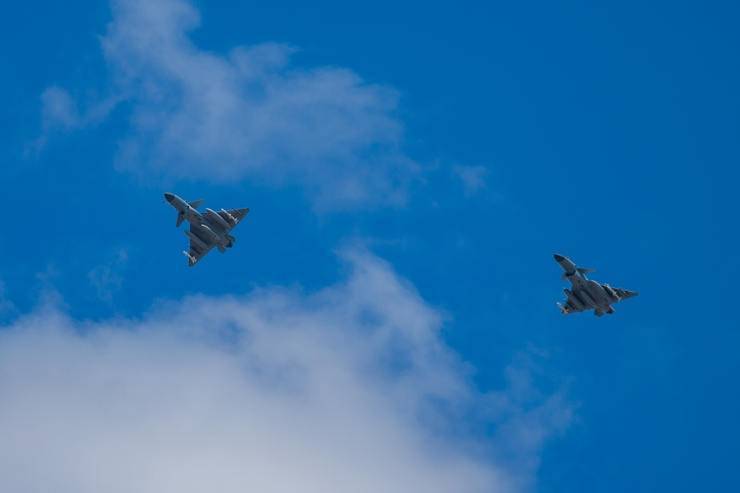
Second, the H-20 supposedly has advanced stealth features. The exterior of the plane does appear stealthy. It appears to have an embedded engine, blended wing body, and absence of vertical structures. Its engine air ducts appear to be woven into the frame underneath the fuselage. All these features make it difficult for radars to pick the plane, while it is engaged in undertaking its strike missions. China is already working on fifth-generation radar.
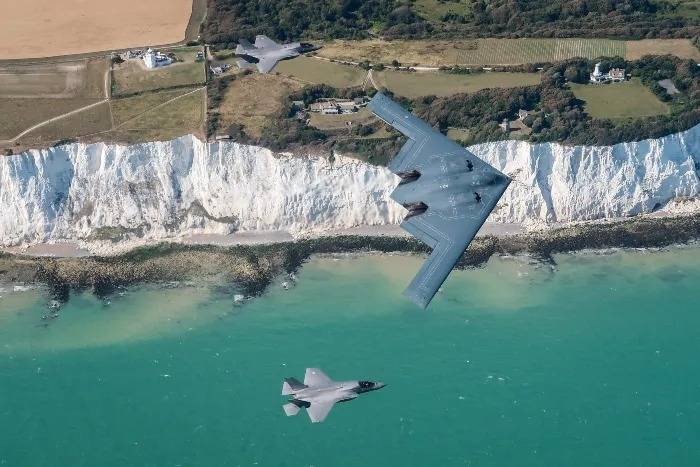
Yet, despite its advanced features, the H-20 will compare poorly with the B-21 bomber of the United States and even the upgraded B-2 plane.
The stealth features of the B-21 are far more sophisticated than the B-2.
For instance, the B-21 appears to have little or almost no external exhaust pipes, raising the question as to whether it incorporates new thermal management or heat dispersion technologies — a feature that would make it virtually impossible for the B-21 to be radar detectable.
Senior US Air Force leaders have said the platform contains a new generation of stealth technologies and can “hold any target at risk in the world at any time,” says an article in the National Interest. **
The writeup points out that US Air Force officials may have a “high measure of confidence” that the B-21 will be virtually “undetectable”.
The Chinese H-20 even compares poorly with the upgraded B-2 bomber of the United States.
Apparently, the B-2 is now incorporating a Defensive Management System sensor. This is designed to pick up locations of enemy air defence hotspots, allowing the plane to circumvent them.
On the electronic side, the B-2 is being fitted with a new computer sensor, which is a thousand times faster than the one currently in use. Consequently, it can integrate new weapons platforms such as the modern, upgraded B-61 Mod12 nuclear bomb, says the National Interest report. Both the B-2 and the B-21 can fire long-range nuclear and conventional cruise missiles, such as the US Air Force’s emerging Long-Range Standoff Weapon.
Both the B-2 and B-21 are built around an “open architecture,” which would allow multiple upgrades during their life-cycle.
(The content is being carried under an arrangement with indianarrative.com)