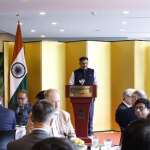
The Modi raised the issue of “transit rights” of food supplies between the neighbouring nations highlighting that it took many months for India to send supplies to Afghanistan via Pakistan…reports Asian Lite News
Prime Minister Narendra Modi on Friday reiterated to make India a manufacturing hub in the wake of the COVID-19 pandemic and the Russia-Ukraine war which has caused global supply-chain disruptions.
“The world is overcoming the COVID-19 pandemic. Several disruptions occurred in the global supply chain because of the COVID and Ukraine crisis. We want to transform India into a manufacturing hub,” PM Modi said while addressing extended format of the 22nd Summit of the Council of Heads of the Shanghai Cooperation Organization Member States (SCO-CoHS) in Uzbekistan’s Samarkand.
Highlighting the country’s economic stability, he said India has more than 70,000 start-ups and over 100 unicorns.
“We are focussing on a people-centric development model. We are supporting innovation in every sector. Today, there are more than 70,000 start-ups and over 100 unicorns in our country,” said PM Modi.
“India’s economy is expected to grow at a rate of 7.5 per cent this year. I’m glad that ours is one of the fastest growing economies among the largest economies of the world,” he added.
The Prime Minister also raised the issue of “transit rights” of food supplies between the neighbouring nations highlighting that it took many months for India to send supplies to Afghanistan via Pakistan.
The SCO Summit usually has 2 sessions – a restricted session, only for the SCO member states, and then an extended session which includes participation by observers and special invitees. Earlier, Uzbekistan’s President Shavkat Mirziyoyev welcomed PM Modi to the Congress Centre in Samarkand for the 22nd SCO Summit. India has been working closely with Uzbekistan towards the success of their Chairship.
The SCO Member States, Observers, Special Guests of the Chair and representatives from regional organisations come together for a meeting in the expanded format.
This is the first in-person SCO Summit after the Covid pandemic hit the world. The last in-person SCO Heads of State Summit was held in Bishkek in June 2019.

The SCO currently comprises eight Member States (China, India, Kazakhstan, Kyrgyzstan, Russia, Pakistan, Tajikistan and Uzbekistan), four Observer States interested in acceding to full membership (Afghanistan, Belarus, Iran, and Mongolia) and six “Dialogue Partners” (Armenia, Azerbaijan, Cambodia, Nepal, Sri Lanka and Turkey).
The Shanghai Five, formed in 1996, became the Shanghai Cooperation Organisation (SCO) in 2001 with the inclusion of Uzbekistan. With India and Pakistan entering the grouping in 2017 and the decision to admit Tehran as a full member in 2021, SCO became one of the largest multilateral organisations, accounting for nearly 30 per cent of the global GDP and 40 per cent of the world’s population. SCO has potential in various new sectors, wherein all the member-states could find converging interests. India has already pushed hard for cooperation in Startups and Innovation, Science and Technology and Traditional Medicine.
From the time of its full membership, India made sincere efforts to encourage peace, prosperity, and stability of the whole Eurasian region in general and SCO member countries in particular. (ANI)