November 6, 2023
4 mins read

BANGLADESH: The Democracy Dividend Fuels Growth

The democracy in Bangladesh is not as mature as in India, which is fast emerging as an economic superpower. However, there is enough evidence that Bangladesh has steadily insulated its politics from the interventions of the army. That stable rule of elected governments for decades is proof of strengthening of the democracy. The dividend is enjoyed through economic prosperity and peace. Pakistan is deprived of such dividends … Dr Sakariya Kareem

India was partitioned into two in 1947 based on religion. In 1971, Pakistan was further divided into two through a civil war. East Pakistan was rechristened as Bangladesh. So, there were now three countries from one: India, Pakistan and Bangladesh.

Considering its vast geography, India was the largest in terms of gross domestic product (GDP), followed by Pakistan and Bangladesh. However, when it comes to per-capita GDP (at the 2015 US dollar), Pakistan was the richest. India and Bangladesh were distinctly poorer with the latter infamously referred to as a ‘basket case’ by the US and suffered severe bouts of famine and devastating natural calamities.

A little more than half a century since the independence of Bangladesh, the development status in these countries has changed dramatically both in terms of context and content. India is now the fastest-growing major economy in the world and Bangladesh has overtaken Pakistan both in terms of GDP and per-capita GDP.
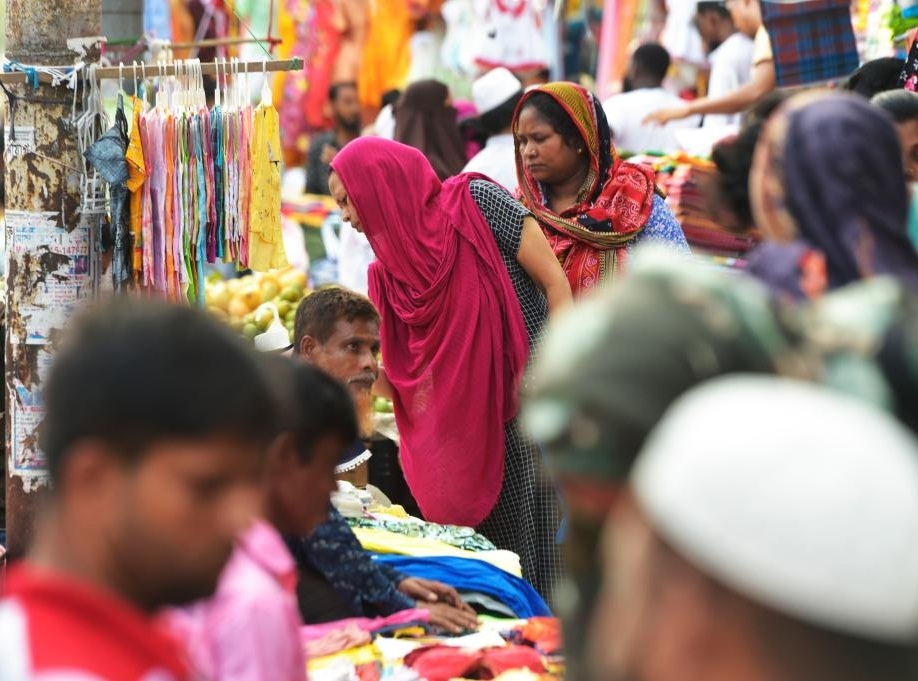
Female customers buy garment items at a roadside stall in Dhaka, Bangladesh, on July 27, 2022. (Xinhua/IANS)

The development in Bangladesh had been all-pervasive. Back in 1972, the export of goods and services stood at 5.7% of Bangladesh’s GDP as against 7.2% in Pakistan. As of 2022, exports contributed 12.9% of Bangladesh’s GDP as against 10.5% in Pakistan. Since 1991, Dhaka has been ruled by elected governments and is politically stable. The country has witnessed unprecedented infrastructure overhaul and a rise in foreign debt over the last 15 years. However, it does not face any major economic risks.

In comparison, Pakistan is in complete doldrums. The economy is on the verge of bankruptcy. The foreign exchange reserve is one-third or less of Bangladesh. The country has been staring at loan default for more than a year now and is at the mercy of foreign lenders. Hyperinflation and food riots became the norm. As of September 2023, inflation crossed above 31% as against 9.63% in Bangladesh and 5% in India.

Even the crisis-hit Sri Lankan economy is in a distinctly better shape than Pakistan. What made the difference between Bangladesh and Pakistan? The answer lies in democracy and political stability. Not a single elected Prime Minister of Pakistan lasted a full term. A few of them like the first Prime Minister Liaquat Ali Khan (1947- 51), Yousaf Raja Gillani (2008-2012) and Nawaz Sharif (2013-2017) were in power for four years. The rest were in office for a shorter period. Pakistan spent 33 of its 75 years of existence under military rule. The last military ruler Pervez Musharraf was in power between 1999 and 2008. That’s about official military rules. Unofficially, Pakistani politics always lived under the thumb of its army. It is they who unsettle the elected Prime Minister whenever he/she starts enjoying popularity. The last on this list is Imran Khan (2018-2022), who is now jailed.

In comparison, army rulers were in power in Bangladesh for 15 straight years between 1975 and 1990. After that, the democratic run was punctured by the army[1]backed caretaker governments between two elections. Once in, caretaker governments often overstayed in power. The last such government was in power for nearly two years between 2006 and 2008. The possibility was ended forever during Prime Minister Sheikh Hasina’s rule since 2008. In 2013, the Bangladesh Supreme Court removed the provision of caretaker governments. Before that army attempted to unsettle the elected government in 2011. The attempted coup failed miserably.

Apart from acquiring power through coups and, caretaker governments; the army also enjoyed control over Bangladeshi politics through the parties floated in its barracks. Leaving the ruling Awami League aside, the other two top political parties in the country were set up by the army rulers Ziaur Rahman (1977-1981) and Hussain Muhammad Ershad (1983-1990). Rahman floated Awami League’s arch-rival Bangladesh Nationalist Party (BNP) in 1978. BNP came to power twice since 1991.

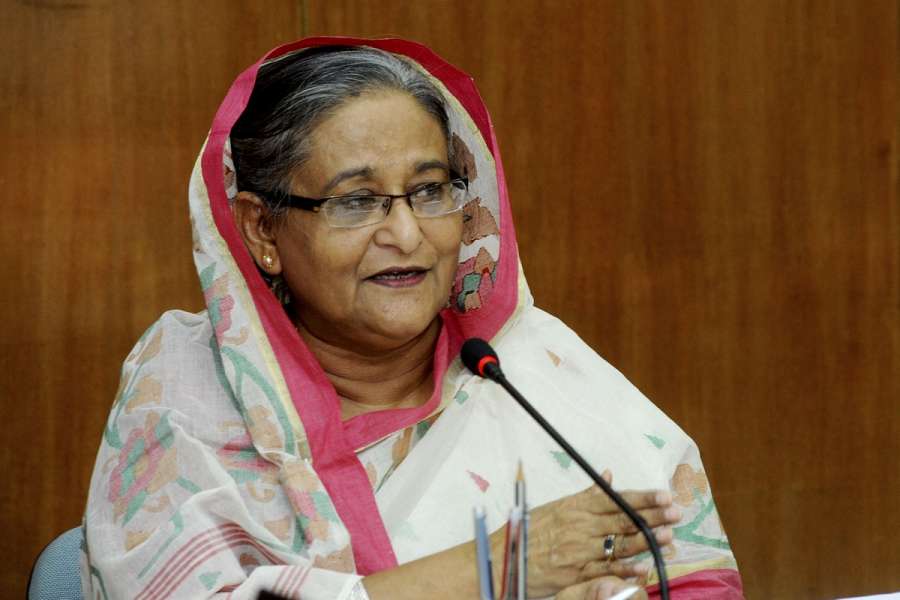
General Ershad floated the Jatiya Party in 1986, which was part of most ruling coalitions after 1991. The uninterrupted 15-year rule of the Hasina government since 2008, interrupted this design substantially. Notably Bangladeshi economy grew at the fastest pace during this period. The League was formed through mass movement against West Pakistani rulers during the East Pakistan days. It led the country to the Liberation War with Shiekh Mujibur Rahman, father of Hasina, at the front. Rahman was the first President of independent Bangladesh. He was assassinated by the military in 1975.

The democracy in Bangladesh is not as mature as in India, which is fast emerging as an economic superpower. However, there is enough evidence that Bangladesh has steadily insulated its politics from the interventions of the army. That stable rule of elected governments for decades is proof of strengthening of the democracy. The dividend is enjoyed through economic prosperity and peace. Pakistan is deprived of such dividends.

Previous Story

‘Everyone Complicit to Some Extent’: Obama on Middle East Crisis

Next Story

Indian Markets Gain, Yet Caution Prevails Amid Global Volatility

Previous Story

‘Everyone Complicit to Some Extent’: Obama on Middle East Crisis

Next Story

Indian Markets Gain, Yet Caution Prevails Amid Global Volatility

Latest from -Top News

Pakistan Risks Overstretching Itself in Yemen War

Pakistan’s expanding military role in Saudi Arabia amid the Yemen conflict could strain its defence resources and fragile finances…reports Asian Lite News Desk Pakistan’s military involvement in the war in Yemen may prove unsustainable because of mounting financial pressures and competing security demands, according to a new report. Islamabad’s growing military presence in Saudi Arabia risks stretching its defence resources while exposing the country to greater strategic and economic challenges. An article by Andrew Wilson in One World Outlook describes Pakistan’s involvement as a case of “fiscal and strategic overreach”, arguing that the country lacks the financial flexibility to sustain an expanded military commitment. Pakistan’s external finances depend heavily on an International Monetary Fund (IMF) programme, financial support from Gulf countries and remittances from Pakistani workers in the region. The report argues that deeper military involvement in the conflict could place additional pressure on these sources of financial stability. It also warns that deploying troops and military equipment abroad could weaken Pakistan’s capacity to address security challenges along its eastern border and deal with two domestic insurgencies. The move could also draw Islamabad into a conflict it has sought to approach cautiously. A Reuters report in May, citing Pakistani security and government sources, said Islamabad had deployed around 8,000 troops, a squadron of approximately 16 aircraft, mostly JF-17 fighter jets, two drone squadrons and a Chinese HQ-9 air-defence battery to Saudi Arabia. According to those sources, Riyadh was financing the deployment, with Pakistani personnel operating the equipment. The sources also said a confidential agreement contemplated the possibility of deploying up to 80,000 troops. Islamabad has not confirmed those figures, although it has acknowledged its military presence in Saudi Arabia, including the deployment of fighter jets at King Abdulaziz Air Base from April. The One World Outlook article argues that Saudi financial support can cover allowances and operating expenses but cannot easily replace military equipment needed elsewhere or resolve the political and strategic challenges of participating in the Yemen conflict. Pakistan’s defence budget is another concern. For the 2026-27 financial year, the federal government allocated PKR 3 trillion, or approximately $10.8 billion, to defence services. The allocation represents an 18 per cent increase from the original PKR 2.55 trillion provision and amounts to around 2.1 per cent of projected gross domestic product (GDP). Defence spending accounts for approximately 16 per cent of the federal government’s PKR 18.8 trillion expenditure. Military pensions are budgeted separately at PKR 822 billion, while debt servicing costs stand at approximately PKR 8 trillion, more than two-and-a-half times the defence allocation. The report argues that these competing financial obligations leave little room for additional military expenditure without placing further pressure on public finances. Pakistan’s reliance on IMF assistance also limits its fiscal flexibility. The country must meet the conditions attached to the programme, including a primary budget surplus target of 2 per cent of GDP and continued restraint on development spending. According to the article, these requirements make it difficult for Islamabad to finance an additional military commitment without compromising other budgetary priorities. Pakistan’s economic indicators offer limited reassurance. Economic growth for the 2025-26 financial year is estimated at between 3.6 and 3.7 per cent, while inflation reached approximately 10.3 per cent in September following an energy price shock. Foreign exchange reserves stood at around $21.5 billion at the end of September. Although this marks an improvement from the low levels recorded in 2023, the report notes that the reserves cover only a few months of imports. Financial assistance from Gulf partners remains central to Pakistan’s external stability. The article says Islamabad holds approximately $8 billion in Saudi deposits at its central bank. In July, the State Bank of Pakistan said Riyadh had extended the maturity of $5 billion in deposits to December 2028, easing the country’s immediate external financing requirements. A further $3 billion deposit was also extended in the spring. However, the article argues that these arrangements provide temporary relief rather than long-term financial independence, particularly as regional conflict threatens the stability of the Gulf economies on which Pakistan relies. The report concludes that Pakistan faces a difficult balance between supporting Saudi Arabia militarily and preserving the financial and military resources needed to address its domestic and regional challenges.

UK and Germany Ratify Kensington Treaty

Britain and Germany ratify the Kensington Treaty, agreeing new cooperation on AI, quantum research, defence and security while targeting investment, jobs and Russian hybrid threats…reports Asian Lite News Desk Britain and Germany

Economic tide is turning in Bangladesh

If there is one thing that can bring some comfort to the struggling Bangladeshi economy, it is good relations with India. Bangladesh should remember that Delhi’s backing, through easy supplies of essentials

DP World Lands 15-Year Bangladesh Port Deal

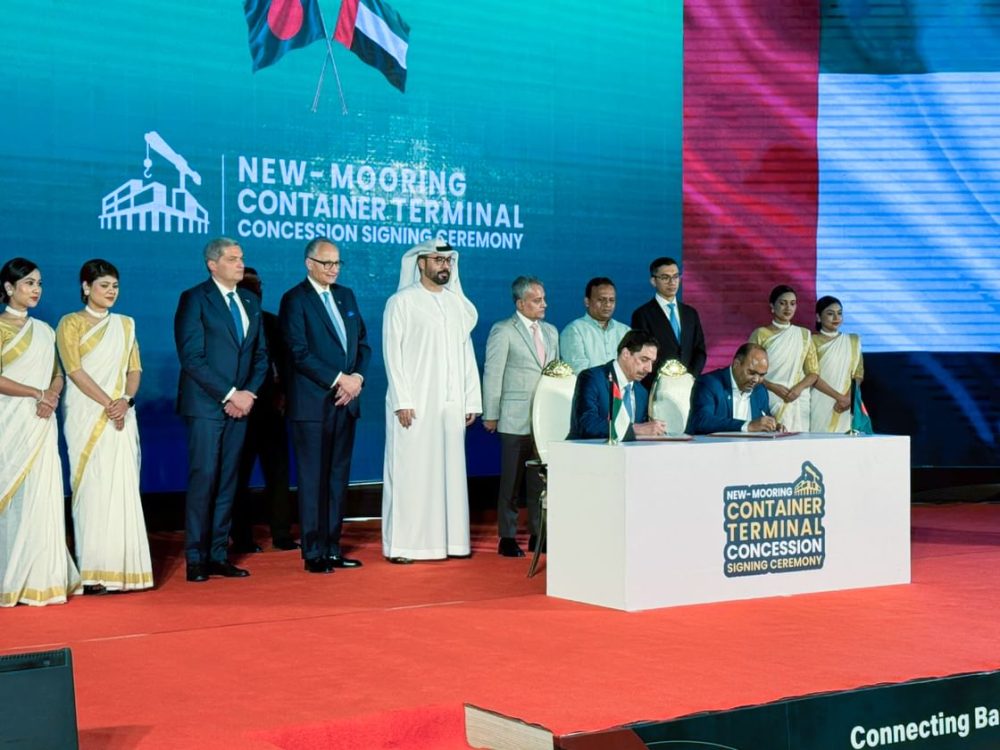
The agreement between the Chittagong Port Authority (CPA) and DP World covers the New Mooring Container Terminal…reports Asian Lite News Desk Bangladesh has signed a 15-year concession agreement with global ports operator
Go toTop