Nijjar, a designated terrorist in India, was killed outside a gurdwara in Canada’s Surrey on June 18. India has also expelled a senior Canadian diplomat in a reciprocal move to Canada expelling a senior Indian diplomat…reports Asian Lite News
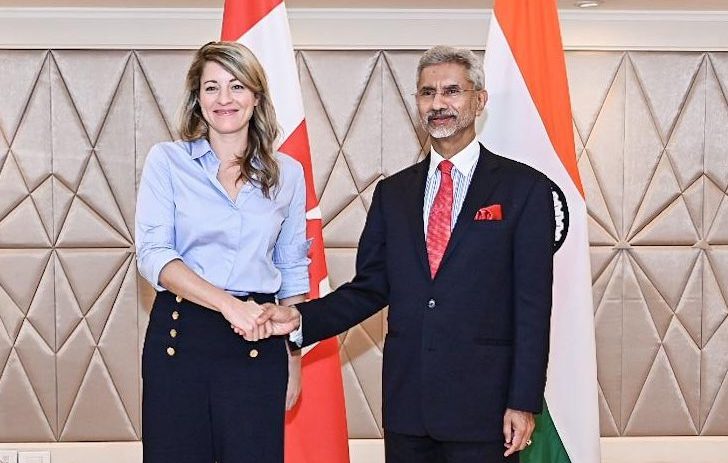
Amid the ongoing diplomatic repercussions following Prime Minister Justin Trudeau’s assertion regarding the potential involvement of Indian agents in the assassination of Sikh separatist leader Hardeep Singh Nijjar, Canada’s Foreign Minister Melanie Joly emphasized the significance of retaining diplomats stationed in the region.
She said Canada believes in the importance of having a “strong diplomatic footprint” in India, Canada-based CPAC reported.
Speaking to reporters, Joly said, “So in moments of tensions, because indeed there are tensions between both of the government more than ever, it’s important that diplomats be on the ground. And that’s why we believe in the importance of having a strong diplomatic footprint in India.That being said, we are in go ongoing conversations with the Indian government, and we will continue…,” CPAC reported.
She made the remarks in response to the question regarding reports claiming that India has asked Canada to remove 41 of its 62 diplomats in the country.
Nijjar, a designated terrorist in India, was killed outside a gurdwara in Canada’s Surrey on June 18. India has also expelled a senior Canadian diplomat in a reciprocal move to Canada expelling a senior Indian diplomat.
Meanwhile, Prime Minister Trudeau on Tuesday said his country was not “looking to escalate the situation with India,” adding that Ottawa wants to remain on the ground in New Delhi to help Canadians, Reuters reported.
“Canada is not looking to escalate the situation with India, will continue to engage responsibly and constructively with New Delhi. We want to be on the ground in India to help the Canadian families there,” Reuters quoted PM Trudeau as saying.
During a debate in the Canadian Parliament in September, Trudeau claimed Canada’s national security officials had reasons to believe that “agents of the Indian government” carried out the killing of Nijjar. India outrightly rejected the claims calling them “absured and motivated”.
Last week, External Affairs Minister S Jaishankar said the ongoing problem with Canada has been there for some years because of the “permissiveness” by the government regarding terrorism, extremism and violence in the country.
Jaishankar said the current situation can’t be termed a “deadlock”, adding that the Indian government is open to looking at any specific and relevant thing shared by the Canadian side in connection with the issue.
Addressing a press conference in Washington DC on Friday, Jaishankar said, “Well, I don’t know if I would use the term deadlock…The issue is as follows: The Canadians have made some allegations. We have pointed out to them that this is not the Government of India’s policy and if they are prepared to share with us specifics and anything relevant, we are also open to looking at it. So in that sense, that’s where the matter stands”. “But what we do not want to see is an incident treated in isolation because then that somewhere does not convey the right picture,” he added.
The EAM said the ongoing problem with Canada is because of the “permissiveness” regarding terrorism, extremism and violence in the country. “The fact is that we have had an ongoing problem with Canada and the Canadian government for some years now. And the ongoing problem really revolves around the permissiveness in regard to terrorism, extremism and violence,” Jaishankar said.
He added, “This permissiveness is also reflected in the fact that some important extradition requests have not been responded to from their side. In fact, that there are individuals and organizations who are clearly involved with violence and illegal activities in India, who have themselves declared it…I mean it is not a secret.”
The EAM further said that even though India wouldn’t have liked suspending the visa operations to Canada, it had to because the Canadian side “made it very difficult” for the Indian side to operate the services. (ANI)
ALSO READ-India seeks extradition of Khalistani Hardeep Nijjar from Canada