The cover story penned by Charlie Campbell drew criticism from netizens, Awami League leaders, activists, and admirers of Prime Minister Hasina….reports Asian Lite News
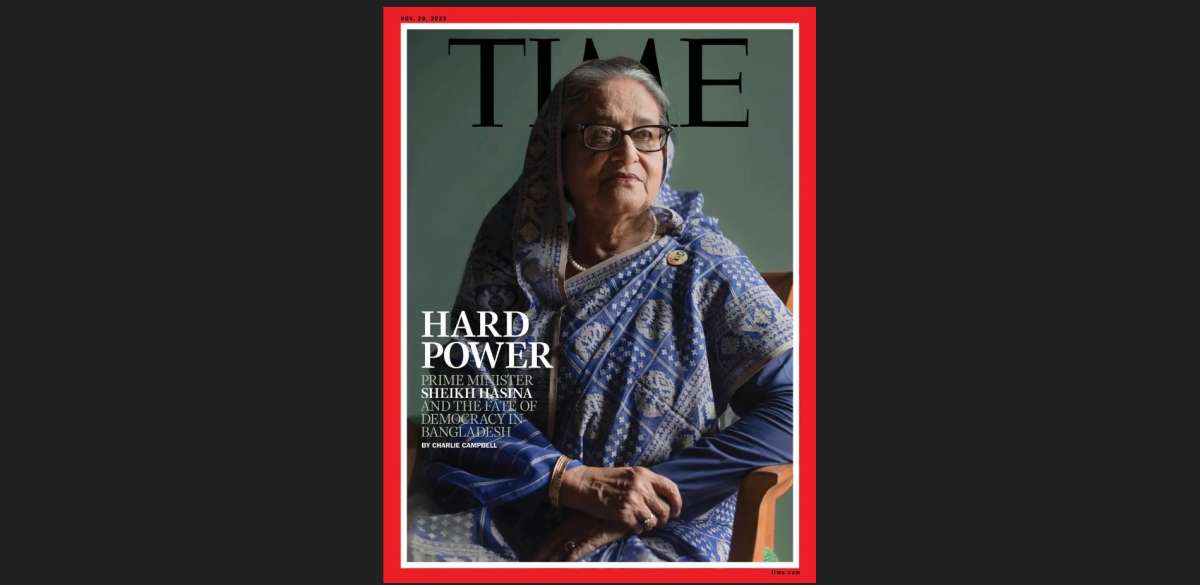
A cover story on Bangladesh Prime Minister Sheikh Hasina in a recent edition of the Time magazine, titled ‘Hard Power: Sheikh Hasina and the Fate of Democracy in Bangladesh’, has drawn frowns from many back home.
The cover feature, authored by Charlie Campbell, wasn’t received too well by netizens, leaders of the ruling Awami League and activists, and those who hold Prime Minister Hasina in high regard.
However, it appears that many readers may not have delved deeply into the content of the article, which presents a multifaceted view of Sheikh Hasina’s tenure, according to the Bangladesh-based Daily Asian Age.
Throughout her tenure in office since 2009, Hasina has faced numerous challenges, including the BDR mutiny, the economic recovery post-Covid, the Russia-Ukraine conflict, and the ongoing Israel-Hamas war.
While not highlighting her achievements as the country’s premier, the cover feature in Time magazine raised concerns over the elections of 2014 and 2018.
“Bangladesh has taken an authoritarian turn under Hasina’s Awami League party. The last two elections were condemned by the US, EU and others for significant irregularities, including stuffed ballot boxes and thousands of phantom voters. She won 84% and 82% of the vote, respectively,” the cover story read.
“Time magazine has conveyed a message to the world that raises diplomatic questions about Sheikh Hasina’s leadership”, stated Asian Age in its take on the cover feature.
“This message touches on the global financial crisis and Bangladesh’s reliance on loans, which reached 96.2 US billion dollars by December 2022. Bangladesh’s key development partners include the United States, the European Union, India, the World Bank, and the International Monetary Fund (IMF),” the Bangladesh-based daily stated.
The article added that “Washington is concerned about Bangladesh’s drift toward despotism. Hasina was not invited to the latest two U.S.-hosted Summit for Democracy gatherings, and in May the country unveiled visa restrictions on any Bangladeshi undermining elections.”
However, the daily also noted that Time magazine undermined Prime Minister Hasina’s achievement in eradicating poverty in Bangladesh.
“Today people are suffering,” one rickshaw driver in Dhaka complained to Time, saying that “his daily wage of 400 taka (USD 3.50) can barely cover the cost of cooking oil and lentils for his wife and two children,” read the cover story in the Time magazine.
The image of Sheikh Hasina on the magazine’s cover depicts her in a less flattering light, raising questions about the choice of photographer, Sarker Protick, who has associations with photojournalist Shahidul Alam, known for criticism of the government, according to Daily Asian Age.
Claiming that Sheikh Hasina may be apprehensive about the upcoming elections in Bangladesh, the Time article stated, “The burning issue for Hasina is that were she removed from power she would likely encounter the same kind of repressive retribution that her government is currently inflicting.”
Significantly, Time magazine previously interviewed Bangladesh Nationalist Party (BNP) chairperson and former Prime Minister Khaleda Zia in 2006, during a period when militancy emerged in Bangladesh. BNP’s regime from 2001 to 2006 witnessed the rise of militancy, including a grenade attack on Hasina in 2004, according to Daily Asian Age.
The contrasting portrayal of Khaleda Zia and Sheikh Hasina by Time magazine has prompted discussions about the role of Bangladesh’s Information and Broadcasting Ministry, the ruling party’s Information and Publicity Secretary, and the Press Wing of the Prime Minister’s Office in addressing these articles.
Hasina remains a prominent and influential figure in Bangladesh politics. Under her leadership, Bangladesh has made significant strides in socio-economic development, earning admiration worldwide for its achievements since 2009, Daily Asian Age reported. (ANI)