India’s Minister of External Affairs S Jaishankar also extended his condolences, tweeting Monday night that he had contacted his Syrian counterpart, Faisal Mekdad…reports Asian Lite News
India will send two more C-17 Indian Air Force planes to Turkey later this evening with 60 Para Field Hospital and personnel to assist in rescue and relief operations.
According to defence officials, the Agra-based Army Field Hospital has despatched an 89-member medical team. The medical team comprises critical care specialist teams including Orthopaedic Surgical Team, General Surgical Specialist Team, Medical Specialist Teams apart from other medical teams. The teams are equipped with X-ray machines, ventilators, Oxygen generation plant, Cardiac monitors and associated equipment to establish a 30 bedded medical facility.
Meanwhile, the first batch of aid from India, which took off from the Hindon airbase in Ghaziabad early this morning reached Adana in Turkey.
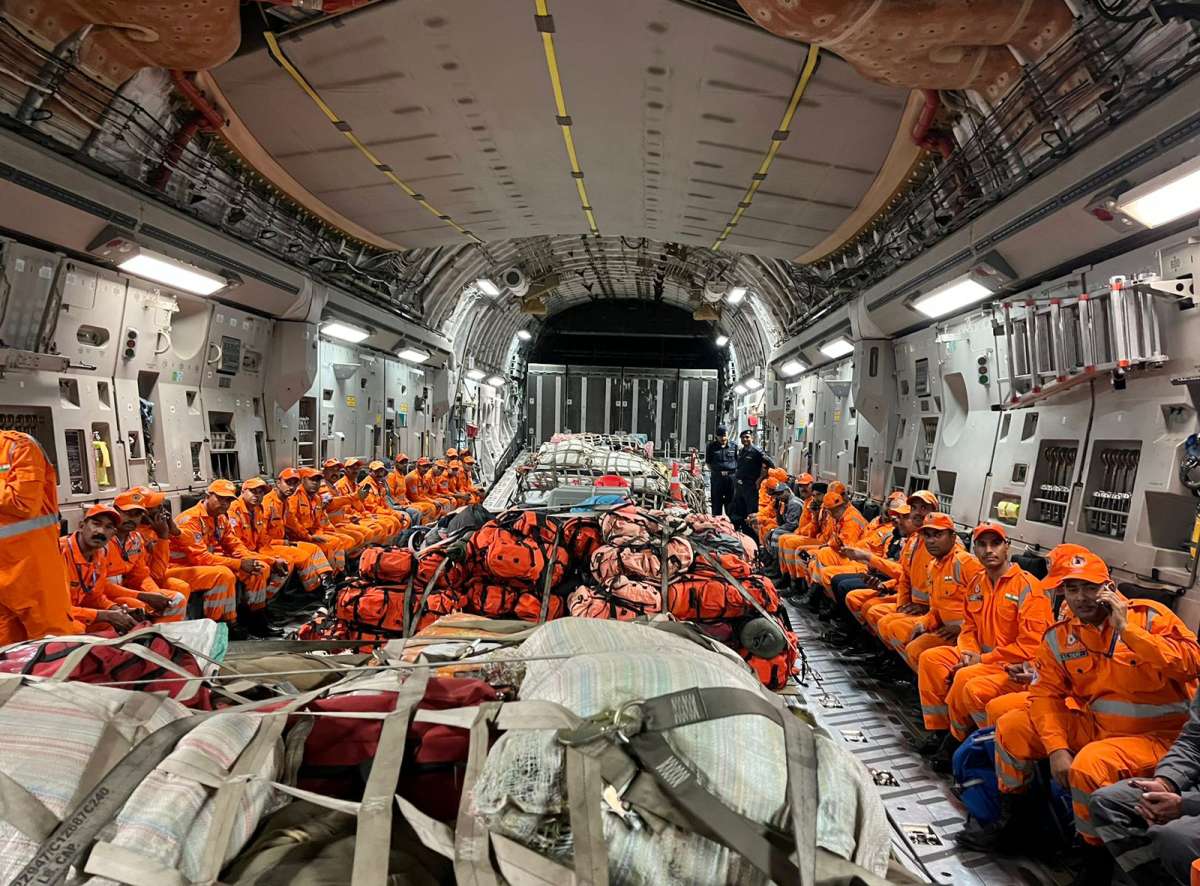
The Indian Air Force tweeted on Tuesday that a C-17, a strategic transport aircraft, left for Turkey “bearing search and rescue teams of the National Disaster Response Force (NDRF).”
According to Ministry of External Affairs spokesperson Arindam Bagchi earlier said India’s Humanitarian Assistance and Disaster Relief (HADR) capabilities were put into action.” The 1st batch of earthquake relief material leaves for Turkiye, along with NDRF Search & Rescue Teams, specially trained dog squads, medical supplies, drilling machines & other necessary equipment,” he tweeted.
Under HADR operations for Turkey and Syria, India dispatched the first C17 airborne for Turkey at 03:09 am today while the second C17 took off around 10:00 hrs with National Disaster Response Force (NDRF) team.
The aircraft is part of a larger relief effort that will be undertaken by the IAF along with other Indian organisations, said the Indian Air Force.
The aid to Syrian has been meanwhile delayed with, a C130 flight for Damascus with medicines only and no personnel, delayed to this afternoon.
As per latest estimates over 4,372 people have been killed and thousands injured after a magnitude 7.8 earthquake struck Turkey and Syria early Monday, according to officials and agencies.
Turkey and Syria were hit by three consecutive devastating earthquakes of magnitude 7.8, 7.6 and 6.0 on Monday, reported Washington Post.
Rescuers in both countries are digging with their bare hands through the freezing night hunting for survivors among the rubble of thousands of buildings.
The quake, one of the strongest to hit the region in more than 100 years, struck 23 kilometres (14.2 miles) east of Nurdagi, in Turkey’s Gaziantep province, at a depth of 24.1 kilometres (14.9 miles), the US Geological Survey said.
Prime Minister Narendra Modi offered his condolences with the Prime Minister’s Office saying that a meeting was held on Monday in which it was decided that “relief material would be dispatched immediately” in coordination with the Turkish government.
“Two teams of NDRF comprising 100 personnel with specially trained dog squads and necessary equipment are ready to be flown to the earthquake-hit area for search and rescue operations,” the statement said.
“Medical teams are also being readied with trained doctors and paramedics with essential medicines. Relief material will be dispatched in coordination with the Government of Turkiye and Indian Embassy in Ankara and Consulate General office in Istanbul,” it added.
India’s Minister of External Affairs S Jaishankar also extended his condolences, tweeting Monday night that he had contacted his Syrian counterpart, Faisal Mekdad.
“Expressed solidarity and conveyed our support including through supply of medicines,” he tweeted.
Initially, a magnitude 7.8 quake struck early Monday at 04:17 local time (01:17 GMT) 23 kilometers (14.2 miles) east of Nurdagi, in Turkey’s Gaziantep province near the Syrian border, at a depth of 24.1 kilometers (14.9 miles), the US Geological Survey said.
This was followed by a 7.5-magnitude quake around 130 kilometres north of Gaziantep, and with epicentre was in the Elbistan district of Kahramanmaras province in Turkey according to the US Geological Survey. Tremors were also felt in several neighboring countries, including Lebanon and Syria.
The third earthquake of magnitude 6.0 on the Richter scale hit Goksun, Turkey on Monday. The earthquake — felt as far away as Lebanon, Jordan, Israel and Egypt — occurred in Kahramanmaras province, north of Gaziantep, near the Syrian border.
At least 100 aftershocks measuring 4.0 or greater have occurred since the 7.8 magnitude earthquake struck southern Turkey on Monday morning local time.
As the time from the original earthquake extends, the frequency and magnitude of the aftershocks tend to decrease. However, 5.0 to 6.0-plus aftershocks are still likely to occur and bring a risk of additional damage to structures that are compromised from the original earthquake. This brings a continued threat to rescue teams and survivors, reported CNN.
The aftershocks stretch for more than 300 kilometres (186 miles) along the fault zone that ruptured in southern Turkey, oriented from southwest to northeast and stretching from the border with Syria up through the province of Malatya. (ANI)
Govt calls urgent meeting for humanitarian aid
The government of India has called an urgent meeting with Indian carriers that operate flights to Turkey, in the aftermath of earthquakes in the western Asian country. During the meeting, India’s low-cost airline IndiGo offered free cargo movement to Istanbul on its scheduled flights.
The Indian aviation regulator has held a meeting with Indian carriers over operating flights to Turkey for cargo movements in commercial scheduled flights. IndiGo has offered free cargo movement on its scheduled commercial flights using Boeing 777 aircraft to Istanbul.” an aviation industry source told.
Recently Indigo started its wide-body flight operation to Turkey in Istanbul by Boeing-777.
“The Indian carrier colony is with Turkey in the disaster and we are ready to provide free cargo movement for humanitarian aid,” sources quoted the airline company as saying in the meeting.
Other ministries are also part of the meeting and a final decision is yet to be taken in this regard.
The first Indian Air Force plane carrying disaster relief material and rescue team to carry out search and rescue efforts in Turkey has reached Adana in the earthquake-hit country, external affairs minister S Jaishankar said on Tuesday.
The C17 flight with over 50 personnel from the National Disaster Response Force (NDRF) and a specially trained dog squad along with necessary equipment, including medical supplies, drilling machines and other equipment required for the aid efforts departed for Turkey early this morning.
Turkish Embassy in New Delhi tweeted, “First batch of earthquake relief material along with NDRF’s special search and rescue teams and trained dog squads just arrived in Turkiye. Thank you India for your support and solidarity.”
Meanwhile, nearly 4,900 people have been killed and tens of thousands injured after a magnitude 7.8 earthquake struck Turkey and Syria on Monday, according to officials, reported CNN.
Turkey’s death toll rose to at least 3,381 as of around 9:45 a.m. local time on Tuesday, Orhan Tatar, an official with the country’s disaster management agency, said in a televised briefing.
At least 20,426 injuries have also been reported, according to Tatar.
Meanwhile in Syria, the death toll has risen to 1,509 across areas controlled by the government and by the opposition, officials said, reported CNN. (ANI)