December 27, 2023
5 mins read

Islamophobic politics amplified across Europe in 2023

Italy’s Prime Minister Giorgia Meloni is often in the news for making bold statements, but she recently scoffed at Islamic culture and said that there is no place for it in Europe….writes Asad Mirza

Recent events and political upheavals in many European countries point to the increasing Islamophobic and anti-Islam right-wingers inching closer to power in these countries.

Italy’s Prime Minister Giorgia Meloni is often in the news for making bold statements, but she recently scoffed at Islamic culture and said that there is no place for it in Europe. She said that there is no place for Islam in Europe: ‘There is a problem of compatibility’

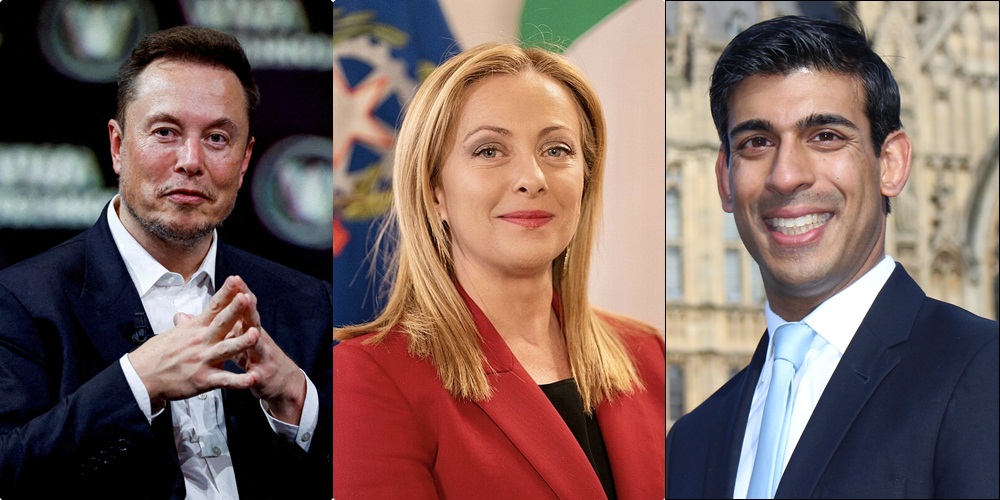
Her comments were made at a political festival organised by her far-right party – the Brothers of Italy, in Rome, which was attended by the British Prime Minister Rishi Sunak and X’s owner Elon Musk, too.

In her speech Meloni said, “The Islamic cultural centres in Italy are financed by Saudi Arabia where Sharia is in force. In Europe, there is a very Islamisation process distant from the values of our civilisation! I believe that there is a problem of compatibility between Islamic culture and the values and rights of our civilisation.”

Meanwhile, an old video of her also re-surfaced on various social media platforms that shows her saying she would not allow Sharia law to be implemented in Italy. Meloni also criticised Saudi Arabia for its strict Sharia Law.

“I believe that these should be raised, which does not mean generalising on Islam. It means raising the problem that there is a process of Islamisation in Europe that is very distant from the values of our civilisation,” she added.

During his speech at the event, Rishi Sunak said that he would push for global reforms to the asylum system while warning that the threat of a growing number of refugees could ‘overwhelm’ parts of Europe.

He even warned that some ‘enemies’ were deliberately ‘driving people to our shores to try and destabilise our societies’.

“If we do not tackle this problem, the numbers will only grow. It will overwhelm our countries and our capacity to help those who actually need our help the most,” Rishi Sunak said, adding, “If that requires us to update our laws and lead an international conversation to amend the post-war frameworks around asylum, then we must do that.”

Meanwhile, Tesla’s founder and X’s owner Elon Musk marked a rare appearance as he met world leaders at the annual gathering.“Immigration isn’t enough to combat population shrinking,” he said at the event, explaining: “There is value in cultures, we don’t want Italy as a culture to disappear, we want to maintain a reasonable cultural identity of those countries or they won’t be those countries.”

Analysing the speeches given by these three leaders, makes it clear that not only political leaders alone but even business leaders are increasingly turning to Islamophobia, based on their belief systems and also converting political issues to anti-Islam utterances, to gain public support.

Both Sunak and Musk couched their Islamophobic feelings into anti-immigrants policies. This could be partly blamed to these countries’ own doing. Firstly, various European nations opened their doors for immigrants from the Muslim dominated countries.

The migrant flow to many western countries increased as the increasing prosperity there was matched with no desire to engage in menial jobs at lower wages, gaps which were filled by the migrants. Further, they allowed Muslim immigrants entry to assuage their own guilt feeling, as many of the migrants fleeing their homes were coming from those countries where these countries had started or were supporting wars against the so-called radical or Islamist elements.

Though many of these immigrants were not connected to any radical ideology, but they became an easy scapegoat to be blamed for any wrongs happening in these western societies.

Rishi Sunak has been accused of adopting the “toxic” rhetoric of his former home secretary Suella Braverman, after he warned that migration would “overwhelm” European countries without firm action.

Sunak also said that both he and Meloni, with whom he has been forging a close relationship over hardline migration policies, were taking inspiration from Margaret Thatcher’s steadfast radicalism in their quest to do “whatever it takes” to “stop the boats”.

Sunak’s relationship with Meloni, Italy’s first female premier has blossomed over their shared hardline approach towards immigration through policies that have pushed the limits of legality. They have also bonded over their admiration of Thatcher.

As far as Elon Musk is concerned, recently studies have found that Islamophobic comments are being spread widely through X and the company does not respond to complaints or seem to take any remedial action, to handle the issue. X users resort to spelling mistakes intentionally while debating controversial subjects like religion, terrorism, crime, and even the Indian history.

These are not errors made in the heat of the moment, but careful distortions meant to keep the tweet from being flagged or deleted for hateful content. For example, a tweet posted in November 2022 that singled out people with Muslim names from a series of random crime news reports did not refer to the perpetrators as “Muslims” but instead used the phrase “Ola keBande” (Ola’s group or Ola’s gang). The word “Ola,” which refers to the Indian ride-hailing taxi service, was used in place of “Allah.” The tweet author currently has close to 7,00,000 followers.

ALSO READ: UK to increase family visa salary requirement in stages

Previous Story

Cameron throws weight behind Rwanda Bill  

Next Story

Institutional Investments Fuel UAE Stocks in 2023

Previous Story

Cameron throws weight behind Rwanda Bill  

Next Story

Institutional Investments Fuel UAE Stocks in 2023

Latest from -Top News

Pakistan Risks Overstretching Itself in Yemen War

Pakistan’s expanding military role in Saudi Arabia amid the Yemen conflict could strain its defence resources and fragile finances…reports Asian Lite News Desk Pakistan’s military involvement in the war in Yemen may prove unsustainable because of mounting financial pressures and competing security demands, according to a new report. Islamabad’s growing military presence in Saudi Arabia risks stretching its defence resources while exposing the country to greater strategic and economic challenges. An article by Andrew Wilson in One World Outlook describes Pakistan’s involvement as a case of “fiscal and strategic overreach”, arguing that the country lacks the financial flexibility to sustain an expanded military commitment. Pakistan’s external finances depend heavily on an International Monetary Fund (IMF) programme, financial support from Gulf countries and remittances from Pakistani workers in the region. The report argues that deeper military involvement in the conflict could place additional pressure on these sources of financial stability. It also warns that deploying troops and military equipment abroad could weaken Pakistan’s capacity to address security challenges along its eastern border and deal with two domestic insurgencies. The move could also draw Islamabad into a conflict it has sought to approach cautiously. A Reuters report in May, citing Pakistani security and government sources, said Islamabad had deployed around 8,000 troops, a squadron of approximately 16 aircraft, mostly JF-17 fighter jets, two drone squadrons and a Chinese HQ-9 air-defence battery to Saudi Arabia. According to those sources, Riyadh was financing the deployment, with Pakistani personnel operating the equipment. The sources also said a confidential agreement contemplated the possibility of deploying up to 80,000 troops. Islamabad has not confirmed those figures, although it has acknowledged its military presence in Saudi Arabia, including the deployment of fighter jets at King Abdulaziz Air Base from April. The One World Outlook article argues that Saudi financial support can cover allowances and operating expenses but cannot easily replace military equipment needed elsewhere or resolve the political and strategic challenges of participating in the Yemen conflict. Pakistan’s defence budget is another concern. For the 2026-27 financial year, the federal government allocated PKR 3 trillion, or approximately $10.8 billion, to defence services. The allocation represents an 18 per cent increase from the original PKR 2.55 trillion provision and amounts to around 2.1 per cent of projected gross domestic product (GDP). Defence spending accounts for approximately 16 per cent of the federal government’s PKR 18.8 trillion expenditure. Military pensions are budgeted separately at PKR 822 billion, while debt servicing costs stand at approximately PKR 8 trillion, more than two-and-a-half times the defence allocation. The report argues that these competing financial obligations leave little room for additional military expenditure without placing further pressure on public finances. Pakistan’s reliance on IMF assistance also limits its fiscal flexibility. The country must meet the conditions attached to the programme, including a primary budget surplus target of 2 per cent of GDP and continued restraint on development spending. According to the article, these requirements make it difficult for Islamabad to finance an additional military commitment without compromising other budgetary priorities. Pakistan’s economic indicators offer limited reassurance. Economic growth for the 2025-26 financial year is estimated at between 3.6 and 3.7 per cent, while inflation reached approximately 10.3 per cent in September following an energy price shock. Foreign exchange reserves stood at around $21.5 billion at the end of September. Although this marks an improvement from the low levels recorded in 2023, the report notes that the reserves cover only a few months of imports. Financial assistance from Gulf partners remains central to Pakistan’s external stability. The article says Islamabad holds approximately $8 billion in Saudi deposits at its central bank. In July, the State Bank of Pakistan said Riyadh had extended the maturity of $5 billion in deposits to December 2028, easing the country’s immediate external financing requirements. A further $3 billion deposit was also extended in the spring. However, the article argues that these arrangements provide temporary relief rather than long-term financial independence, particularly as regional conflict threatens the stability of the Gulf economies on which Pakistan relies. The report concludes that Pakistan faces a difficult balance between supporting Saudi Arabia militarily and preserving the financial and military resources needed to address its domestic and regional challenges.

UK and Germany Ratify Kensington Treaty

Britain and Germany ratify the Kensington Treaty, agreeing new cooperation on AI, quantum research, defence and security while targeting investment, jobs and Russian hybrid threats…reports Asian Lite News Desk Britain and Germany

Economic tide is turning in Bangladesh

If there is one thing that can bring some comfort to the struggling Bangladeshi economy, it is good relations with India. Bangladesh should remember that Delhi’s backing, through easy supplies of essentials
Go toTop

Don't Miss

Trump vs. Zelensky: Tensions Rise

On Truth Social on Wednesday, Trump called Zelensky a “dictator

Can Europe escape its looming energy crisis?

Europe is struggling to contain an energy crisis that could