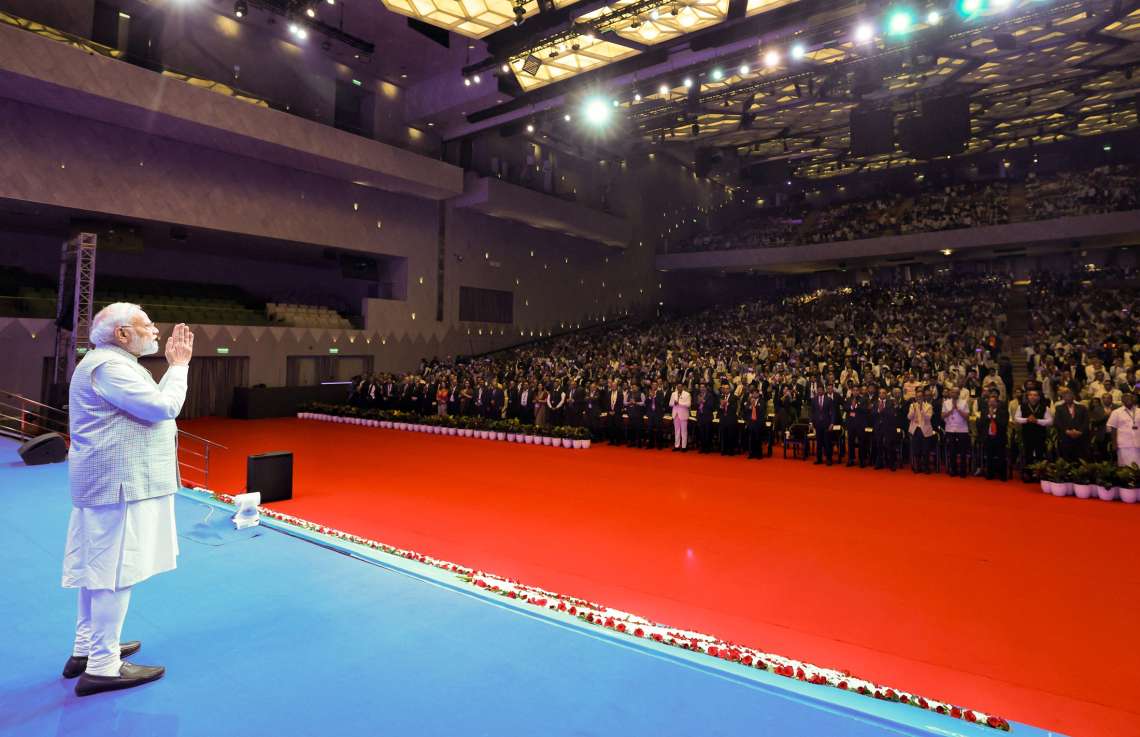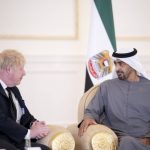
Modi arrived in Abu Dhabi on Saturday morning and held talks with President Sheikh Mohamed bin Zayed Al Nahyan….reports Asian Lite News
Prime Minister Narendra Modi on Saturday concluded his “productive visit” to France and United Arab Emirates (UAE), one which is defined by “transformative outcomes”.
He landed in India after concluding two short but very important two-nation tours which begun on July 13.
“A visit defined by transformative outcomes. PM @narendramodi emplanes for New Delhi after wrapping up a successful visit to UAE,” tweeted official spokesperson of Ministry of External Affairs Arindam Bagchi.
Modi arrived in Abu Dhabi on Saturday morning and held talks with President Sheikh Mohamed bin Zayed Al Nahyan.
Modi’s UAE visit was marked by key agreements including opening a new IIT Delhi campus in Abu Dhabi. The two countries also pledged to promote using local currencies (Rupee and Dirham) for cross-border transactions and to interlink payment systems.
During the visit, Modi and UAE President Mohammed bin Zayed Al Nahyan witnessed the exchange of three historic Memoranda of Understanding (MoU).
An MoU on Local Currency Settlement (LCS) System was signed between the Reserve Bank of India and the Central Bank of the United Arab Emirates enabling the use of Indian Rupee (INR) and UAE Dirham (AED) for Cross-border Transactions.
“This is a very important aspect of India-UAE cooperation. It paves the way for enhanced economic collaboration and will make international financial interactions simpler,” tweeted Modi.
Another MoU was exchanged for the establishment of a campus of IIT Delhi in Abu Dhabi between the Indian Ministry of Education, UAE’s Abu Dhabi Department of Education and Knowledge and the Indian Institute of Technology, Delhi (IIT).
This is the first ever IIT to be set up in the Middle East/North Africa (MENA) region. This is a landmark project which reflects the vision of the leaders and it will be a tribute to the people of India and the UAE who are the backbone of the historic relationship.
“This marks a significant stride in our educational internationalisation and is testament to India’s innovation prowess. Education is the bond that unites us, it’s the spark that ignites innovation. Together, we will leverage this power for mutual prosperity and global betterment,” Modi tweeted.
A third MoU was exchanged on bilateral cooperation on interlinking the payment and messaging systems between the Reserve Bank of India and the Central Bank of the UAE.

The MoU will facilitate the integration Unified Payments Interface (UPI) of India and the Instant Payments Platform (IPP) of the UAE. It will also facilitate interlinking card switches of the two countries – RuPay switch and UAESWITCH to facilitate the mutual acceptance of their domestic cards and processing of card transactions directly without relying on any other network.
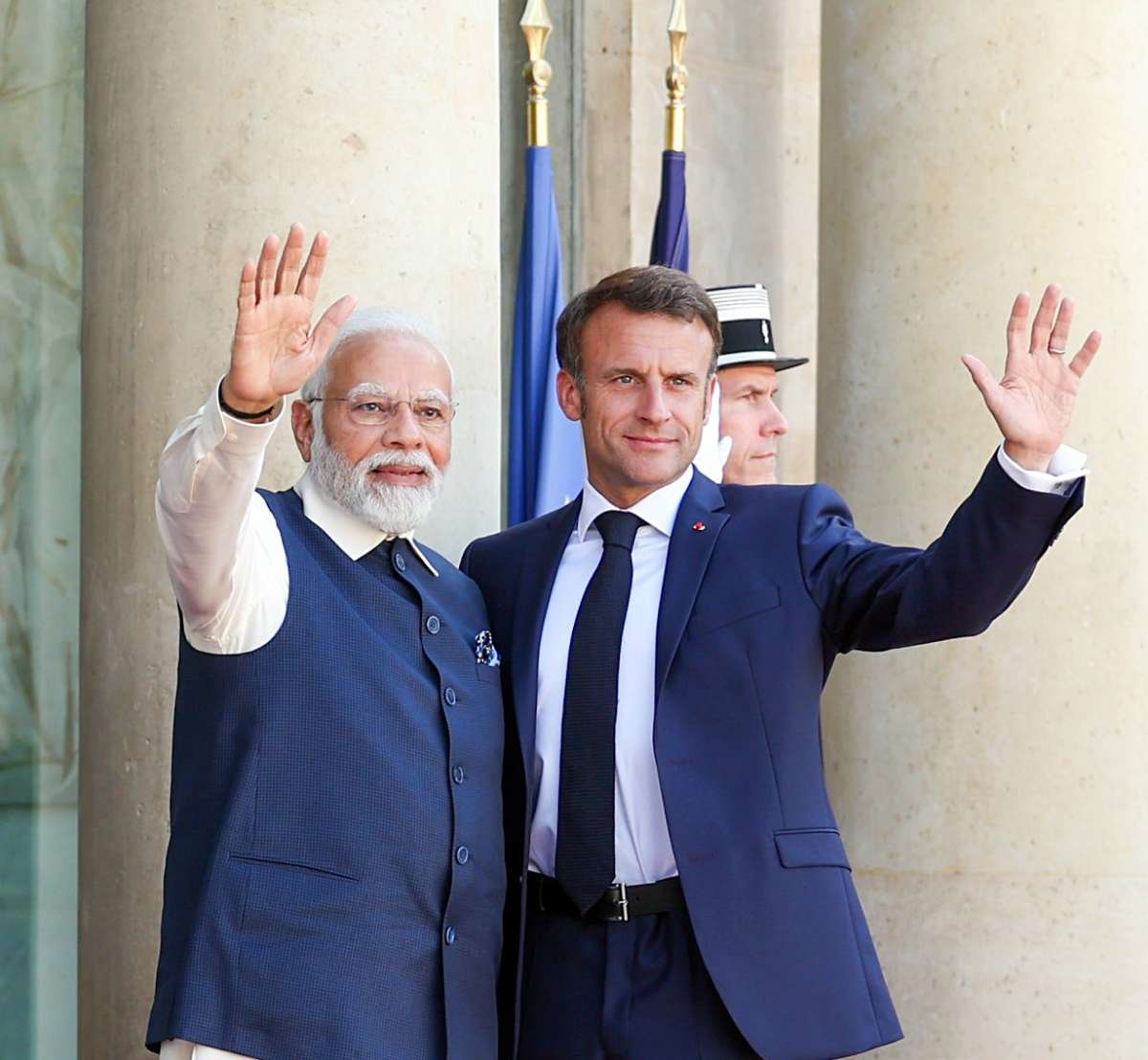
Prior to visiting UAE, Modi was in Paris, where, in a historic moment, French President Emmanuel Macron bestowed the Grand Cross of the Legion of Honour on Prime Minister Narendra Modi. It is the highest French honour in military or civilian orders. With this, PM Modi becomes the first Indian PM to receive this honour.
Modi was hosted by French President Emmanuel Macron and France’s first lady Brigitte Macron at the Elysee Palace.
Modi also attended Bastille Day Parade as Guest of Honour at the invitation of French President Macron on the Champs-Élysées.
The key highlights of Modi’s France visit were the MoUs signed to enhance further cooperation in defence sector which included the first Scorpene submarine construction programme (P75 – Kalvari), a model of ‘Make-in- India’ and the sharing of naval expertise between companies in the two countries.
In A joint statement issued following the Modi’s delegation level talks with President Macron, both leaders applauded the collaboration between naval companies from both countries in sharing their expertise.
The leaders also expressed their satisfaction with the Memorandum of Understanding (MoU) signed between [TT3] [P4] Mazgon Dockyard Ltd and Naval Group, which outlines the construction of three additional submarines as part of the P75 program.
The Scorpene Submarines are extremely potent platforms, they have advanced stealth features and are also equipped with both long-range guided torpedoes as well as anti-ship missiles. These submarines have a state-of-the-art SONAR suite and sensor suite permitting outstanding operational capabilities.
With a view to adopting a Roadmap on Defence Industrial Cooperation between the two countries, India is setting up a Technical Office of the DRDO at its Embassy in Paris.
Highlighting the French commitment to the “Make-in-India” initiative, Modi and President Macron also commended the defence industrial partnerships rooted in mutual trust, including the contract between Safran Helicopter Engine and HAL for the Transfer of Technology of Forging and Castings for the Shakti Engine.
In line with their outstanding cooperation in military aviation spanning over five decades, India and France welcome the timely delivery of the 36 Rafale ordered by India.
In a significant decision, India and France on Friday decided to extend their ground-breaking defence cooperation in advanced aeronautical technologies by supporting the joint development of a combat aircraft engine.
A roadmap on this project will be prepared between French company Safran and Defence Research and Development Organisation (DRDO) before the end of this year.
They also decided to support industrial cooperation for motorization of heavy-lift helicopters under the Indian Multi Role Helicopter [IMRH] programme with Safran Helicopter Engine. (ANI)
ALSO READ: