May 17, 2024
4 mins read

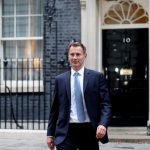
Hunt vows tax cut if Tories win polls

The chancellor argued that a Tory promise to cut taxes will be a major dividing line at the election, even though the overall tax load has risen to postwar highs under his party…reports Asian Lite News

Jeremy Hunt defended large-scale Conservative tax rises during this parliament, but insist that only his party will cut the tax burden if it wins the next general election.

The chancellor argued that a Tory promise to cut taxes will be a major dividing line at the election, even though the overall tax load has risen to postwar highs under his party.

“Labour like to criticise tax rises this parliament thinking people don’t know why they have gone up — the furlough scheme, the energy price guarantee and billions of pounds of cost of living support,” Hunt said.

Hunt’s speech in central London comes ahead of the release next week of official inflation data that the chancellor hopes will show inflation falling below the Bank of England’s 2 per cent target.

He sees this as a key moment for the economy. The Tories are trailing Labour by 20 percentage points in opinion polls and have worse ratings on the economy than Sir Keir Starmer’s party.

Hunt’s speech marks the opening skirmishes between the two main parties on the economy ahead of an election expected this autumn. On Thursday, Labour said creating “economic stability” would be its first priority if it wins.

The chancellor will claim Labour attacks on his party’s tax-raising record were “playground politics”, noting Starmer’s party had supported policies to help the UK through a series of economic shocks.

Despite recent cuts to national insurance, the Institute for Fiscal Studies think-tank has said “this remains a parliament of record tax rises”.

Meanwhile, Hunt on Thursday convened technology groups and regulators in an attempt to identify ways of making the country more attractive to the high-growth industry.

He hosted a summit at his grace-and-favour Dorneywood estate in Buckinghamshire to canvas executives’ views on what the government could do to retain tech groups in the UK and help them to grow.

One person at the summit said it was “very positive” and that a number of people stated they were planning to have initial public offerings in London.

However, the Treasury declined to say how many companies attended the event or provide names.

Some major companies — including Revolut, Klarna, Checkout.com and ClearScore — did not attend. The chief executive of one large tech group said he had not known the Dorneywood summit was being held.

Industry figures attending included Monzo boss TS Anil and Eben Upton, chief executive of Raspberry Pi, the computer maker on which hopes for a reopening of the London IPO market are pinned.

The Cambridge-based company said on Wednesday that it would seek a listing on the London Stock Exchange’s main market. It was valued at $597mn in November. 

The Treasury said the summit “focused on the offer that the UK has for innovative firms wanting to raise capital in the UK”.

One person at the meeting said tech bosses had challenged Nikhil Rathi, boss of the Financial Conduct Authority, to provide “clarity and certainty” on future regulation and to take a more “pro-growth” approach.

The UK has a record of developing more start-ups than other European countries but Hunt is attempting to overhaul London’s stock market rules to encourage more companies to grow and list in the country.

Sunak vows to remain an MP even if Tories lose election

Prime Minister Rishi Sunak has vowed to stay on as an MP even if his ruling Conservative Party loses the next general election.

The PM said his North Yorkshire constituency is “wonderful” and “of course” he will remain in Parliament whatever the outcome when he goes to the country.

There has been speculation that Sunak, who previously worked at a hedge fund in California, could be eyeing a job in Silicon Valley as the Tories trail by more than 20 points in opinion polls.

But asked on ITV’s Loose Women whether he would stay on as an MP if the party loses, the MP for Richmond (Yorks) said: “Of course I’m staying. I love being an MP. I love my constituents, I love my home in North Yorkshire.”

Elsewhere in the show, which Sunak claimed was “one of the more intimidating things” he had done over the course of his job, Sunak conceded that “we’re not there yet” in terms of the progress he wants to make before calling an election.

He has dismissed demands for a change of political course after the Tories suffered a drubbing in the local elections earlier this month, saying he is “determined more than ever to show the public that what we’re doing is making a difference” on issues including the economy and migration.

“I’ll happily come back and talk to you during the election. But I am focused on that, I am focused on the choice of that election,” he told the panel.

“We’ve been through a lot but I do think actually the things we are doing are starting to make a difference. We’re not there yet, of course”.

ALSO READ-Tories will commit to pensions triple lock, says Hunt
Previous Story

Russia expels UK defence attache from Moscow

Next Story

UN Hears Plea from Families of Hamas Hostages

Previous Story

Russia expels UK defence attache from Moscow

Next Story

UN Hears Plea from Families of Hamas Hostages

Latest from -Top News

Pakistan Risks Overstretching Itself in Yemen War

Pakistan’s expanding military role in Saudi Arabia amid the Yemen conflict could strain its defence resources and fragile finances…reports Asian Lite News Desk Pakistan’s military involvement in the war in Yemen may prove unsustainable because of mounting financial pressures and competing security demands, according to a new report. Islamabad’s growing military presence in Saudi Arabia risks stretching its defence resources while exposing the country to greater strategic and economic challenges. An article by Andrew Wilson in One World Outlook describes Pakistan’s involvement as a case of “fiscal and strategic overreach”, arguing that the country lacks the financial flexibility to sustain an expanded military commitment. Pakistan’s external finances depend heavily on an International Monetary Fund (IMF) programme, financial support from Gulf countries and remittances from Pakistani workers in the region. The report argues that deeper military involvement in the conflict could place additional pressure on these sources of financial stability. It also warns that deploying troops and military equipment abroad could weaken Pakistan’s capacity to address security challenges along its eastern border and deal with two domestic insurgencies. The move could also draw Islamabad into a conflict it has sought to approach cautiously. A Reuters report in May, citing Pakistani security and government sources, said Islamabad had deployed around 8,000 troops, a squadron of approximately 16 aircraft, mostly JF-17 fighter jets, two drone squadrons and a Chinese HQ-9 air-defence battery to Saudi Arabia. According to those sources, Riyadh was financing the deployment, with Pakistani personnel operating the equipment. The sources also said a confidential agreement contemplated the possibility of deploying up to 80,000 troops. Islamabad has not confirmed those figures, although it has acknowledged its military presence in Saudi Arabia, including the deployment of fighter jets at King Abdulaziz Air Base from April. The One World Outlook article argues that Saudi financial support can cover allowances and operating expenses but cannot easily replace military equipment needed elsewhere or resolve the political and strategic challenges of participating in the Yemen conflict. Pakistan’s defence budget is another concern. For the 2026-27 financial year, the federal government allocated PKR 3 trillion, or approximately $10.8 billion, to defence services. The allocation represents an 18 per cent increase from the original PKR 2.55 trillion provision and amounts to around 2.1 per cent of projected gross domestic product (GDP). Defence spending accounts for approximately 16 per cent of the federal government’s PKR 18.8 trillion expenditure. Military pensions are budgeted separately at PKR 822 billion, while debt servicing costs stand at approximately PKR 8 trillion, more than two-and-a-half times the defence allocation. The report argues that these competing financial obligations leave little room for additional military expenditure without placing further pressure on public finances. Pakistan’s reliance on IMF assistance also limits its fiscal flexibility. The country must meet the conditions attached to the programme, including a primary budget surplus target of 2 per cent of GDP and continued restraint on development spending. According to the article, these requirements make it difficult for Islamabad to finance an additional military commitment without compromising other budgetary priorities. Pakistan’s economic indicators offer limited reassurance. Economic growth for the 2025-26 financial year is estimated at between 3.6 and 3.7 per cent, while inflation reached approximately 10.3 per cent in September following an energy price shock. Foreign exchange reserves stood at around $21.5 billion at the end of September. Although this marks an improvement from the low levels recorded in 2023, the report notes that the reserves cover only a few months of imports. Financial assistance from Gulf partners remains central to Pakistan’s external stability. The article says Islamabad holds approximately $8 billion in Saudi deposits at its central bank. In July, the State Bank of Pakistan said Riyadh had extended the maturity of $5 billion in deposits to December 2028, easing the country’s immediate external financing requirements. A further $3 billion deposit was also extended in the spring. However, the article argues that these arrangements provide temporary relief rather than long-term financial independence, particularly as regional conflict threatens the stability of the Gulf economies on which Pakistan relies. The report concludes that Pakistan faces a difficult balance between supporting Saudi Arabia militarily and preserving the financial and military resources needed to address its domestic and regional challenges.

UK and Germany Ratify Kensington Treaty

Britain and Germany ratify the Kensington Treaty, agreeing new cooperation on AI, quantum research, defence and security while targeting investment, jobs and Russian hybrid threats…reports Asian Lite News Desk Britain and Germany

Economic tide is turning in Bangladesh

If there is one thing that can bring some comfort to the struggling Bangladeshi economy, it is good relations with India. Bangladesh should remember that Delhi’s backing, through easy supplies of essentials
Go toTop

Don't Miss

IMF defends gloomy UK forecast after govt criticism

Forecasts are never perfect given the many factors that affect

Hunt junks ‘Trussonomics’

The chancellor of the exchequer said no government could control