New Delhi says curbs on Microsoft, Infosys, TCS and other technology companies undermine shared economic ambitions, as JD Vance faces criticism over claims of visa abuse…reports Asian Lite News Desk
India has strongly criticised the Trump administration’s decision to suspend eight major technology and outsourcing companies from a key employment-based green card programme, warning that the restrictions could complicate permanent residency applications for skilled professionals and undermine economic cooperation between the two countries.
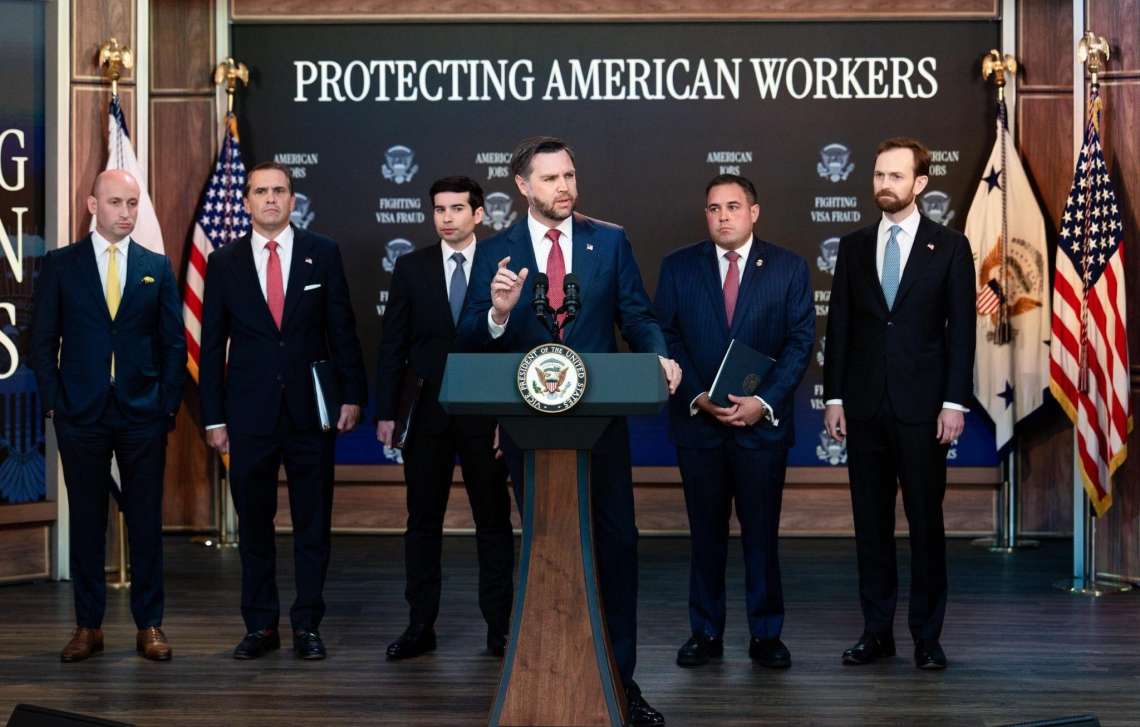
The US action affects Microsoft, Adobe, Infosys, Tata Consultancy Services (TCS), Wipro, HCL, Cognizant and Capgemini. Announced on Thursday by US Labour Secretary Keith Sonderling at a press conference led by Vice-President JD Vance, the restrictions prevent the companies from submitting new applications under the Permanent Labour Certification programme and halt the processing of pending applications.
India’s Ministry of External Affairs (MEA) said on Friday that the decision could affect eligible employees seeking permanent residency, although it does not automatically invalidate existing H-1B visas or change the immigration status of their holders and dependants.
“The steps announced by the US do not advance the shared ambitions of both countries,” the ministry said, arguing that skilled migration benefits both economies by supporting innovation, research, productivity, competitiveness and job creation.
The diplomatic response marks a significant development in an escalating dispute over skilled immigration, with Indian technology companies, their employees and American businesses facing fresh uncertainty over employment-based immigration pathways.
India rejects Vance’s description of foreign workers
New Delhi also took exception to Vance’s description of foreign professionals as “foreign indentured servants”, saying the terminology was offensive and disregarded the contributions made by Indian workers to the American economy.
“We believe that such descriptions are unwarranted and ignore the fact that Indian professionals in the United States are highly educated and skilled contributors to its economy and innovation ecosystem,” the MEA said.
It added that generations of immigrants had helped shape American economic growth and prosperity through their labour, enterprise and innovation.
“Resorting to terminology that carries painful historical and colonial legacy connotations is deeply offensive,” the ministry said.
Vance has argued that the H-1B visa programme, intended to enable employers to recruit foreign professionals for specialised occupations, has been exploited by companies seeking cheaper labour at the expense of American workers.
He said the programme should be reserved for exceptional international talent whose skills cannot readily be found in the domestic workforce.
“The H-1B visa program is meant to allow companies to bring in really the best of the best from outside the United States of America for positions that are completely impossible to fill with American workers,” Vance said.
He alleged that H-1B employees earned around $20,000 less annually than American citizens in comparable positions, with the difference rising to $48,000 for workers recruited through foreign outsourcing firms.
The figures and allegations were presented by Vance as part of the administration’s case for stronger enforcement. The announcement did not include a company-by-company breakdown of the alleged violations or detailed findings establishing wrongdoing by each of the eight firms.
Microsoft singled out over layoffs and visas
Microsoft emerged as a central target of the administration’s criticism.
Vance alleged that the company had laid off 6,000 American workers while benefiting from 6,300 H-1B visas and nearly 3,000 green cards. He used the figures to argue that employment-based immigration programmes were being used to displace American workers.
However, the figures cited at the press conference did not establish that the employees who lost their jobs had been directly replaced by individual foreign workers.
Microsoft defended its recruitment practices, saying most of its H-1B applications during the last financial year related to employees already working for the company rather than new arrivals.
The company said approximately 80 per cent of around 6,000 applications were intended to extend or change the immigration status of existing employees. The remaining applications involved people already legally present in the US who had decided to join the company, it said.
Microsoft maintained that those applications accounted for about 1 per cent of its American workforce.
“We believe in the strength and talent of the American workforce. That is why the vast majority of Microsoft employees in the United States are Americans,” the company said in a statement.
It also rejected allegations that foreign workers were being used to undercut American employees.
“We pay our H-1B employees the same as any other employees doing comparable work,” Microsoft said, adding that it intended to provide the administration with further information about its hiring practices.
The company did not disclose how many employees could be affected by the PERM suspension or provide details of the legal grounds for the action.
What the PERM suspension means
The restrictions centre on the Permanent Labour Certification programme, known as PERM, which is administered by the US Department of Labour.
PERM is an important step in many employment-based green card applications. It generally requires an employer to demonstrate that there are insufficient available and qualified US workers for the position and that hiring the foreign worker will not adversely affect the wages and working conditions of similarly employed American workers.
The programme is separate from the H-1B visa system, which allows employers to recruit eligible foreign professionals for temporary employment in specialised occupations, including technology, engineering and scientific research.
The suspension does not, by itself, cancel existing H-1B visas or revoke green cards already granted. Its immediate effect is on the ability of the named employers to submit new PERM applications and progress pending cases through that process.
Nevertheless, the restrictions could delay permanent residency plans for eligible employees whose applications depend on employer sponsorship. The longer-term implications will depend on how the suspensions are implemented and how the investigations develop.
Sonderling said the companies covered by the action had collectively sought nearly three million foreign workers since 2009. According to figures he presented, they had received more than 230,000 H-1B visa approvals and over 100,000 permanent labour certifications.
The administration did not provide a company-specific breakdown of those figures or release detailed findings relating to the investigations.
Sonderling said the action followed ongoing investigations by the Department of Labour’s inspector general. He also cited multiple active federal investigations in announcing the suspensions involving Microsoft and Adobe.
Vance indicated that the restrictions would remain in place for as long as the administration considered necessary.
“The suspension of PERM is gonna last as long as it needs to,” he said.
He added that the administration wanted the companies to change their hiring practices rather than abandon the American market.
The Justice Department has also said it is investigating companies suspected of favouring foreign workers over Americans. Attorney General Todd Blanche said criminal prosecutions and civil lawsuits could form part of the enforcement response.
Indian IT industry plays down immediate impact
India’s technology industry has sought to reassure employees and customers that the suspension will not necessarily disrupt day-to-day operations.
The National Association of Software and Service Companies (Nasscom), the industry’s representative body, said the number of employees transitioning from H-1B visas to permanent residency through PERM was relatively limited.
It said Indian technology companies had reduced their dependence on H-1B visas in recent years while expanding local recruitment and building their US workforces.
Nasscom argued that immigration and skilled talent mobility should be treated as distinct issues, adding that Indian technology companies operate in more than 80 countries and remain committed to complying with local laws.
Tata Consultancy Services, India’s largest IT services company, said its US workforce strategy was built around local recruitment, including campus hiring.
In a statement to the stock exchanges, TCS said it had established a substantial local workforce across 31 offices and delivery centres in the US. The company also reiterated plans to recruit an additional 15,000 people in the country over the next five years.
Its PERM applications had been in single digits over the previous two years, TCS said, adding that it did not expect the suspension to affect its workforce strategy or customer engagements.
The company said it had taken note of the US government’s announcement and would comply with any directive from the Department of Labour.
The response suggests that the immediate operational consequences could vary considerably between employers, depending on their reliance on permanent residency sponsorship and the number of employees with pending applications.
For workers already employed in the US, however, the distinction between holding a valid temporary visa and securing permanent residency remains significant. Delays in the latter process can complicate long-term career and family plans even where existing permission to work remains valid.
Democrats warn of damage to innovation
The suspension has also drawn criticism from Democratic lawmakers in the US, who argue that restricting the green card pathway for workers already employed by American companies could damage innovation and create unnecessary uncertainty.
Representatives Pramila Jayapal and Suzan DelBene, both from Washington state, said the administration’s action risked undermining legal immigration rather than addressing specific instances of alleged abuse.
Jayapal, the ranking Democrat on the House immigration subcommittee, said PERM provided an established process for employment-based permanent residency, with safeguards intended to protect American workers.
“You don’t fix a broken immigration system by taking a hammer to legal immigration,” she said.
She argued that targeting Microsoft and the PERM programme could weaken America’s ability to attract and retain skilled professionals.
DelBene described the suspension as an attack on current H-1B holders already in the country, warning that removing access to a permanent residency pathway for employees at selected companies would increase uncertainty.
She also questioned whether the restrictions would address the alleged misuse of H-1B visas, arguing that they could instead hamper innovation and competitiveness.
The administration, by contrast, maintains that tougher enforcement is necessary to prevent employers from exploiting immigration programmes and to protect American wages and employment opportunities.
The competing arguments underline a central challenge for US policymakers: ensuring that companies cannot use overseas recruitment to evade domestic employment protections while preserving the country’s ability to attract highly skilled workers.
Trump honours Nadella as administration targets Microsoft
The controversy has been sharpened by the contrast between the administration’s immigration action against Microsoft and President Donald Trump’s recognition of its chief executive, Satya Nadella.
Trump honoured Nadella at the New Golden Age Summit, presenting him with the National Medal of Technology and Innovation alongside other prominent technology figures.
Praising Nadella’s contribution to Microsoft and American technological leadership, Trump highlighted his role in transforming the company’s cloud computing business and expanding its influence across industries.
Nadella, who was born in Hyderabad and became Microsoft chief executive in 2014, thanked the President for the recognition.
The award came hours after Vance defended the decision to restrict Microsoft’s access to the PERM programme.
Asked about the apparent contradiction, Vance described Microsoft as a great American company and said the administration would continue to support it while denying it the ability to apply for permanent residency for foreign workers until it demonstrated a commitment to prioritising American employees.
The distinction reflects the administration’s stated position that it welcomes exceptional foreign talent but opposes what it regards as the use of immigration programmes to replace American workers with cheaper labour.
Vance cited technology leaders including Elon Musk and AMD chief executive Lisa Su as examples of people whose skills and achievements demonstrate the value of international talent.
The broader question is how the administration will distinguish between genuinely exceptional recruitment and the routine hiring of skilled professionals in a sector that relies on international expertise.
A wider test for US-India technology ties
The dispute comes at a time when US technology companies rely on international talent to support software development, cloud computing, artificial intelligence and advanced research. Indian technology services companies also maintain substantial operations in the American market, serving major corporate clients and employing local staff alongside workers recruited from abroad.
The Trump administration has said it wants to strengthen domestic employment while preserving America’s technological leadership. India, meanwhile, has argued that skilled migration is mutually beneficial and that Indian professionals make a substantial contribution to US innovation and economic growth.
The immediate impact of the PERM suspension will depend on the number of pending applications affected at each company and the duration of the restrictions. The absence of detailed public findings also leaves questions about the allegations against individual employers unanswered.
For Indian professionals seeking permanent residency through the named companies, the decision introduces fresh uncertainty into an already complex immigration process. For employers, it raises questions about recruitment, workforce planning and the long-term retention of skilled employees.
The dispute now extends beyond visa enforcement into a broader debate over the role of skilled immigration in American competitiveness and the future of US-India economic cooperation.
The administration has made clear that it intends to use its existing powers to scrutinise employers and press for changes to the H-1B system. India’s response signals that New Delhi will continue to defend the contribution of its professionals and challenge measures it believes undermine the shared interests of the two countries.