The NSC would connect Russia – and possibly other European countries – to ports on the west coast of India using a combination of railways, road transport and shipping….reports Arul Louis
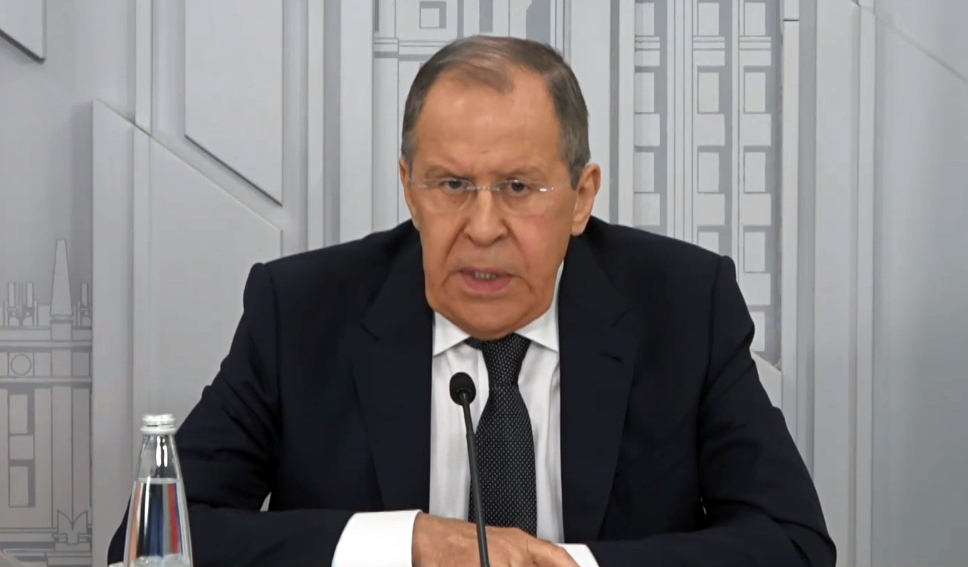
The development of the North-South Corridor (NSC) — linking India and Russia — is a priority for Moscow as the two countries explore alternatives to the Western routes, according to Russia’s Foreign Minister Sergey Lavrov.
“The North-South Corridor will benefit India directly [and] will go through Russia, Azerbaijan, Iran, further down to India,” he said on Wednesday at a news conference here.
He added, “Pakistan has also an interest in that”.
The NSC would connect Russia – and possibly other European countries – to ports on the west coast of India using a combination of railways, road transport and shipping.
The NSC, Lavrov said, “would allow bringing from the Baltic Sea, goods efficiently reliably, to the Persian Gulf”.
That and other alternatives to the Western routes would be cheaper and faster for trade between the two countries and not depend on the West, he said.
Adding a political element, he said, “It will be independent of those who systematically abuse their position in global trade and global transportation routes”.
Currently, India-Russia trade is through the Suez Canal and, when forced to avoid it, a longer route around Africa.
He said that other alternatives being considered are the Eastern Maritime Corridor (EMC) and the Northern Sea Route (NSR).
The EMC that is under active consideration and likely to come into use soon would connect ports on India’s East and Russia’s Far East through the Malacca Strait, South China Sea and the Sea of Japan.
On Wednesday, Indian and Russian officials met in Chennai to discuss the EMC connecting the city’s port and Vladivostok, and also others in the two countries.
India’s Shipping Minister Sarbananda Sonowal and Anatoly Yuryevich Bobrakov, Russia’s deputy minister for the Development of the Far East, were at the meeting along with officials and business representatives.
The route is projected to be 40 per cent shorter than the western route and take less than 20 days for ships travelling between India and Russia.
“The Northern Sea Route is of great interest to India and China,” Lavrov said.
The future of the NSR, which runs through the Arctic region, is linked to global warming with warming seas making year-round navigation possible through the Arctic Ocean. the Barents Sea and the Bering Sea
Lavrov said, “Northern Sea Route, considering the global warming factor and a promise that it will be very soon, very soon, we’ll be navigable all year round [and] will compete with all other transportation routes, winning more time by one-third [reduction] compared to this West channel.”
He also dismissively referred to the New Delhi and Washington-led India-Middle East-Europe Economic Corridor that was announced at the G20 summit last year and will have the participation of the United Arab Emirates, Italy, France, Germany and the European Union.
“So it’s up to the Western Europeans,” he said.
Given the hostilities between India and Pakistan, it is unlikely under current circumstances that Islamabad would allow connectivity to India through the NSR.
Therefore, goods coming in by the road-rail combination would have to be transhipped from the Chabahar Port that India is developing in Iran.
During his press conference, Lavrov took a swipe at the Western countries asserting that in a changing world order, the countries of the BRICS – the expanding group of Brazil, Russia, India, China and South Africa – “are leaving the West behind”.
“So, ex-colonial powers have to face up to the reality in today’s world, you shouldn’t just think that you’re so strong just because you have the dollar you can strangle people with this dollar,” he said.
ALSO READ: Russia calls for emergency UNSC meeting after downing of plane