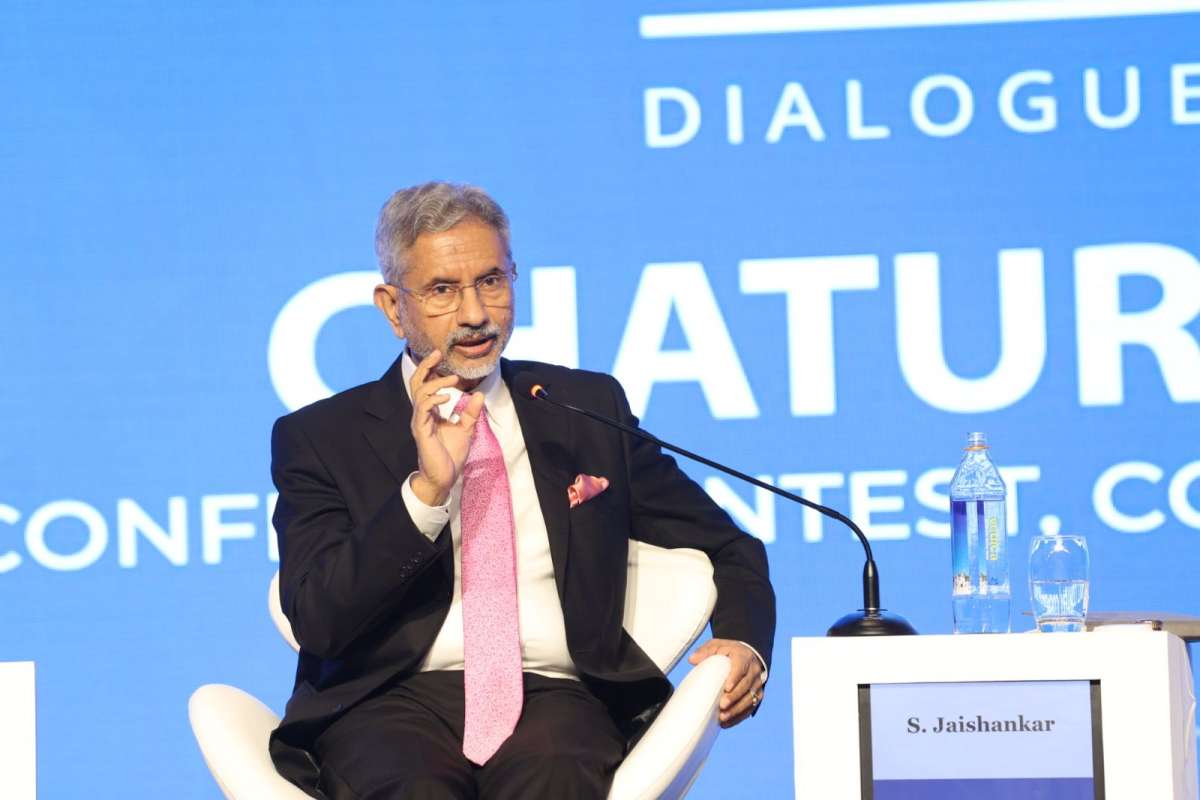
At the Raisina Dialogue discussion today, Jaishankar also took a veiled jab at China, one of the five permanent members of the 15-member UN Security Council for being the “biggest” opponent of its reforms….reports Asian Lite News
External Affairs Minister S Jaishankar said on Thursday that the failure of the United Nations to find multilateral solutions to issues such as the gaming of trading rules, which many countries have taken advantage of at the expense of the international system, demonstrated the case for a comprehensive reform of the global organisation.
“When the UN was invented, it had approximately 50 members. We have four times the members. So it’s a common sense proposition that you can’t continue the same way when you have four times the members. If you look at the last five years, for all the big issues, we have not been able to find a multilateral solution. So the lack of results demonstrates the case for reform,” Jaishankar said.
The minister was participating at a session, ‘A Tapestry of Truths; Can the two hemispheres agree?’ during the ongoing Raisina Dialogue 2024 in the national capital.
“In many cases, the rules have been gamed. We speak about globalization. The fact is that the world trading rules have been gamed. … a lot of our challenges today also emanate from how countries have used that for their benefit at the expense of the international system,” Jaishankar said.
When asked about various complex geopolitical challenges and diverse positions on them by different key countries, such as the US support of Israel in its ongoing war with Hamas and India’s strong relationship with Russia in view of the Ukraine conflict, Jaishankar said the endeavour has to be to find middle ground.
“The reality in many cases is we won’t find a middle ground. In addition to the old issues, there are also the new issues. The big debates of the day, connectivity, debt, trade, and how these are leveraged today, are not necessarily all coming out of the West. So the West, as the dominant force earlier, is largely responsible for where we are today. The new players haven’t helped,” Jaishankar said.
At the Raisina Dialogue discussion today, Jaishankar also took a veiled jab at China, one of the five permanent members of the 15-member UN Security Council for being the “biggest” opponent of its reforms.
India, a founding members of the UN in 1945, played an active role in the drafting of the UN Charter and has been a vocal proponent of reforming the UNSC.
“If you take UN Security Council reform, the biggest opposer is not a Western country. So let’s get the totality of the problem right. We have to battle bit by bit to create groups for change. On many issues, you will get different combinations of countries, and we’ll have to live with a long period of incremental progress before we get to some kind of landing point,” Jaishankar said.
Last week, India’s permanent ambassador to the United Nations, Ruchira Kamboj highlighted that India supports a comprehensive reform of the United Nations Security Council across all five clusters, including an expansion in both the permanent and non-permanent categories.
Kamboj was speaking at the intergovernmental negotiations on Security Council Reform in New York.
Meanwhile, the panel discussion at the Raisina Dialogue was centered around whether trust in the international system could be rebuilt, even in the absence of effective multilateral institutions and Are emerging powers that are more acceptable to a wider array of international actors obliged to stitch together coalitions that work, or is a patchwork of plurilateral agreements a fait accompli? The discussion also touched on how the “Global South” could be made aspirational.
Hanke Bruins Slot, Minister of Foreign Affairs, Netherlands, January Yusuf Makamba, Minister of Foreign Affairs and East African Cooperation, Tanzania, Jorge Quiroga, former President, Bolivia, and Anwar bin Mohammed Gargash, Diplomatic Advisor to the President, United Arab Emirates were the other participants in the interaction. (ANI)