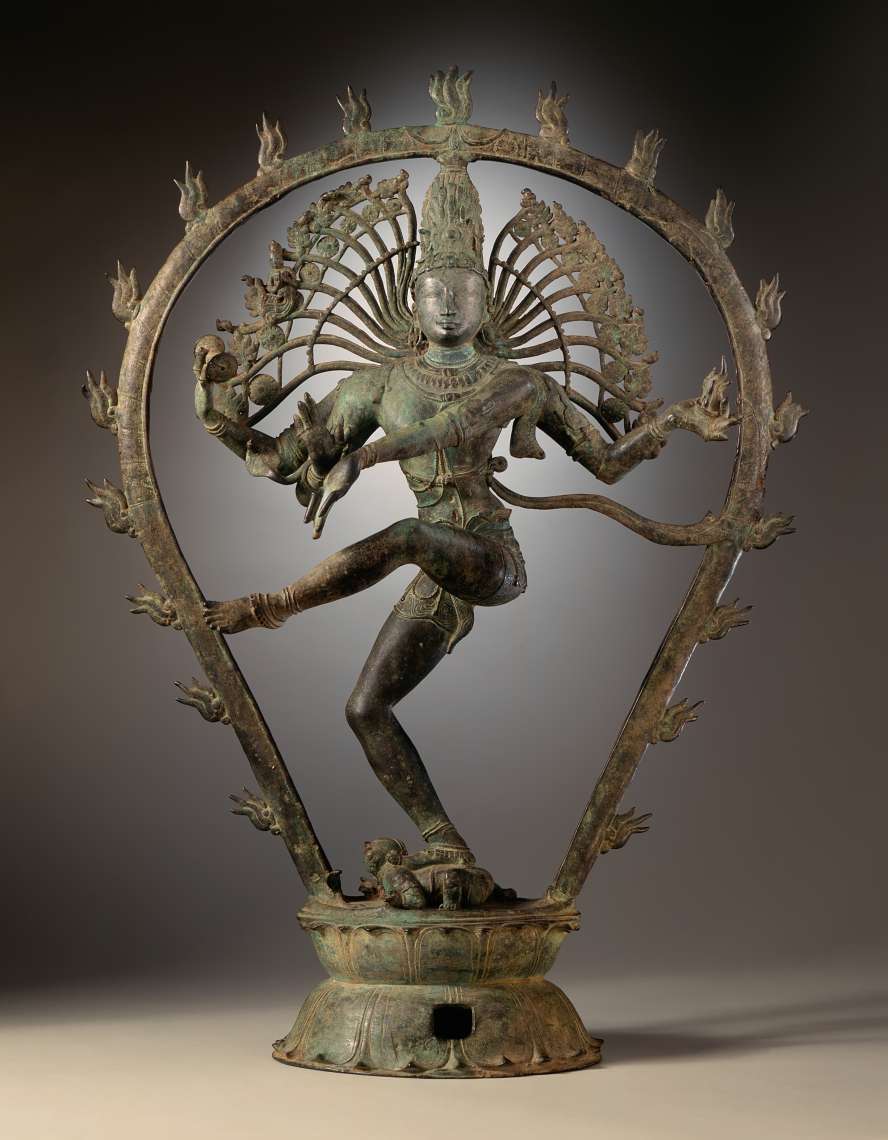
Lord Shiva whose other name is Nataraj means King of Cosmic Dance depicted in a dancing pose
The theory of Rasa enunciated by the sage Bharata has stimulated creativity in the Indian arts for more than two thousand years. The text of Natyashastra as relevant to literature, poetry and drama as it is to architecture, sculpture, painting, music and dance. Its treatment of artistic experience, expression and communication content and form emerges from an integral vision which flowers as a many branched tree of all the Indian arts. The text is composed of two words, ‘Natya’ and ‘Shastra’ which in Sanskrit means Dramatic art book of Treatise a compilation of all forms of performing arts. Natyashastra is notable as an ancient manual which comprises dance, drama, music and literary traditions of India

Bharata compiled the entire treatise around (500 BCE) the text consists of 36 volumes of six thousand poetic verses describing all the branches of performing arts. All these is imbibed in the Hindu religious traditions. As the Grrek historians saw it, India is the original land of arts as revealed by Dionysus. Classed as an ancillary science to the Veda, musical theory is also called Gandharvaveda the science of the celestial beingswho are musicians and dancers to the gods. Lord Brahma created the Natyashastra as the fifth Veda, which, unlike the four others, would be accessible to people of all social classes. The generic term for performing arts, Samgita Ratnakara. There is an immense literature on music to be found in Sanskrit. The collection of vedic chants is probaly the oldest on record. The Rigveda and Yajurveda is chanted on four or five tones while the Samaveda uses a full scale of seven tones thus, the hymns of the Samaveda are sung and its psalmody is fully musical.

It is said that Lord Indra used to entertain gods in his heavenly palace called Swargaloka by his celestial maidens who are divine nymphs known for their beauty, musical and dancing skills. The prominent among the Apsaras are Menaka, Rambha and Urvashi considered to be the most talented in performing arts.
Lord Shiva whose other name is Nataraj means King of Cosmic Dance depicted in a dancing pose.
PS: It must be noted here like everything ancient Indian from mathematics to art the Greeks took it from India and made it their own Natyashastra is one of them. The famous 19th century German composer Richard Wagner borrowed it from the Greeks and developed his own theory called Gesamtkunstwerk (Total Work of Art) in which he combined all the performing arts dance, drama, poetry and music successfully.

In April 2025,the Natyashastra manuscript was added to UNSCO’s World Register.
(The author Dilip Roy comes from the family of artists, his mother specialised in fine arts and classical music who taught in senior schools while his father Shri K C Roy excelled in Dramatics and was associated with Calcutta’s Minerva and Star theater where stalwarts like Ahindranath Choudhuri and Shishir kumar Bhaduri performed. Roy’s father was approached by the famous Devika Rani of Bombay Talkies and another famous star from Calcutta called Sadhana Bose. Roy’s father not only acted but directed several plays in his time. Roy’smaternal grand father, who went by the name of Prof. Naag was one of the well known magicians of India who’s speciality was ventriloquism was influenced by Western style of magic he was unique in the sense he wore a black suit with a black bow tie and he looked very much like a European because of his fair skin.)
Looking back I really feel proud that I belonged to the family of artists (Dilip Roy)
(A researcher on cultural subjects Dilip Roy is a Fellow of Royal Asiatic Society of UK)