The book argues that the INA trial directly confronted Britain with a reality it had long resisted: that Indians no longer accepted dominion status and would settle for nothing less than purna swaraj, complete independence. Ray contends that Britain’s eventual acceptance of this principle was not a gradual evolution but a response to the raw political force unleashed by the trial and its aftermath
Eighty years after the first Indian National Army (INA) trial opened at Delhi’s Red Fort, veteran journalist Ashis Ray has revisited the seismic event in a new book that argues the court martial hastened Britain’s acceptance of India’s independence. The Trial That Shook Britain: How a Court Martial Hastened Acceptance of Indian Independence, published by Routledge, blends archival depth with narrative clarity to illuminate a moment that electrified a nation on the brink of freedom.
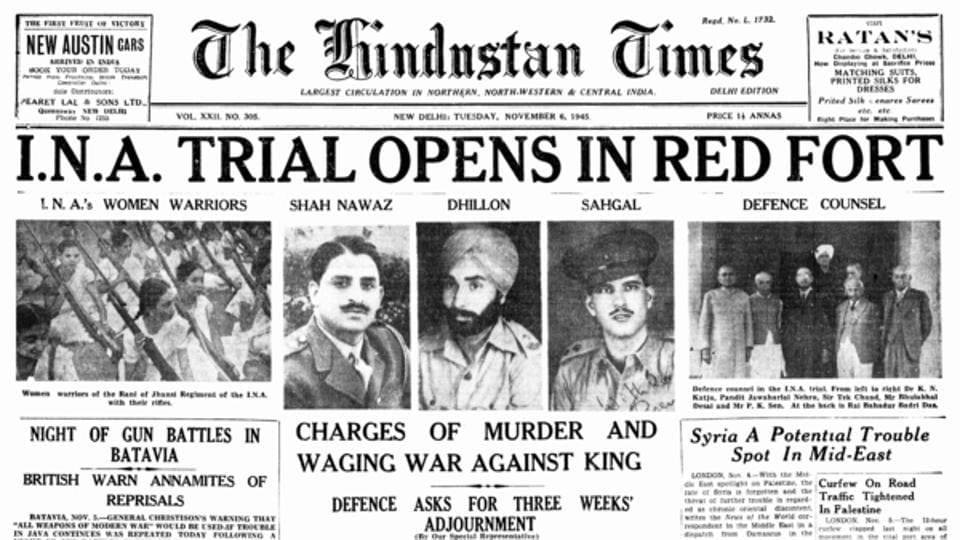
The trial, which began on 5 November 1945, placed three INA officers—Captain Shah Nawaz Khan, Captain Prem Sahgal and Lieutenant Gurbaksh Dhillon—before a British military court on charges of “waging war against the King-Emperor.” All three had been commissioned in the British-commanded Indian Army before joining Netaji Subhas Chandra Bose’s INA in its campaign against colonial rule. Technically, they could face death. Politically, the proceedings ignited a firestorm.
Ray’s book examines how the British intended the trial as a deterrent but instead triggered an unprecedented national eruption. Protests broke out across cities; processions demanded the officers’ release; and the usually disciplined ranks of the Royal Indian Navy mutinied in a show of solidarity that shook colonial confidence. Even within the Army, murmurs of dissent unnerved the British command. The tension reached London, where officials watched an India they believed they still governed slip from their grasp.

Central to Ray’s narrative is General Sir Claude Auchinleck, Commander-in-Chief of the British Indian Army, whose decision to commute the sentences proved decisive. Confronted with the public fury and the unease rippling through the armed forces, Auchinleck recognised that executing the men could provoke uncontrollable turmoil. Ray draws heavily on Auchinleck’s personal papers, seldom-seen trial transcripts and British parliamentary records to reconstruct the drama with precision.
The book argues that the INA trial directly confronted Britain with a reality it had long resisted: that Indians no longer accepted dominion status and would settle for nothing less than purna swaraj, complete independence. Ray contends that Britain’s eventual acceptance of this principle was not a gradual evolution but a response to the raw political force unleashed by the trial and its aftermath.
Academics have welcomed the book’s contribution to modern Indian historiography. Professor Faisal Devji of the University of Oxford calls it “a riveting account of one of the most important events in modern Indian history.” Professor Crispin Bates of the University of Edinburgh highlights its illumination of “a crucial period when British politicians finally came to realise that India had become effectively ungovernable.” Professor Mridula Mukherjee, formerly of Jawaharlal Nehru University, praises Ray’s “extensive archival evidence” and his argument that the trials “undoubtedly hastened the achievement of Indian independence.”
Ray’s own connection to the subject began during his tenure as an Academic Visitor at St Antony’s College, Oxford, where access to archival collections enabled him to turn years of research into a book-length study. Reflecting on the experience, he recalls Jawaharlal Nehru’s words after the original hearing: “No trial in India either by Court Martial or in the Civil Courts has attracted so much public attention or has dealt with issues of such fundamental national importance.” That sentiment—echoed through newspapers, memoirs and official records—forms the emotional spine of the book.
The 80th anniversary provides a timely reminder of just how charged the atmosphere was in late 1945. India, having supplied men and resources to the Second World War, was seething with discontent over economic hardship, political repression and broken promises of self-government. The INA, though militarily defeated, symbolised an uncompromising, pan-Indian defiance that resonated across class and region. When the British chose to prosecute its officers inside the Red Fort, they inadvertently created a national spectacle. Crowds outside chanted for freedom; volunteers offered legal aid; newspapers ran banner headlines that elevated the accused into folk heroes.
Ray’s work situates these episodes within a broader debate about decolonisation. By placing the trial in conversation with global arguments around the right of colonised peoples to rebel, he challenges the narrative that independence was granted through gradual negotiation alone. Instead, he presents a picture of a colonial power forced to confront the moral and political illegitimacy of its rule.

For students of modern Indian and South Asian history, the book is already being recommended as a key text for postgraduate study. Yet its appeal extends far beyond academic circles. Written with the clarity of a seasoned foreign correspondent—Ray has reported for the BBC, CNN, ITN, The Guardian, The Times and major Indian publications—the narrative combines rigour with accessibility. Readers new to the subject will find the book an engaging portal into the final chapter of the freedom struggle, while those familiar with the period will appreciate the freshness of its insights.
Ashis Ray’s long journalistic career, which spans international reporting, editorial leadership and multiple awards, underpins the authority of the work. The Trial That Shook Britain is his fourth book and perhaps his most historically significant. As he continues to engage with academia, Ray remains available for print and broadcast interviews.
Eighty years on, the trial still echoes—inside the Red Fort’s stone walls, within archives across continents and in the memory of a nation whose destiny shifted during those turbulent weeks.