China escalates tensions with Washington by sanctioning US defence firms and executives over Taiwan arms sales, warning that any challenge to its sovereignty will face firm retaliation….reports Asian Lite News
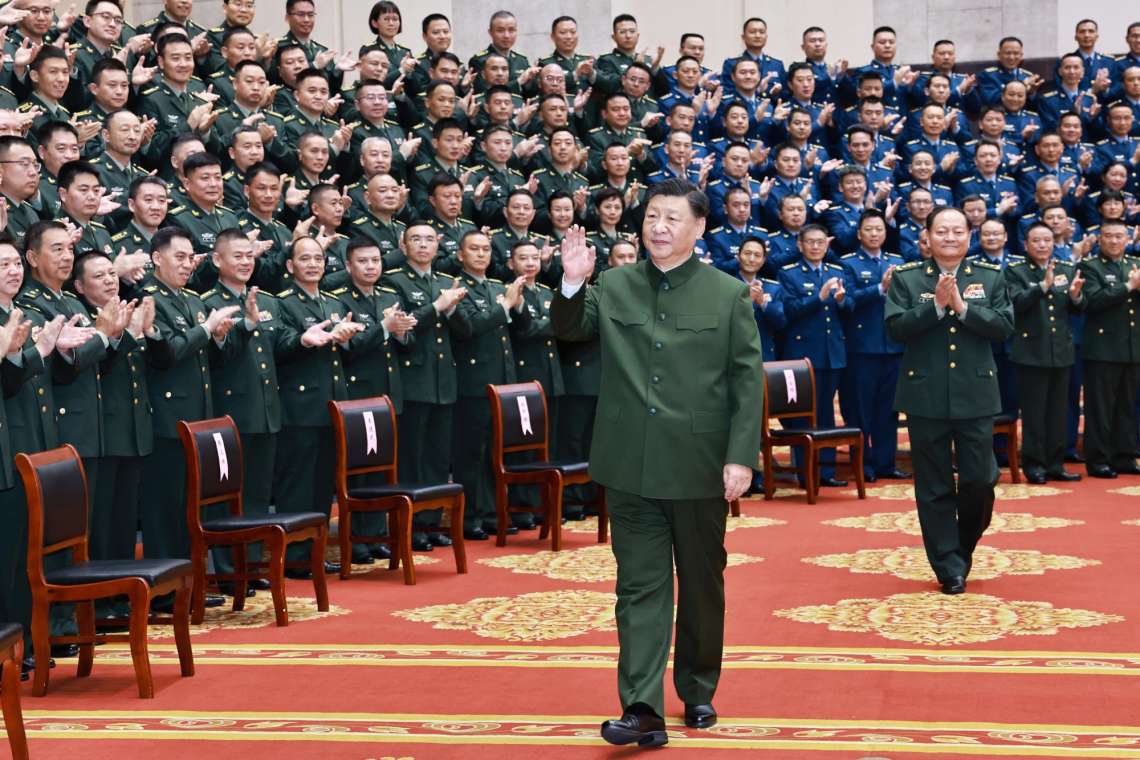
China has announced sweeping sanctions against a group of major US defence companies and senior executives, escalating tensions with Washington over continued American arms sales to Taiwan and issuing a fresh warning that those involved would “pay the price”.
The measures, unveiled on Friday by China’s Foreign Ministry, target 20 US defence-related companies and 10 senior executives accused of playing key roles in supplying weapons to Taiwan in recent years. The sanctions come in direct response to the United States’ approval of a large arms package for the self-governed island, a move Beijing says crosses a critical red line.
According to the ministry, the sanctions have been imposed under China’s Anti-Foreign Sanctions Law and take effect immediately. All movable and immovable assets belonging to the listed companies that are located within China will be frozen, while Chinese organisations and individuals will be prohibited from conducting any form of business or cooperation with them.

Among the companies named are major US defence and technology firms including Northrop Grumman Systems Corporation, L3Harris Maritime Services, Boeing’s St. Louis defence unit, Gibbs & Cox, Advanced Acoustic Concepts, VSE Corporation, Sierra Technical Services, Red Cat Holdings, Teal Drones, ReconCraft and High Point Aerotechnologies. The list also includes Epirus, Dedrone Holdings, Area-I, Blue Force Technologies, Dive Technologies, Vantor, Intelligent Epitaxy Technology, Rhombus Power and Lazarus Enterprises.
The sanctions also extend to 10 senior executives associated with these companies. The ministry said their assets in China would be restricted and that they would face limits on activities linked to China, including travel and commercial engagement. Among those named was Palmer Luckey, founder of defence technology firm Anduril Industries, alongside senior figures from L3Harris, VSE Corporation and other defence suppliers.
Beijing said the sanctions were a necessary response to what it described as a serious violation of the one-China principle and the three China–US Joint Communiqués. The Foreign Ministry said US arms sales to Taiwan amounted to interference in China’s internal affairs and undermined its sovereignty and territorial integrity.
A ministry spokesperson said the Taiwan issue lay at the very core of China’s national interests and represented a red line in relations between Beijing and Washington. The spokesperson warned that any attempt to challenge China’s position on Taiwan would be met with firm countermeasures.
The spokesperson added that any company or individual involved in arms sales to Taiwan would face consequences for what China described as wrongdoing. The statement said no country or external force should underestimate China’s resolve or its ability to safeguard national sovereignty and territorial integrity.
China also urged the United States to honour its existing commitments, halt weapons sales to Taiwan and refrain from actions that could further inflame tensions in the Taiwan Strait. Beijing warned that it would continue to take resolute measures to protect its security interests if provocations continued.
The latest sanctions follow the approval last week by the administration of US President Donald Trump of a major arms package for Taiwan. According to the US State Department, the proposed sales are valued at more than $10 billion and include medium-range missiles, artillery systems and unmanned aerial vehicles.
Taiwanese media reported that the potential deal consists of eight separate arms packages with an estimated combined value of $11.1 billion. These include HIMARS rocket systems, M109A7 howitzers, TOW 2B and Javelin anti-tank missiles, as well as anti-armour and reconnaissance drones.
Five of the eight proposed packages are covered under a special defence budget submitted by Taiwan’s government last month. The package, valued at NT$1.25 trillion, or roughly $39.85 billion, is currently awaiting review by lawmakers, according to Taiwan’s Defence Ministry.
China has long opposed US arms sales to Taiwan, arguing that such moves encourage separatist sentiment on the island and threaten peace and stability in the region. Beijing considers Taiwan part of its territory and has not ruled out the use of force to achieve reunification, while the United States maintains unofficial relations with Taipei and supplies it with defensive weapons under the Taiwan Relations Act.
The latest exchange highlights the increasingly confrontational tone between the world’s two largest economies, as strategic rivalry deepens across trade, technology and security. Analysts say the sanctions are unlikely to significantly disrupt US defence companies’ operations, given their limited exposure to the Chinese market, but note that the move carries strong symbolic weight.
As tensions continue to rise, diplomatic efforts to stabilise China–US relations face renewed strain, with Taiwan once again at the centre of a growing geopolitical fault line.