Bangladesh’s Eurofighter deal signals a major defence upgrade, but the country’s escalating legal battles, resignations and deepening political rifts cast a long shadow over its transition…reports Asian Lite News
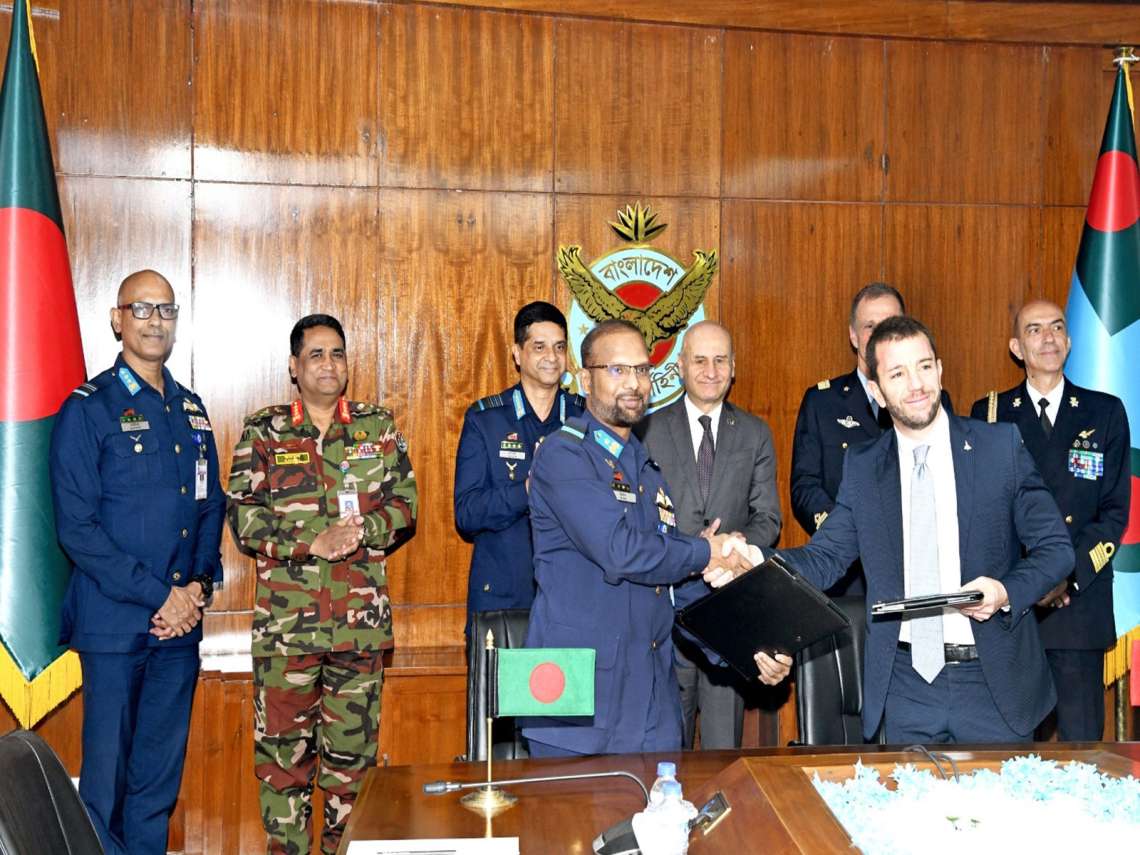
Bangladesh has taken a significant step towards modernising its air combat capabilities, with the country confirming plans to procure Eurofighter Typhoons from Italy. The Inter Services Public Relations (ISPR) announced on Tuesday that a Letter of Intent (LoI) had been signed between the Bangladesh Air Force (BAF) and Italian aerospace conglomerate Leonardo S.p.A.
The agreement was formalised on 9 December in Dhaka, in the presence of Air Chief Marshal Hasan Mahmood Khan, the Chief of Air Staff, and Antonio Alessandro, Italy’s Ambassador to Bangladesh. Senior officials from the Bangladesh Armed Forces Division and representatives from Italy also attended the signing ceremony.
According to the ISPR statement, the LoI marks a decisive step toward equipping the BAF with modern multi-role combat aircraft. The Eurofighter Typhoon, a twin-engine, supersonic, canard-delta-wing fighter developed by a European consortium, is widely regarded as one of the world’s most advanced 4.5-generation aircraft. The ISPR, however, offered no details regarding timelines, quantity or the financial scope of the deal.
For Bangladesh, the platform’s advanced avionics, air-to-air capabilities, and multirole functionality would significantly enhance its defensive posture and operational reach. The acquisition also marks a shift in Dhaka’s procurement patterns, traditionally dominated by China and Russia, signalling an effort to widen strategic partnerships amid a rapidly evolving geopolitical landscape.
But the announcement comes at a time when Bangladesh’s domestic political arena remains deeply unsettled.
Warrant for Sajeeb Wazed Joy
Bangladesh continues to grapple with intense political polarisation following the dramatic fall of Sheikh Hasina’s government last August, when a student-led uprising forced the former prime minister to flee to India. The turbulence has only accelerated in recent weeks.
The International Crimes Tribunal (ICT) has now issued an arrest warrant for Sajeeb Wazed Joy, Hasina’s son and her former ICT affairs adviser. Chief Prosecutor Tajul Islam confirmed to ANI that the charges relate to “crimes against humanity”, specifically the shutdown of the internet during student protests in July 2024 — a move prosecutors allege was aimed at suppressing dissent.
Adding to the former ruling family’s troubles, a Dhaka court on Monday sentenced Sheikh Hasina to five years in prison on corruption charges tied to the alleged illegal allocation of government plots in Purbachal. Her sister, Sheikh Rehana, received a seven-year sentence, while Rehana’s daughter, British MP Tulip Siddique, was handed a two-year prison term in the same set of cases filed by the Anti-Corruption Commission in January.
In a separate and highly controversial verdict, the ICT has already sentenced Hasina to death for the killing of students during last year’s protests — a judgement strongly criticised by rights groups and legal analysts, who argue the proceedings lack due process and appear politically driven.
The combination of overlapping legal cases, mass indictments, and sweeping charges against former government members has raised concerns over the rule of law and the independence of Bangladesh’s judicial institutions.
Resignations shake interim government
The volatility has extended into the interim government led by Nobel laureate Professor Muhammad Yunus. On Wednesday, the Chief Adviser’s Press Wing confirmed the resignations of two student-representative advisers — Mahfuz Alam and Asif Mahmud Sajeeb Bhuiyan — from the 23-member Advisory Council.
The pair reportedly stepped down to maintain the neutrality of the cabinet ahead of parliamentary elections, the schedule for which will be announced by the Chief Election Commissioner on Thursday. Both advisers are expected to contest the upcoming polls.
Mahfuz Alam had been advising the Ministry of Information and Broadcasting, while Asif Mahmud served roles in the Ministry of Local Government, Rural Development and Co-operatives, as well as the Ministry of Youth and Sports.
Political fragmentation among youth
Their resignations are the latest sign of political realignment among the youth leaders who spearheaded the July 2024 uprising. A third student representative, Md Nahid Islam, resigned from the council in February and went on to form the National Citizens Party (NCP), a new political force emerging directly from the protest movement.
The fragmentation within the youth bloc underscores the shifting dynamics of Bangladesh’s political transition — a period marked by public frustration, legal upheavals and an increasingly competitive path to national elections.
As Dhaka moves forward with a major defence procurement deal with Italy, the turbulence in its political architecture continues to overshadow the country’s attempts at institutional stability.