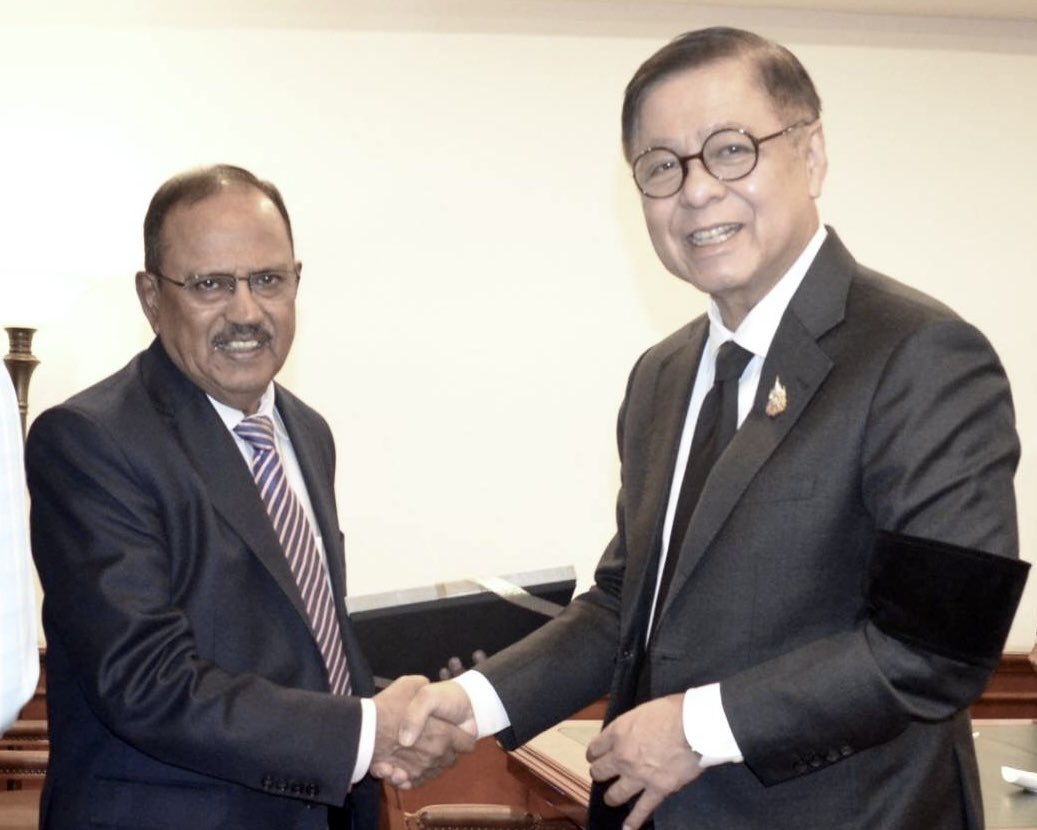
India and Thailand deepen strategic cooperation with high-level talks in New Delhi, focusing on cyber-scam syndicates, maritime security, regional stability and Bangkok’s request for India’s support in joining BRICS….reports Asian Lite News
India and Thailand have intensified diplomatic engagement this week, with National Security Advisor Ajit Doval and Thailand’s Foreign Minister Sihasak Phuangketkeow holding a substantive bilateral meeting in New Delhi on Monday to deepen strategic cooperation and address shared security challenges. The exchanges, detailed in an official statement by the Thai Ministry of Foreign Affairs, underline the growing importance of cybercrime prevention, maritime security and regional stability in the expanding partnership between the two countries.
According to the Ministry, both sides discussed ways to broaden the existing Strategic Partnership and significantly strengthen cooperation on key security concerns. The Thai delegation placed particular emphasis on maritime security as well as the need for coordinated mechanisms to tackle the accelerating threat posed by online scams across the region. Thailand also formally invited India to participate in the International Conference on Global Partnerships to Combat Online Scams, scheduled to be held from 17–18 December 2025 in Bangkok.
The dialogue reflected a shared recognition of emerging cross-border threats and the urgency of developing joint responses. The Thai Ministry’s statement noted that discussions extended to regional strategic issues, including promoting peace in Myanmar and supporting a peaceful settlement of the border situation between Thailand and Cambodia. Bangkok further encouraged deeper Cambodian cooperation with Thailand in demining operations along their shared border.

The momentum continued on Tuesday when External Affairs Minister S Jaishankar met his Thai counterpart for a second round of talks, reaffirming the longstanding friendship between the two nations. Jaishankar described Thailand as “a very important maritime neighbour” and highlighted steady progress in bilateral cooperation, from political engagement and trade to science, technology, innovation and startups. Both sides welcomed developments in bilateral and multilateral trade and connectivity projects, with an eye on long-term regional economic integration.
Thailand also sought India’s support for its intention to join BRICS during India’s Chairmanship of the grouping in 2026, signalling Bangkok’s growing interest in new multilateral alignments. The ministers exchanged views on evolving geopolitical challenges, with Myanmar emerging as a key point of concern for both. Jaishankar emphasised the importance of regular dialogue on pressing regional developments to ensure coordinated responses.
Cybercrime remained a central theme throughout the Thai Foreign Minister’s visit. In separate remarks to ANI, Sihasak Phuangketkeow issued a stark warning over the rapid proliferation of transnational cyber-scam networks operating near Thailand’s borders with Myanmar and Cambodia. He described the problem as “becoming more serious” and called for urgent, collaborative action. The minister revealed that more than 1,000 Indian nationals fled into Thailand during a recent crackdown on scam syndicates, prompting Thai authorities to extend emergency assistance. Many others, he said, are believed to be trapped in scam hubs controlled by criminal networks across the region.
Calling cyber scams a “shared threat”, the minister stressed that Thailand and India must work closely together, while also pushing for broader regional and international cooperation. During bilateral discussions, both sides reaffirmed commitment to joint action to combat online scams and facilitate assistance to Indian victims ensnared in these transnational networks.
The two-day engagement underscored the increasing convergence between New Delhi and Bangkok on security, technology and regional governance. As cybercrime accelerates and geopolitical shifts reshape Asia, both countries appear determined to match their growing strategic partnership with practical coordination on the most pressing challenges of the Indo-Pacific.