Seven arrests over a Hindu youth’s lynching highlight Bangladesh’s deepening law and order crisis, as mob violence, political arson and security fears mount under the interim government.
Bangladesh’s interim government has confirmed the arrest of seven people over the lynching of a Hindu youth in central Bangladesh, as a series of violent incidents fuel concerns about law and order, minority safety and deeper instability under the caretaker administration led by Muhammad Yunus.
Chief Adviser Muhammad Yunus said on Saturday that Rapid Action Battalion (RAB) officers had arrested seven suspects in connection with the brutal killing of Dipu Chandra Das, a 27-year-old factory worker, in Bhaluka, Mymensingh. In a statement posted on X, Yunus said the arrests followed targeted operations by RAB-14 at multiple locations. The suspects have been identified as Limon Sarkar, Tarek Hossain, Manik Mia, Ershad Ali, Nijum Uddin, Alomgir Hossain and Miraj Hossain Akon.
The killing took place on Thursday night at the Pioneer Knit Composite Factory in the Square Masterbari area. Dipu, a resident of Tarakanda upazila in Mymensingh, was allegedly accused of making derogatory remarks about Islam and Prophet Muhammad during an event marking World Arabic Language Day at the factory. Local media reports say the allegations spread rapidly, triggering tension among workers and in the surrounding area.
Eyewitness accounts suggest Dipu was attacked by an angry mob inside the factory premises and died on the spot. Reports further claim that the violence continued even after his death, with the body dragged to a nearby bus stand, tied to a tree, beaten while slogans were shouted and later set on fire. Local authorities confirmed that the body is now in police custody and investigations are ongoing.

Minority safety concerns intensify
The incident has sparked widespread condemnation and renewed fears among minority communities. Former information minister and Awami League leader Mohammad Ali Arafat described the killing as evidence of Bangladesh sliding towards radicalism, accusing the interim government of failing to protect citizens and uphold the rule of law.
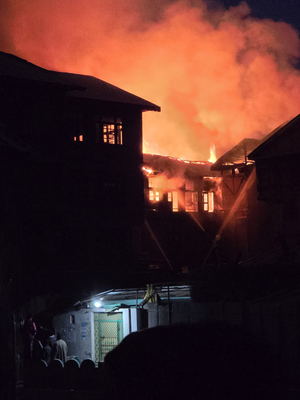
The lynching comes against the backdrop of escalating violence across the country, including a deadly arson attack in Lakshmipur that claimed the life of a child. Early on Saturday, the house of a local Bangladesh Nationalist Party leader, Belal Hossain, was allegedly locked from the outside and set on fire in Lakshmipur Sadar upazila. Belal’s seven-year-old daughter, Ayesha Akter, was burnt to death, while Belal himself and two of his teenage daughters sustained critical burn injuries.
Police said Belal Hossain, an assistant organising secretary of the BNP in Bhabaniganj Union, is undergoing treatment at Lakshmipur Sadar Hospital, while his daughters have been transferred to Dhaka for advanced care. Doctors said 50 to 60 per cent of their bodies had suffered burn injuries. Family members alleged that petrol was poured on the house before it was set ablaze, though the perpetrators have yet to be identified.
Wider destabilisation fears
The violence has coincided with fresh intelligence warnings from Indian agencies, which claim Pakistan’s Inter-Services Intelligence has activated a specialised “Dhaka Cell” to exploit unrest in Bangladesh. According to intelligence sources, the cell was allegedly established within the Pakistan High Commission in Dhaka and tasked with grooming extremists and fuelling instability.
Indian officials allege the cell has been planning large-scale unrest since October, with a broader objective of destabilising India’s eastern border regions, including West Bengal and the North East, ahead of upcoming elections. While Dhaka has not formally responded to the claims, the reports have intensified scrutiny of the interim government’s ability to maintain internal security.
Human rights groups have expressed alarm over the growing number of incidents involving mob violence, religious extremism and political arson, warning that delays in justice risk emboldening further attacks. With elections scheduled for early 2026, analysts say Bangladesh is entering a volatile period marked by political uncertainty, social tension and regional security concerns.