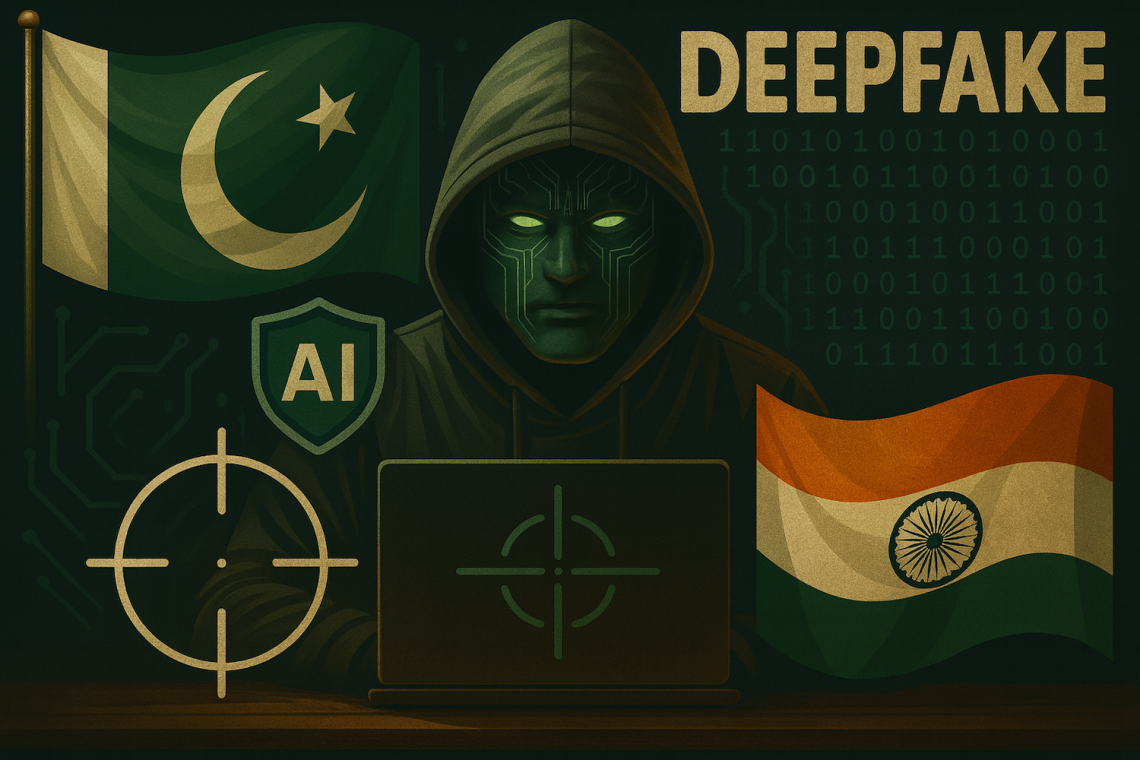
Pakistan’s new arsenal is not made of steel or fuel. It is made of pixels, prompts and carefully edited illusions. And while these tools cannot alter the balance of forces at sea, they can create noise loud enough to temporarily distort the same picture…writes Commodore Johnson Odakkal
There is a peculiar moment in every conflict when you realise the loudest explosions are happening on screens, not battlefields. During the recent India–Pakistan flare-ups, that moment arrived when a stream of grainy missile launches, burning ships, collapsing aircraft and triumphant ‘Pak Navy strikes’ began circulating online. None of it matched radar logs, maritime reports or even basic geography. But accuracy was never the point. These clips existed to flood the zone.
What made this wave different from older propaganda cycles was not the messaging but the machinery behind it. Indian fact-checking units across the board reported the same pattern. Nearly every viral ‘proof’ of Pakistani success was stitched together from AI-generated visuals, manipulated audio, recycled footage from other wars or repurposed clips from video games. More importantly, the volume was unprecedented. For every real update from the ground or sea, there were ten synthetic alternatives crafted to overwhelm the information space.

One of the clearest examples surfaced when a video claimed to show an Indian destroyer ablaze after a supposed Pakistani strike. The clip had the dramatic lighting, the smoke plume and the shaky hand-held realism that normally catches attention. Within hours, analysts identified it as an altered sequence from a Mediterranean naval fire incident from years earlier, with AI-driven colour correction and ambient noise added to disguise the origin. Yet it had already travelled through thousands of WhatsApp groups by then.
Another clip portrayed a Pakistani missile barrage during Operation Sindoor. The launch frames were lifted from a 2019 live-fire exercise and re-edited with synthetic bloom effects and a modernised sky gradient. The impact shots, on the other hand, came straight from a publicly available military simulation game. Viewers who played the game recognised the terrain layout instantly. Those who did not simply assumed they were watching real-time conflict. In the modern information sphere, familiarity is no longer a barrier to fabrication.

Indian agencies that specialise in digital verification observed that the disinformation wave had distinct fingerprints. The audio in many communications intercept clips was artificially flattened, with the unmistakable cadence of text-to-speech generators. Airborne footage of Indian aircraft shot down had frame glitches linked to AI interpolation. Several exclusive visuals were traced back to stock explosion clips used repeatedly across multiple regional conflicts. In short, it was not a campaign designed to fool experts. It was designed to occupy attention spans long enough to shape sentiment.
The timing was equally revealing. Every major Indian naval deployment during Operation Sindoor was matched with a parallel surge of fake Pakistani naval victories online. When Indian P-8I patrol aircraft were operating routinely across the Arabian Sea, Pakistan supporters circulated AI-generated videos alleging the aircraft had been downed. When Indian warships expanded their presence westward, images showing burning frigates began popping up in the usual channels. The mismatch between reality and online fiction grew wider by the day.

It created a strange duality in the conflict. At sea, India operated with discipline, steady command and near-real-time coordination. Online, Pakistan operated with volume, improvisation and unrestrained fabrication. Analysts who studied the incident later described it as South Asia’s first confrontation where the digital battlespace ran on a completely separate track from the physical one.
Indian fact-checking bodies, including the official verification units and independent digital forensics teams, eventually catalogued a pattern. The deepfake engine powering this wave grew stronger as the conflict progressed. In the opening days, the clips were unsophisticated – simple crops, bad audio layering, old footage re-tagged. Within a week, more advanced synthetic episodes appeared, complete with AI-generated smoke trails and voiceovers calibrated to sound authoritative. By the end of the cycle, Pakistan-linked networks were even circulating fabricated ‘radio chatter’ that sounded close enough to naval communication to confuse the inattentive.

All of this raises a broader point about capability versus narrative. A country with a strong navy projects strength through patrols, exercises and deployments. A country with limited naval reach projects strength through the loudness of online artefacts. Pakistan’s new weapons during this period were not hardware upgrades or breakthrough missile systems. They were high-frequency waves of fake visuals meant to compensate for what was not happening at sea.
This is not entirely new. Pakistan has previously used doctored content during air-power disputes, including attempts to misrepresent Rafale performance metrics. But what has changed is the toolkit. AI allows faster turnover, cheaper production and a far wider pool of contributors. A narrative that once required effort can now be fabricated in minutes. And when speed beats accuracy, the first clip often wins attention long before debunking catches up.

For India, the lesson from this cycle is not just about vigilance but about pace. Countering deepfakes is no longer a matter of issuing corrections after the fact. It is about recognising that disinformation operates on a different tempo. Pakistan’s virtual navy fires salvos at the speed of an upload. The real world does not.
In the end, these synthetic weapons reveal more about Pakistan’s anxieties than its capabilities. A navy that cannot project power into the Arabian Sea constructs a digital fleet capable of winning imaginary battles. It is theatre, not strategy. But theatre, when amplified at scale, can muddy the waters for viewers who engage casually with unfolding events.
Pakistan’s new arsenal is not made of steel or fuel. It is made of pixels, prompts and carefully edited illusions. And while these tools cannot alter the balance of forces at sea, they can create noise loud enough to temporarily distort the same picture. In an era where perception travels faster than fact, that distortion becomes an instrument in its own right.
(Commodore (Dr.) Johnson Odakkal is a maritime scholar, strategic affairs analyst, and Indian Navy veteran. He serves as Faculty of Global Politics and Theory of Knowledge at Aditya Birla World Academy, Mumbai, and Adjunct Faculty of Maritime and Strategic Studies at Naval War College, Goa)