China’s growing nuclear arsenal, including air, land, and sea capabilities, raises fears of coercion over Taiwan, potentially limiting US intervention and reshaping Indo-Pacific deterrence….reports Asian Lite News
China’s rapid growth and diversification of its nuclear capabilities have intensified concerns among Western nations that Beijing could resort to “nuclear blackmail” or even a limited nuclear conflict if foreign powers intervene in a Taiwan crisis. Analysts note parallels with Russia’s nuclear warnings during its invasion of Ukraine, suggesting that lessons from Moscow may have influenced Beijing’s evolving posture.
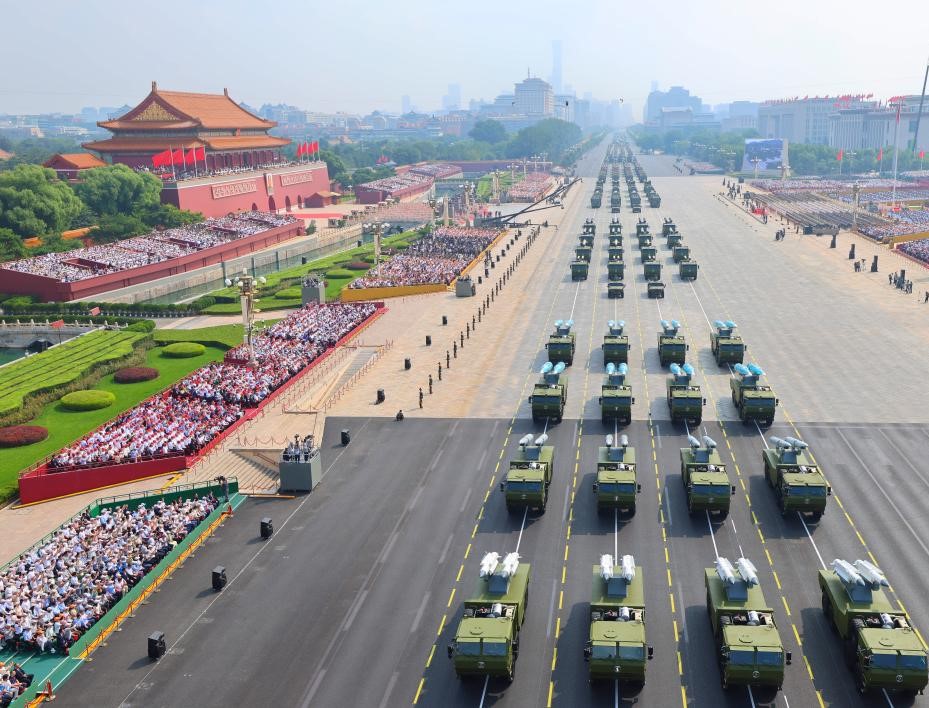
During the September 3 military parade at Tiananmen Square, China unveiled three missiles capable of carrying nuclear warheads: the JL-1 air-launched ballistic missile, the JL-3 submarine-launched intercontinental missile, and the DF-61 surface-to-surface intercontinental missile. This display, interpreted by experts as a demonstration of a potential Chinese “nuclear triad,” indicates that Beijing now possesses the capacity to launch nuclear weapons via air, land, and sea—a capability it previously lacked, especially for airborne nuclear strikes.
Eric Heginbotham, a research scientist at MIT’s Security Studies Program, told the Central News Agency (CNA) that China’s advanced tactical nuclear weapons, such as the DF-26, provide a “more credible” deterrent than its strategic arsenal. “This not only reduces US escalation dominance in overall capabilities but also equips [China] with more realistic options to respond proportionately against potential US use of tactical nuclear arms,” he explained.
Historically, China’s nuclear posture relied on strategic retaliatory options that implied any use against the US would be “suicidal,” prompting fears of overwhelming retaliation. Heginbotham noted that the new capabilities allow Beijing to engage in conventional conflicts with reduced concern over catastrophic US nuclear responses, potentially altering calculations in a Taiwan contingency.
Yang Tai-yuan, chairman of the Secure Taiwan Associate Corporation, warned that these advancements might influence Washington’s willingness to deploy forces in Taiwan’s defence. “The Chinese Communist Party may have drawn lessons on nuclear intimidation from Russia during the Ukraine conflict and could threaten to deploy tactical nuclear weapons against major powers that get involved in regional disputes, including in the Taiwan Strait,” he said.
If US forces were dispatched to support Taiwan, Yang suggested, China could use its tactical nuclear arsenal to coerce American troops stationed in the western Pacific. “The US would probably take such threats seriously and assess its choices between deploying troops to the Taiwan Strait or limiting its reaction to diplomatic measures, such as support through the United Nations, to prevent direct conflict,” he added.
The evolving nuclear landscape in East Asia has heightened the stakes for policymakers, as China’s growing triad and tactical capabilities create new strategic dilemmas. Analysts argue that Beijing’s modernisation of its nuclear forces is designed not merely for deterrence but also to strengthen leverage over potential adversaries in regional disputes, especially over Taiwan.
While Washington continues to bolster military partnerships and security assurances in the Indo-Pacific, China’s expanding nuclear options add a complex layer of uncertainty to any potential conflict scenario. Experts warn that the combination of conventional strength and tactical nuclear flexibility may reshape deterrence dynamics in the region for years to come.