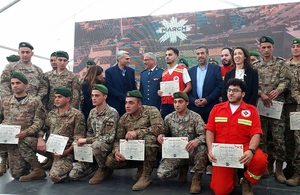
The project united the Lebanese Army and marginalised young people in a rare display of collaboration aimed at protecting the city’s heritage…reports Asian lIte News
Tripoli’s historic Citadel Raymond De Saint Gilles, a 12th-century fortress overlooking the ancient port city, was officially inaugurated today following extensive restoration efforts supported by the United Kingdom. The project, conducted over several months, was carried out by the Lebanese Army in partnership with young people from marginalised communities, working through the NGO MARCH. Their joint labour has not only revived one of Lebanon’s most important heritage landmarks but also demonstrated a wider commitment to social cohesion in a city long affected by economic strain and political division.
The ceremony, held within the imposing stone walls of the citadel, brought together Lebanese officials, community representatives and international partners. Deputy Head of Mission at the British Embassy, Victoria Dunne, attended alongside the Director General of Antiquities at the Ministry of Culture, Sarkis Al Khoury, who represented Minister Salameh. Tripoli’s Mayor, Dr Abdel Hamid Kareemeh, senior Lebanese Army officers, the Head of MARCH, Lea Baroudi, and youth from across the city were also present for the formal reopening.
The citadel, which has endured centuries of conflict, neglect and environmental wear, has been a priority for preservationists concerned about Lebanon’s deteriorating cultural sites. Its strategic hilltop position has made it a symbol of the city’s layered history, while its decline in recent years reflected the broader challenges facing Tripoli, one of the poorest urban centres on the Mediterranean. The restoration marks a rare moment of optimism, highlighting the value of investing in heritage as a means of strengthening local identity and resilience.
The UK-funded project also underscores the central role MARCH has played in Tripoli since 2016, working to bridge divides and reduce sectarian tensions. By engaging at-risk youth from historically opposed neighbourhoods, the organisation has sought to create pathways away from violence and marginalisation. Its partnerships with local institutions — notably the Lebanese Armed Forces — have been credited with fostering dialogue, building trust and offering young people opportunities to contribute to their city’s renewal.
The inauguration was as much a celebration of this social mission as it was a cultural milestone. For many of the young volunteers involved, the citadel has become a symbol of what collaborative work can achieve in difficult circumstances. Their presence at the ceremony, alongside senior military officers and government representatives, reflected the project’s effort to give marginalised communities a meaningful stake in protecting Tripoli’s future.
In remarks following the inauguration, Deputy Head of Mission Victoria Dunne said, “I am proud of the UK’s support to restore Tripoli’s oldest historic Citadel, which brought together the Lebanese Armed Forces and Tripoli’s young people through the NGO MARCH. Hand in hand, these initiatives promote community cohesion here in Tripoli and across Lebanon, fostering trust between local communities and Lebanese institutions.”
Her comments echoed the British government’s broader approach to stabilisation efforts in Lebanon, where cultural preservation is increasingly seen as part of a holistic strategy to support economic development, strengthen social fabric and reinforce state institutions. For the Ministry of Culture, the event provided a moment to emphasise the importance of partnership in safeguarding Lebanon’s archaeological wealth — particularly at a time when public funding remains scarce.
Local officials, including the Mayor of Tripoli, noted that the reopening of the citadel is expected to provide a boost for cultural tourism and community pride. As Lebanon continues to grapple with economic crisis, projects of this kind are regarded as vital in generating employment, attracting visitors and revitalising the urban landscape.
With the Citadel Raymond De Saint Gilles once again open to the public, Tripoli now stands poised to reconnect its residents and visitors with a pivotal chapter of its past — and, through the collaborative model that made this restoration possible, chart a more united path for the years ahead.