The UAE and European Union pushed their fast-advancing free trade talks into sharper focus, vowing a deeper strategic partnership spanning economics, technology, energy, stability and humanitarian action…reports Asian Lite News
The UAE and European Union placed their accelerating free trade negotiations at the heart of a major diplomatic push in Abu Dhabi, with both sides declaring that the long-standing partnership is entering its most ambitious phase yet.
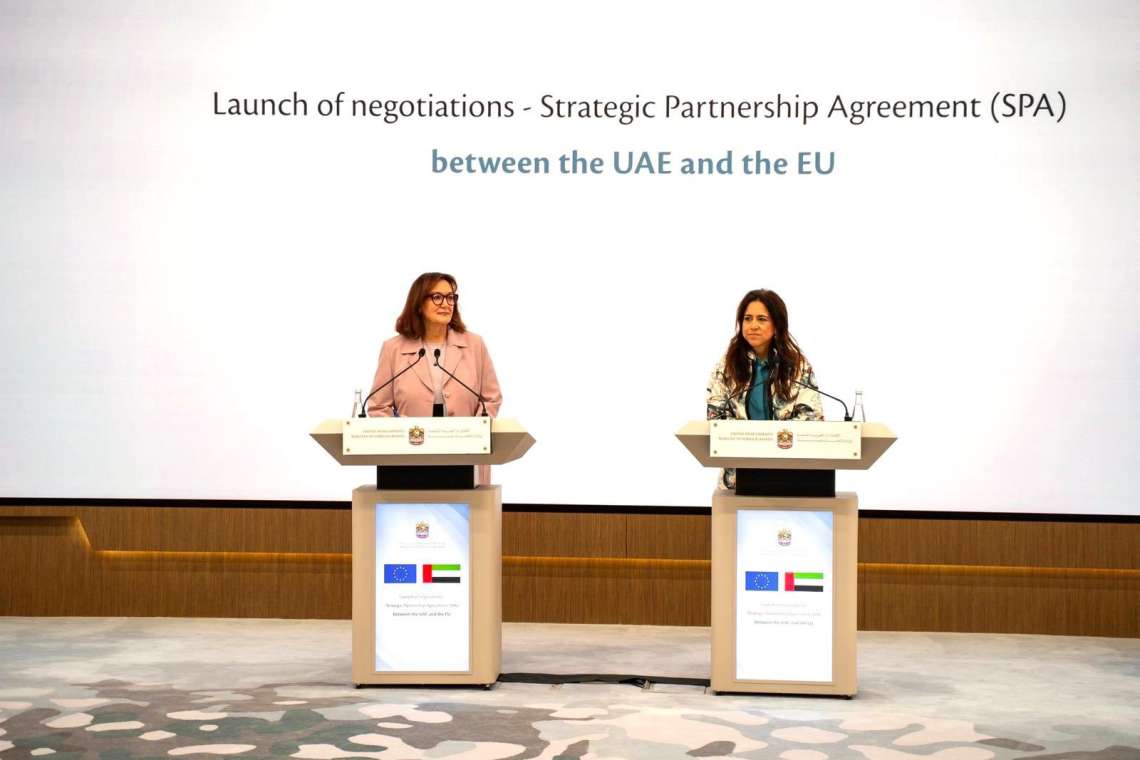
At a joint press conference, Lana Zaki Nusseibeh, UAE Minister of State, and Dubravka Šuica, EU Commissioner for the Mediterranean, outlined a rapidly expanding roadmap that they said will reshape economic ties, drive innovation and bolster regional and global stability.
Nusseibeh opened the briefing by highlighting the launch of formal negotiations on a Strategic Partnership Agreement, calling it “a significant step” toward transforming UAE–EU cooperation into a comprehensive, forward-looking framework.
But it was the progress on the free trade agreement—described as intensive, fast-paced and grounded in strong mutual economic interests—that dominated the discussion. According to Nusseibeh, momentum is now firmly behind the talks, with both sides convinced that closer economic integration will unlock major benefits for businesses and communities across Europe, the Gulf and beyond.
She stressed that the UAE’s global experience with comprehensive partnership agreements has already demonstrated their transformative economic impact.
With the EU being the UAE’s top investment partner and its second-largest global trading partner, Nusseibeh said the time is right to elevate the relationship to “a more ambitious level” and to finally tap the full potential of cooperation between Europe and the Gulf states—potential she noted has historically been underutilised.
Tech, energy and humanitarian action
The minister pointed out that strengthened trade ties would deepen investment flows, energise business-to-business cooperation and expand opportunities in emerging industries.
She also underscored that the Strategic Partnership Agreement under negotiation will create an institutional structure for collaboration in sectors of growing global urgency, including digitisation, artificial intelligence and renewable energy. These areas, she said, form the backbone of the future global economy and align closely with the UAE’s national priorities.
Yet Nusseibeh was equally clear that the relationship is not merely transactional. She emphasised that the UAE and EU share a responsibility to support stability, constructive engagement and humanitarian relief worldwide.
Citing the UAE’s pledge of US$550 million to the UN’s humanitarian response plan, she said such commitments are central to ensuring that cooperation delivers “dignity and hope” to vulnerable populations. The broader goal, she said, is to convert strategic intent into practical implementation—ensuring the partnership produces measurable benefits for governments, private sectors and global communities.
Šuica echoed this message, describing the day’s announcement as a defining milestone in the trajectory of UAE–EU relations.
She said the upcoming Strategic Partnership Agreement builds on decades of cooperation and aligns with the EU’s 2032 strategy, which seeks long-term stability, economic resilience and shared prosperity with partners across the Mediterranean, Middle East and Africa.
Shared security goals
On trade, Šuica confirmed that work will continue at pace on the free trade agreement negotiations launched in May. She described the UAE as a pivotal partner—a dynamic hub connecting Europe with the Middle East and Asia, and a key player in both trade and investment.
The free trade agreement, she said, is envisioned as a modern and ambitious framework reaching far beyond tariff reductions, one that will strengthen cooperation in scientific research, innovation, energy systems, artificial intelligence, digital governance, humanitarian action and education.
Šuica added that the deal is expected to unlock large-scale collaborative projects across the Middle East and North Africa, creating new opportunities to confront shared challenges ranging from climate adaptation to energy transition and regional instability. Europe, she said, sees its role in this partnership as essential to reinforcing prosperity and stability across interconnected regions.
Responding to media questions, Nusseibeh said the free trade discussions have been “highly productive”, noting the UAE’s own record of rapid progress in trade diplomacy: 31 Comprehensive Economic Partnership Agreements concluded in just three years.
She also addressed the situation in Sudan, emphasising that the UAE remains in close consultation with partners, including the EU, as the conflict continues to devastate communities.
She welcomed the European Parliament’s support for mediation efforts and the EU Foreign Affairs Council’s call for an immediate humanitarian truce followed by a permanent ceasefire and a transition to a civilian, independent government.
Nusseibeh pointed to the Quartet’s September statement as a historic moment that laid out a realistic roadmap for de-escalation. Sudan, she said, must not be allowed to slide into extremism or become a haven for terrorists.
Its future depends on stability, civilian leadership and sustained international engagement. The UAE and Europe, she reaffirmed, remain aligned on these principles and are working closely to support a peaceful resolution.