As Bangladesh inches toward a crucial election, these killings cast a long shadow over the country’s democratic and social fabric. The repeated pattern of unresolved murders, official denial, and visible emboldenment of radical elements has intensified scrutiny of the interim administration’s governance …writes Fazal Rahman
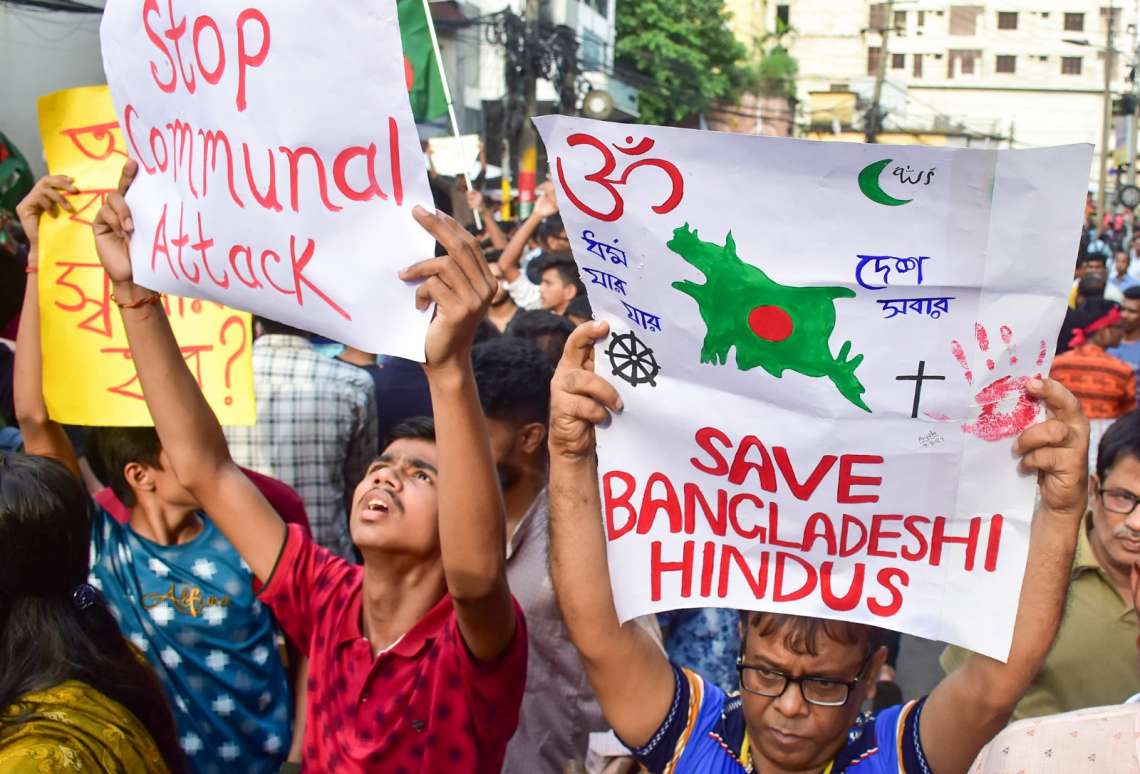
Between December 2, 2025, and January 8, 2026, at least 13 members of Bangladesh’s Hindu minority were killed in a series of violent incidents spanning multiple districts. The deaths, documented through reports from Indian and Bangladeshi media, reveal a disturbing pattern of targeted brutality, mob violence, and unresolved investigations.
This surge in killings has unfolded against a backdrop of political instability following the ouster of Prime Minister Sheikh Hasina in August 2024 and the rise of a Muhammad Yunus–led interim administration.
The murders range from shootings and mob lynchings to throat-slittings and arson attacks. While authorities have repeatedly dismissed the violence as “non-communal” or “isolated,” the chronology tells a more unsettling story.
The victims include traders, workers, a teenage driver, and even a decorated freedom fighter from Bangladesh’s 1971 Liberation War.
December 2: Two killings in one night
The first two deaths occurred on December 2. In Narsingdi district, 42-year-old gold trader Prantosh Kormokar was lured out of his home by masked men under the pretext of a business meeting.

He was taken to a nearby school playground and shot in the chest. He died shortly after being taken to the hospital. Police said the attackers and motive were unknown.
Hours earlier, in Faridpur district, 35-year-old fish trader Utpol Sarkar was intercepted while travelling to a market.
Assailants blindfolded and tied up his van driver before hacking Sarkar to death. His body was later found dumped in an open field. Police said robbery did not appear to be the motive, leaving the killing unexplained.
December 7: Freedom fighter and wife slain
On December 7, the bodies of Jogesh Chandra Roy, a 75-year-old 1971 Liberation War veteran, and his wife, Suborna Roy, were found in their Rangpur home with their throats slit.
Neighbours discovered the couple after repeated knocks went unanswered. Investigators estimated the murders occurred around 1 am.
The couple lived alone, though their two sons served as officers in different units of the Bangladesh Police. Despite the gravity of the crime, no suspects were immediately named, and no case had been formally filed by the following day.
December 12: Teenage driver murdered
On December 12, 18-year-old autorickshaw driver Shanto Chandra Das was found dead in a cornfield in Cumilla district.
His throat had been slit, and his vehicle was missing. Police linked the murder to robbery, but the brutality of the killing heightened fear among minority families in the area.
December 18: Lynching of Dipu Chandra Das
The murder of 27-year-old garment worker Dipu Chandra Das marked a turning point. In Bhaluka, Mymensingh, Das was forced to resign from his job by factory supervisors and then handed over to a mob.

He was beaten to death, his body hung from a highway overpass and set on fire. Although vague accusations of blasphemy were cited, investigators found no evidence. Subsequent probes suggested the attack was premeditated.
The killing drew international condemnation. India’s Ministry of External Affairs called the incident “a matter of grave concern,” citing continued hostilities against minorities in Bangladesh.
It was only after this public outrage that the Yunus administration appeared to take visible action.
December 24: Mob killing of Amrit Mandal
On December 24, 30-year-old Amrit Mandal was beaten to death in Rajbari district. Police described him as a local criminal accused of extortion.
Authorities insisted the killing stemmed from a dispute rather than communal motives. However, it occurred just days after the lynching of Dipu Das, further amplifying anxieties within the Hindu community.
December 29: Paramilitary officer shot
On December 29, Bajendra Biswas, a Hindu member of the Ansar Bahini auxiliary force, was shot by his colleague inside a garment factory in Mymensingh.
Eyewitnesses said the shooter jokingly asked if he should fire before pulling the trigger. Biswas later died at a health complex. Police termed it a possible “prank gone wrong,” a characterisation that raised questions about accountability and workplace safety.
January 3: Burned alive on New Year’s Eve
Khokon Chandra Das, a pharmacist from Shariatpur, died on January 3 from severe burn injuries sustained during a New Year’s Eve attack.
He was stabbed, doused with petrol and set on fire near Keurbhanga Bazar. Das jumped into a pond in a desperate attempt to extinguish the flames but suffered burns to 30 percent of his body, including his respiratory tract. He succumbed after three days in the hospital.
January 5: Two more deaths
On January 5, newspaper editor Rana Kanti Bairagi was shot dead in Jessore. Three men on a motorcycle lured him into an alley and opened fire at close range, also slitting his throat.

Hours later, Mani Chakraborty, a grocery vendor in Narsingdi, was attacked at his shop and later died from his injuries. Both cases remain under investigation, with motives unclear.
January 6: Death while fleeing
Hindu businessman Mithun Sarkar died in Bangladesh’s Naogaon district after jumping into a canal while allegedly being chased by a mob on suspicion of theft on January 6, according to media reports.
Sarkar, a resident of Bhandarpur village, was found dead after police recovered his body from the canal on Tuesday.
Authorities have not officially confirmed whether he was involved in any theft, raising questions about the circumstances that led to the fatal chase.
January 8: Youth ‘lured, beaten, poisoned to death’
Hindu youth Joy Mahapatro died on January 8 in Bangladesh’s Sunamganj district after allegedly being brutally beaten and poisoned by a local resident, according to his family.
He was rushed to Sylhet MAG Osmani Medical College Hospital, where he later succumbed to his injuries while receiving treatment in the intensive care unit.
Police said an investigation is underway and that further details will be released as inquiries progress.
Official denial and statistical reality
The Yunus-led interim administration has consistently rejected claims that these killings reflect communal violence, calling them exaggerated or coincidental. Yet data paints a darker picture.
A December 2025 report by Bangladeshi human rights NGO Ain o Salish Kendra recorded 197 mob killings in 2025 alone, contributing to a total of 293 mob-related deaths since 2024.
Human rights groups have raised alarms. On December 19, the Washington-based organisation Hindus for Human Rights urged Bangladesh’s interim government to establish a Ministry for Minority Affairs and ensure minority safety.
Eroding law and order
Beyond targeted killings, law and order appear to be deteriorating nationwide. A viral video from a Habiganj police station showed leaders of the Anti-Discrimination Student Movement confronting officers and demanding the release of a detained activist.
During the altercation, they openly bragged about setting a police station on fire in August 2024 and burning a Hindu police officer alive. The chilling admission was made without fear of consequences, underscoring the shrinking authority of law enforcement.
A nation at crossroads
As Bangladesh inches toward a crucial election, these killings cast a long shadow over the country’s democratic and social fabric. The repeated pattern of unresolved murders, official denial, and visible emboldenment of radical elements has intensified scrutiny of the interim administration’s governance.
The deaths of at least 13 Hindus in just 38 days are not isolated statistics. They represent a chilling chronology of violence that raises profound questions about minority safety, institutional accountability, and the future of secularism in Bangladesh.