Afghan returnees say sudden arrests and forced deportations left them unable to collect their belongings, while many now face housing and employment difficulties….reports Asian Lite News Desk
Afghan refugees returning from Pakistan have accused authorities of arresting, harassing and detaining them before forcibly deporting them through the Torkham border crossing. Several returnees said police raids and sudden arrests left them with little or no time to collect their belongings, forcing them to abandon homes, vehicles and businesses built over years of living in Pakistan.
The returnees shared accounts of their experiences after reaching Afghanistan, with some describing the deportations as distressing and humiliating. Their allegations were reported by Afghan broadcaster Amu TV.
Among them was 35-year-old Sediqullah, originally from Afghanistan’s Kunar province, who was born in Pakistan’s Punjab province and had spent more than 30 years there before being deported.
He said Pakistani police arrested him without warning and did not allow his family sufficient time to gather their possessions before they were sent back to Afghanistan.
“Everything was left behind. Our vehicles were left behind. We worked as drivers, and our businesses were left behind,” Amu TV quoted him as saying.
Another recent returnee, Mohammad Qasim, said he had lost access to his belongings, including tractors, during the deportation process. He also alleged that he was not given clear information about the procedures involved.
Qasim said Pakistani authorities demanded fees for stamps and documentation after he crossed the border into Afghanistan.
“They caused so much trouble for us. I swear, our belongings and tractors were left behind,” Amu TV quoted him as saying.
The returnees also raised concerns about the difficulties they face after arriving in Afghanistan, particularly the lack of housing and reliable sources of income. Some have appealed to the Taliban authorities and humanitarian organisations for assistance with resettlement and basic needs.
Abdul Malik, who returned to Afghanistan after spending seven years in Pakistan, said he and others arriving in the country had no homes to return to. He urged the Taliban authorities to create employment opportunities for people deported from Pakistan.

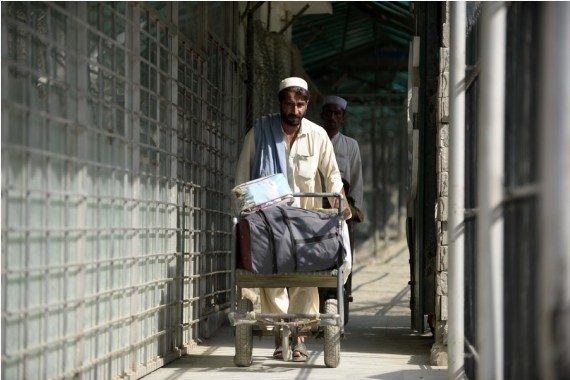
Caption : TORKHAM (PAKISTAN), March 20, 2017 (Xinhua) — People cross Pakistan-Afghanistan border in northwest Pakistan’s Torkham, on March 20, 2017. Pakistani Prime Minister Nawaz Sharif on Monday issued directives to immediately re-open the country’s border with Afghanistan after it was closed over a month ago. (Xinhua/Muhammad Hadi/IANS)
“We have returned deeply humiliated and distressed because of Pakistan,” Amu TV quoted him as saying.
The accounts come amid continued arrests and returns of Afghan nationals from different parts of Pakistan. According to local media reports, 796 Afghans were arrested by law enforcement agencies in Balochistan, Khyber Pakhtunkhwa, Punjab and Islamabad during the first week of November.
Afghan Citizen Card (ACC) holders and undocumented Afghans accounted for 99 per cent of those arrested and detained, while Proof of Registration (PoR) cardholders represented the remaining one per cent, according to the latest update jointly released by the United Nations High Commissioner for Refugees (UNHCR) and the International Organisation for Migration (IOM).
Balochistan recorded the highest number of arrests, followed by Khyber Pakhtunkhwa, Punjab and Islamabad, Pakistani newspaper Dawn reported.
The figures highlight the continuing pressure on Afghan nationals living in Pakistan, particularly those without recognised documentation. The arrests have taken place alongside a broader movement of Afghan nationals returning to their country, including people who have been deported and others who have returned through border crossings.
According to the UNHCR-IOM update cited by Dawn, a total of 2,758,958 people returned to Afghanistan between September 23, 2023 and November 7, 2026.
The number of returns fell by 16 per cent during the first week of November compared with the previous week of October, while deportations declined by 91 per cent over the same period, the report said.
A total of 4,662 people returned to Afghanistan during the first week of November. Of these, 809 were deported from Pakistan to Afghanistan.
Among those who returned from Pakistan between November 1 and 7, undocumented Afghans accounted for 78 per cent. Proof of Registration cardholders made up 12 per cent, while Afghan Citizen Cardholders represented 10 per cent.
The latest figures and testimonies point to the challenges facing Afghan returnees as they attempt to rebuild their lives after leaving Pakistan. For those who spent decades there, the sudden loss of homes, property and livelihoods has added to the difficulties of resettlement.
Returnees have called for assistance with shelter, employment and basic services, while humanitarian organisations face the challenge of supporting people arriving in Afghanistan with limited resources and uncertain living conditions.