Vast South Sinai rock shelter reveals 10,000 years of art, tools and pottery, tracing human life from prehistoric hunters to pharaonic and Roman eras…reports Asian Lite News
A vast rock shelter on a remote desert plateau in South Sinai has yielded what archaeologists are calling one of the most significant prehistoric art discoveries in the region, preserving an almost continuous record of human expression spanning nearly 10,000 years.
An Egyptian mission from the Supreme Council of Antiquities documented the site at the Umm Erak Plateau, around five kilometres northeast of the Temple of Serabit el-Khadim, a well-known ancient turquoise mining and religious centre dedicated to the goddess Hathor.
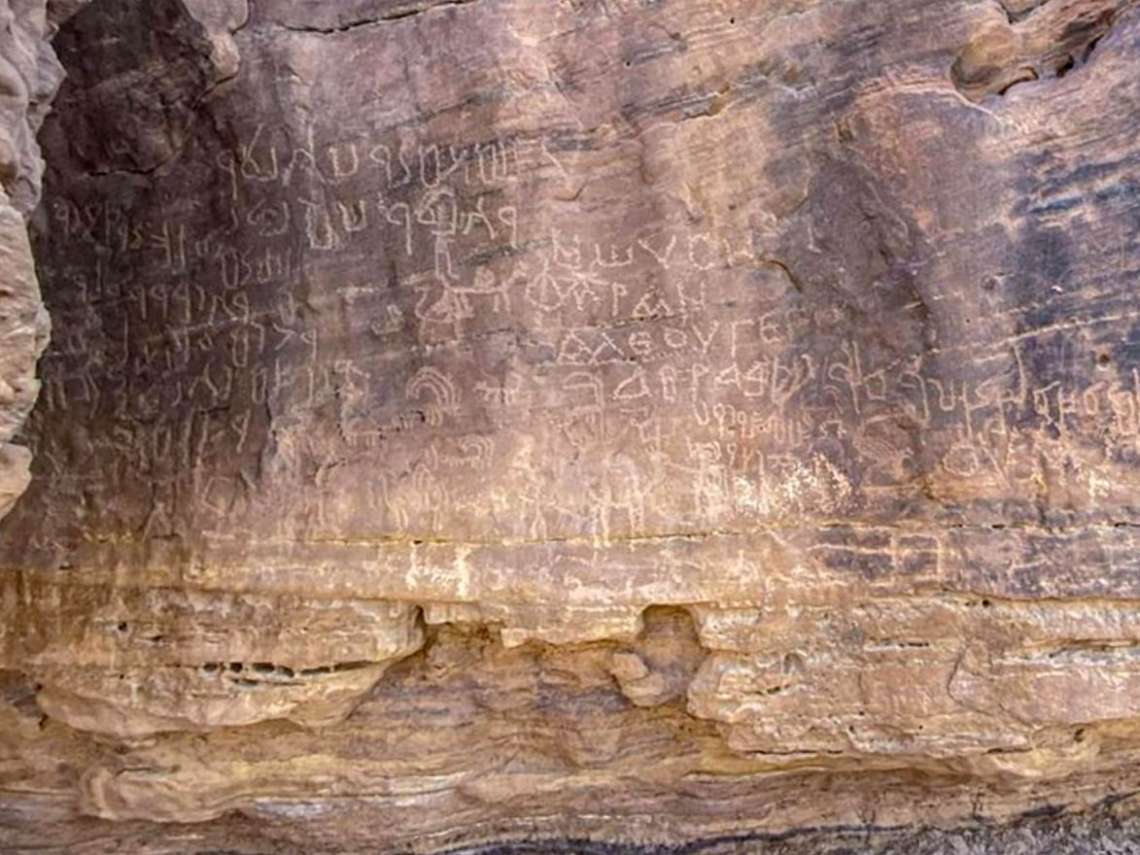
The newly recorded shelter, carved into sandstone and stretching more than 100 metres in length, contains layers of rock art believed to date from roughly 10,000 to 5,500 BCE. The earliest images, executed in red pigment, depict animals that once roamed the region, offering rare visual testimony to a dramatically different climatic and ecological landscape in prehistoric Sinai. During parts of the early Holocene, North Africa and the Sinai Peninsula were far wetter than today, supporting wildlife and human communities whose lives are now traced through these engravings and paintings.
Dr Hisham El-Leithy, Secretary-General of the Supreme Council of Antiquities, described the site as a “natural open-air museum” that captures the evolution of symbolic and artistic expression from prehistoric communities through to later historical and Islamic periods. The superimposed layers of drawings indicate repeated use of the shelter across millennia, suggesting that it may have held ritual, social or territorial significance.
Dr Hisham El-Leithy, Secretary-General of the Supreme Council of Antiquities, described the site as a “natural open-air museum” that captures the evolution of symbolic and artistic expression from prehistoric communities through to later historical and Islamic periods.
Beyond the rock art itself, the archaeological team recovered flint tools characteristic of early hunter-gatherer societies, along with pottery fragments dating to Egypt’s Middle Kingdom period and the Roman era. The presence of these materials indicates that the site remained active long after the prehistoric paintings were created, possibly serving as a waypoint or refuge linked to mining routes and desert trade networks centred on Serabit el-Khadim.
South Sinai has long been recognised as a crossroads between Africa and Asia, and discoveries such as Umm Erak reinforce its role in human prehistory and ancient commerce. Rock art sites across the wider region have provided evidence of early pastoralism, migration patterns and evolving belief systems, but the scale and continuity of this shelter set it apart.
Egypt’s Ministry of Tourism and Antiquities said the find represents a major addition to the country’s archaeological map and underscores the cultural depth of the Sinai Peninsula, an area often overshadowed by the monumental remains of the Nile Valley. Officials added that further documentation and conservation work will be undertaken to protect the fragile paintings from environmental degradation.
As researchers continue to analyse the imagery and associated artefacts, the Umm Erak shelter promises to shed new light on how early communities in Sinai understood their world — and how artistic expression endured across changing climates, cultures and empires.