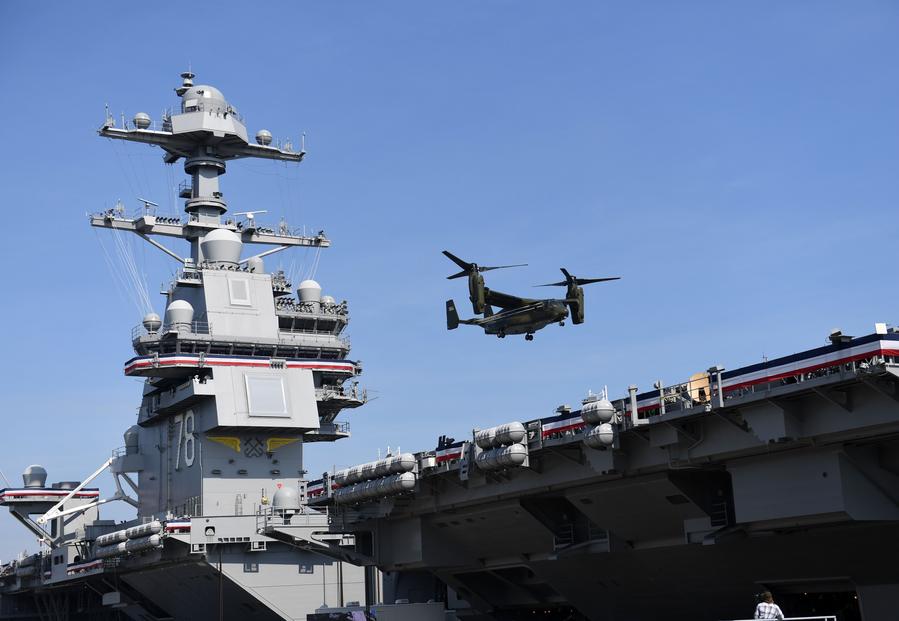
US deploys second carrier to Gulf as Trump presses Iran for nuclear deal, blending diplomacy and deterrence amid warnings of escalation and regional retaliation….reports Asian Lite News
The United States is reinforcing its military presence in West Asia as President Donald Trump intensifies pressure on Iran to reach a fresh agreement over its nuclear programme, even as indirect negotiations continue through regional channels.
According to a report by The New York Times, Washington is deploying a second aircraft carrier, the USS Gerald R. Ford, along with its escort ships, from the Caribbean towards West Asia. The carrier strike group is expected to join the USS Abraham Lincoln in the Persian Gulf, creating a rare dual-carrier presence in the region.
US officials, speaking anonymously, indicated that the Ford and its accompanying vessels are unlikely to return to their home ports until late April or early May, underscoring the seriousness of the current posture. The Lincoln carrier strike group, accompanied by three guided-missile destroyers, arrived in West Asia more than two weeks ago.
The Ford’s deployment has been unusually fluid. Originally scheduled for a European cruise after departing Norfolk, Virginia, on June 24, the carrier was redirected to the Caribbean as part of Washington’s pressure campaign against Venezuela before being reassigned again. Aircraft from the strike group reportedly participated in a January 3 operation targeting Caracas that resulted in the capture of Venezuelan President Nicolas Maduro. Its current mission marks a further extension of a deployment that sailors had expected to conclude earlier this year.
The stepped-up naval presence comes as Trump weighs military options alongside diplomacy in dealing with Tehran. Talks between Washington and Iran over the latter’s nuclear activities are ongoing, with Oman facilitating indirect contacts.
The current tensions follow the US military operation dubbed Operation Midnight Hammer, conducted on June 21–22, 2025. During that operation, US forces struck three major Iranian nuclear sites — Fordow, Natanz and Isfahan — in an effort to degrade enrichment capacity and compel renewed negotiations. Tehran condemned the strikes as violations of international law and the UN Charter.
Speaking after a meeting with Israeli Prime Minister Benjamin Netanyahu, Trump stressed the urgency of securing a deal. He warned that failure to reach an agreement could be “very traumatic” for Iran, adding that while he preferred a negotiated outcome, alternatives remained on the table.
“We have to make a deal,” Trump told reporters, describing his discussions with Netanyahu as productive. In a separate post on Truth Social, he encouraged continued negotiations but referenced previous US military action, saying it “did not work well for them,” in apparent reference to the earlier strikes.
Netanyahu, for his part, revealed that Trump had sought his assessment of the ongoing negotiations. The Israeli leader expressed scepticism about the nature of any prospective agreement and insisted that a comprehensive deal must go beyond the nuclear file. He argued that any arrangement should also address Iran’s ballistic missile programme and its support for proxy groups across the region.
In an interview with Al Jazeera, senior Iranian official Ali Larijani confirmed that indirect talks with Washington are underway in Oman but said no specific US proposal has yet been presented. Iranian state media, including Islamic Republic News Agency, quoted him as rejecting the idea of “zero enrichment”, maintaining that Iran requires uranium enrichment for civilian energy and medical purposes.
Larijani also warned that any US military attack would be met with retaliation against American bases in the region, raising the stakes as US naval assets converge near Iranian waters.
With two carrier strike groups now positioned within reach of Iran and diplomacy proceeding under the shadow of force, Washington appears to be pursuing a dual-track strategy: negotiate from strength while signalling readiness to escalate if talks falter.