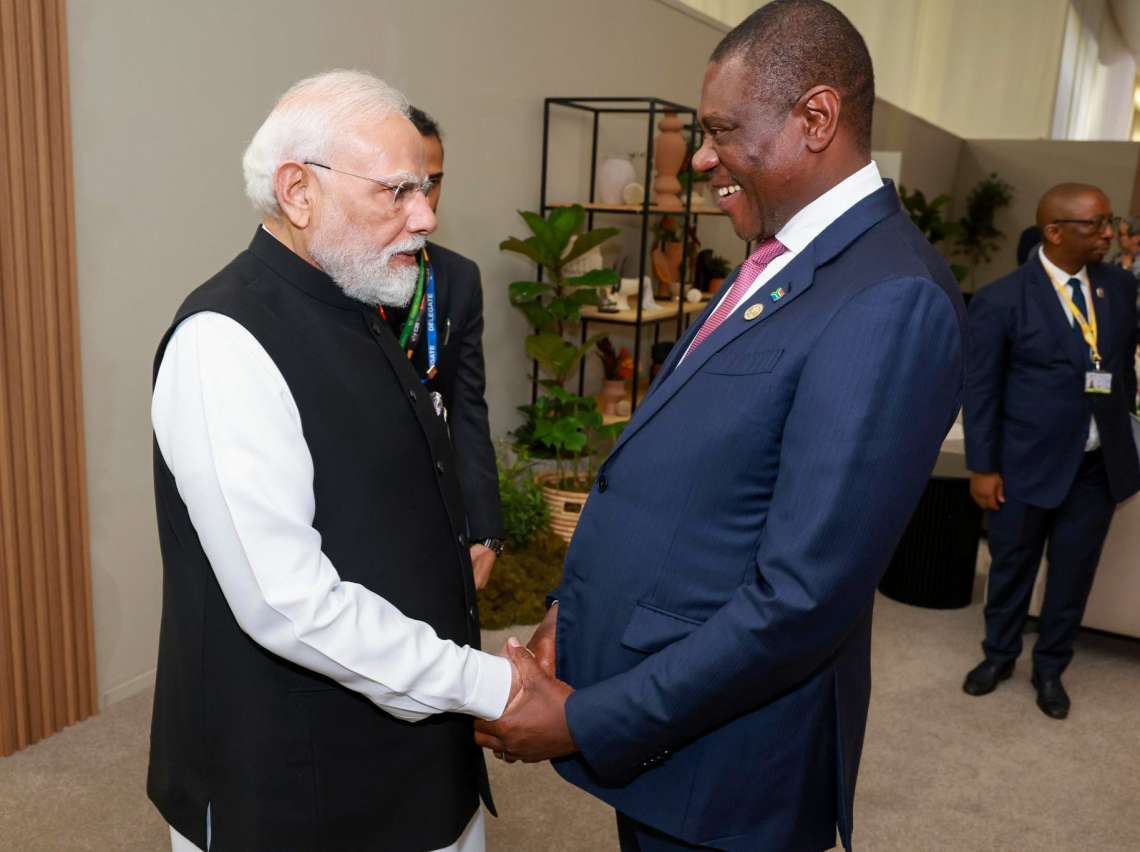
South African Deputy President’s visit underscores growing trade, investment and Global South cooperation….reports Africa Daily News Desk
India is increasingly positioning itself as a pivotal partner in shaping Africa’s economic future, strategic autonomy and global influence, according to a report released on Monday, highlighting the significance of South African Deputy President Paul Mashatile’s recent six-day visit to India.
The report, authored by Abebe Bikila, Senior Research Fellow at the Global Trade and Economic Council (GTEC) and published by India Narrative, said Mashatile’s visit underscored India’s growing importance as a destination where African nations are seeking to strengthen economic partnerships and advance the interests of the Global South.
During talks in New Delhi, leaders from both countries framed their discussions around advancing the priorities of the Global South, including reforming multilateral financial institutions and ensuring greater representation for developing nations in global governance.
The report noted that South Africa has consistently supported India’s efforts to secure full membership for the African Union in the G20, a move welcomed by South African President Cyril Ramaphosa during Prime Minister Narendra Modi’s visit last year.
Economic ties between India and Africa have expanded rapidly in recent years.
Bilateral trade between India and South Africa has reached between $15 billion and $18 billion, making South Africa India’s largest trading partner in Africa. Overall India-Africa trade crossed $100 billion in 2024-25, almost doubling from $56 billion five years earlier. India has also emerged as one of the top five investors on the African continent.
According to the report, Mashatile’s engagements with Indian business leaders, industry associations and companies—including meetings with technology and pharmaceutical firms in Hyderabad and a keynote address at the Global Trade and Technology Council of India—went beyond promoting bilateral commerce.
Instead, the visit sought to position South Africa as India’s preferred gateway into the African market through the African Continental Free Trade Area (AfCFTA), a role Pretoria has been actively promoting.
The report also highlighted growing cooperation in critical minerals, an area of increasing strategic importance for both countries.
The India-South Africa Critical Minerals Symposium, held in March 2026 at the University of Pretoria’s Future Africa campus, brought together policymakers, scientists and industry leaders to explore collaboration in minerals such as manganese, chromium, rare earth elements and platinum group metals—resources that are essential for electric vehicles, batteries and renewable energy technologies.
During Mashatile’s visit, both sides reiterated their commitment to expanding cooperation in mining, particularly in critical minerals, while continuing collaboration in traditional sectors such as coal and gold.
The report said India views South Africa not only as a reliable supplier of critical minerals but also as a potential partner in mineral processing and value addition. The two governments are exploring joint ventures, technology sharing and greater cooperation in mining and beneficiation.
Bikila argued that the timing of Mashatile’s visit reflected broader shifts in the global economy.
With geopolitical conflicts disrupting supply chains, changing tariff regimes reshaping manufacturing and countries seeking to reduce dependence on any single economic bloc, South-South cooperation has become increasingly attractive.
The report concluded that India’s expanding trade, investment and strategic engagement with Africa demonstrate New Delhi’s ambition to become one of the continent’s principal long-term economic partners while strengthening the collective voice of developing nations in an evolving global order.