The Summit seeks to widen access to core AI resources, ensuring inclusive innovation across the globe, while harnessing artificial intelligence to drive economic growth and social good…reports Asian Lite News
The India AI Impact Summit being held at the Bharat Mandapam from February 16-20 puts India front and centre as a key player in Artificial Intelligence. It showcases India’s role in global AI governance and demonstrates how India is prioritizing on deployment of AI and its measurable impact on citizens. The summit brings together global leaders, policymakers, technology companies, innovators, and experts to showcase and deliberate on the transformative potential of AI for inclusive growth, governance, and sustainable development.
The AI Summit’s deliberations are being organised through structured “Chakras”, each centred on interconnected thematic priorities.
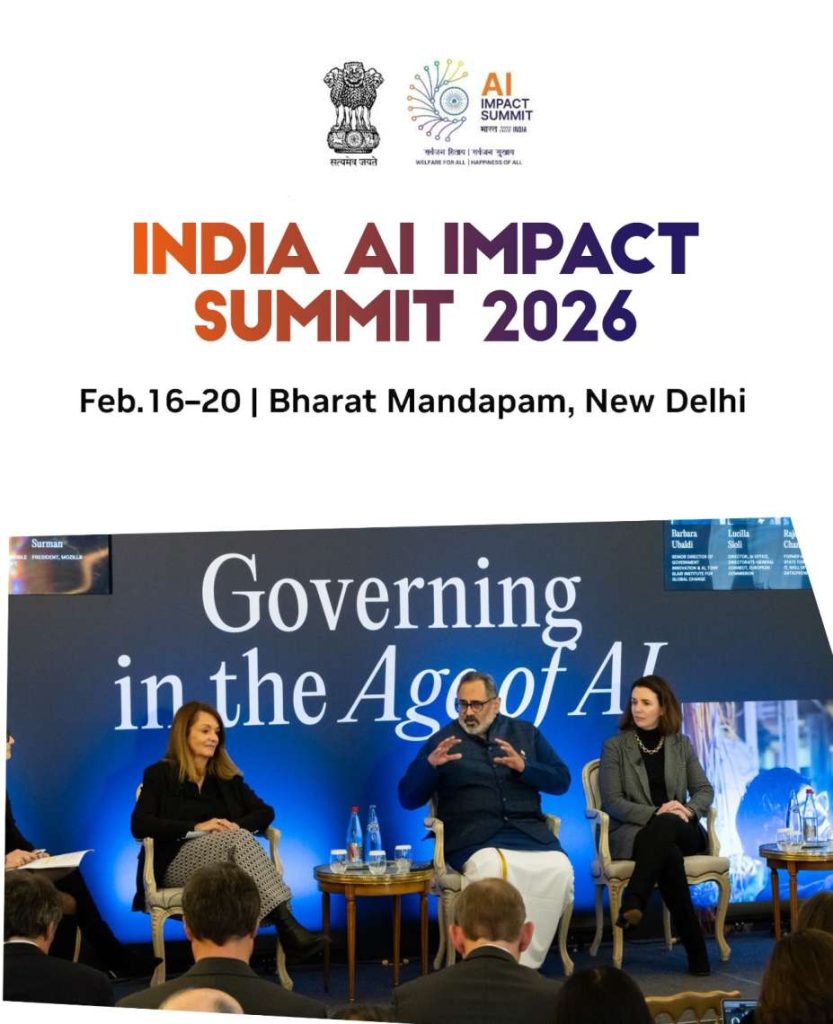
These include advancing human capital by promoting equitable skilling and supporting inclusive workforce transitions for an AI-enabled future of work; fostering inclusion for social empowerment by designing AI systems that represent and uplift diverse communities; and ensuring safe and trusted AI through transparency, accountability and shared global safeguards.
The discussions also focus on harnessing AI to accelerate frontier science and strengthen international scientific collaboration, while driving resilience, innovation and efficiency through sustainable and resource-conscious AI systems that support climate goals.
In addition, the Summit aims to democratise access to foundational AI resources to enable inclusive innovation worldwide, and to leverage AI for economic development and social good by enhancing productivity, competitiveness and broad-based societal progress.
Artificial Intelligence (AI) has become a central pillar of India’s development journey. It is strengthening governance, improving public service delivery, and enabling solutions that can reach citizens at scale.
India is one of the fastest-growing Artificial Intelligence (AI) markets worldwide, projected to exceed USD 17 billion by 2027 according to a Boston Consulting Group report. It is backed by government support, around 800 million internet users, a strong STEM Education policy and scalable public digital infrastructure.
AI creates value only when it reaches people at scale. India’s approach focuses on practical deployment across sectors so that AI improves everyday life and public services. Just as the internet and mobile phones transformed society through widespread use, AI is now following the same path. By prioritising applications that are easy to use and widely accessible, India is ensuring that AI delivers inclusive and measurable public impact. In agriculture, AI supports farmers by predicting weather, identifying pest risks, and guiding irrigation and sowing decisions.
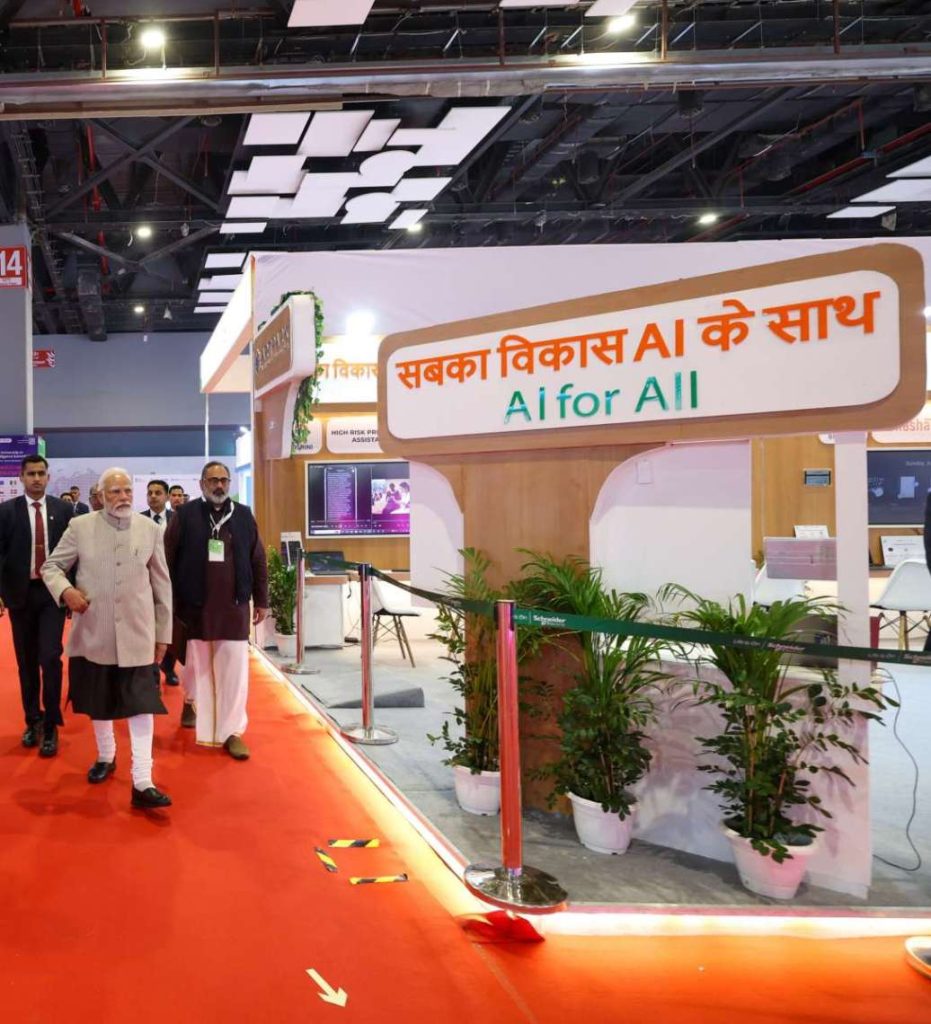
AI has become a top priority on policy agendas worldwide, as it has the power to foster innovation, generate employment opportunities, and contribute to the growth of the country. Over the past several years, the Government of India has taken concrete steps to encourage the adoption of AI in a responsible manner and build public trust in its use, placing the idea of ‘AI for All’ at its very core. Favourable policies and continuous interventions strive to harness the potential of AI for social development and inclusive growth.
At the AI Action Summit in Paris in 2025, PM Modi underlined the need to democratise technology.
“AI can help transform millions of lives by improving health, education, agriculture and so much more. It can help create a world in which the journey to Sustainable Development Goals becomes easier and faster. To do this, we must pool together resources and talent. We must develop open-source systems that enhance trust and transparency. We must build quality data sets, free from biases. We must democratise technology and create people-centric applications,” the Prime Minister had said.
“We are at the dawn of the AI age that will shape the course of humanity. Some people worry about machines becoming superior in intelligence to humans. But, no one holds the key to our collective future and shared destiny other than us humans,” he had further stated.
India today leads the world in digital public infrastructure from identity systems to payment platforms. Its transformative experience has shown how institutional capacity in democratising technology can lead to soceital wins. India’s approach to the democratisation of AI shows that scale, inclusion, and innovation can progress together. A focus on affordability and openness ensures that benefits of AI reach all citizens from farmers to students, startups, and public institutions.
In March 2024, the Government of India launched IndiaAI mission with outlay of Rs 10,372 Cr for development of the overall AI ecosystem in the country. The IndiaAI Innovation Centre aims to develop India’s own large multimodal models trained on Indian datasets and languages to ensure sovereign capability and global competitiveness in generative AI. Twelve organisations and consortia, including startups, industry players and academic institutions have been selected for developing Large and Small Language Models based on Indian datasets.
The resulting AI models will contribute to the open-source ecosystem and be available for use by Government organizations and support innovation across India’s startup and research community.
From code to creativity, Artificial Intelligence (AI) is rewriting the rules of growth, powering industries, transforming jobs, and propelling India into the future. AI is becoming a kinetic enabler for the growth of India’s digital economy, investments, and jobs. According to a NASSCOM report published in August 2024, AI talent in India is expected to grow from 600,000-650,000 professionals to more than 1.25 million by 2027, at a compound annual growth rate (CAGR) of 15 per cent.
India’s global AI readiness is backed by a unique combination of a young, digitally skilled population, robust digital public infrastructure, and a fast-growing startup ecosystem. These foundational strengths provide India with a durable strategic edge in developing, deploying, and governing AI at scale. India is in the first group of AI-ready nations, with systematic progress across all five layers of the AI architecture applications, models, chips, infrastructure, and energy.
India is at the forefront of an AI-led transformation, where technology is driving productivity, innovation, and job creation. With robust digital infrastructure, a young workforce, and progressive policies, the nation is well-positioned to leverage AI for inclusive growth. This integrated approach of government ensures that AI enhances employability and bridges skill gaps across sectors.