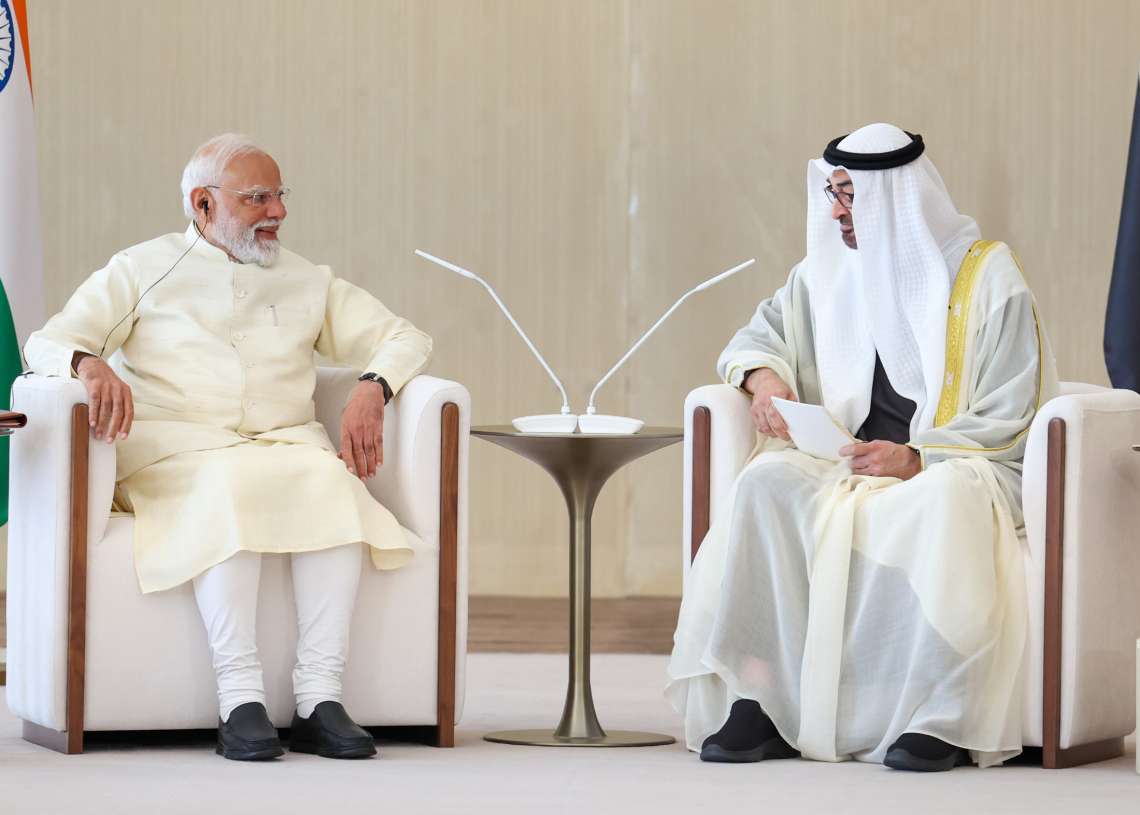
Modi’s UAE visit signals deeper economic integration, strategic energy alignment and emerging tech collaboration, underscoring a maturing partnership shaped by shared interests and leadership-level trust, reports Asian Lite Newsdesk
Prime Minister Narendra Modi’s brief visit to the United Arab Emirates may have lasted only a few hours, but the scale and structure of the outcomes point to a deeper strategic recalibration in India–UAE ties, moving well beyond symbolic diplomacy into long-term economic alignment.
At the centre of the visit is the headline $5 billion investment commitment, confirmed by India’s ambassador Deepak Mittal. While headline figures often dominate diplomatic messaging, the composition of this investment is more telling than the total itself. A $3 billion entry by Emirates NBD into India’s banking sector is particularly significant. Unlike infrastructure or portfolio flows, this signals deeper institutional integration, suggesting that Gulf capital is increasingly willing to embed itself within India’s financial architecture rather than operate on its margins.
The additional $1 billion commitment from the Abu Dhabi Investment Authority, routed through India’s infrastructure pipeline, reinforces a pattern that has been building over the past decade: the UAE positioning itself as a long-term stakeholder in India’s growth story. The parallel $1 billion investment by International Holding Company adds a private-sector dimension, indicating that this is not just state-driven engagement but a broader alignment of capital interests.
Energy cooperation remains the strategic backbone of the relationship, but here too the contours are shifting. The agreement to expand the UAE’s role in India’s strategic petroleum reserves—from around 5.5 million barrels to potentially 30 million—marks a move towards deeper interdependence. More notably, the discussions on extending cooperation to gas, LNG and LPG storage signal a diversification of the energy partnership. In effect, both sides are seeking to hedge against future volatility by building shared infrastructure and long-term supply arrangements.
The technology component of the visit, particularly the proposed eight-exaflop supercomputing facility, is another indicator of evolving priorities. If realised, it would place India among a select group of countries with high-performance computing capabilities at scale. More importantly, it reflects a convergence between India’s ambition to build domestic AI capacity and the UAE’s push to position itself as a global technology investor. This is not a conventional bilateral technology transfer; it is a co-development model, underpinned by shared strategic goals.
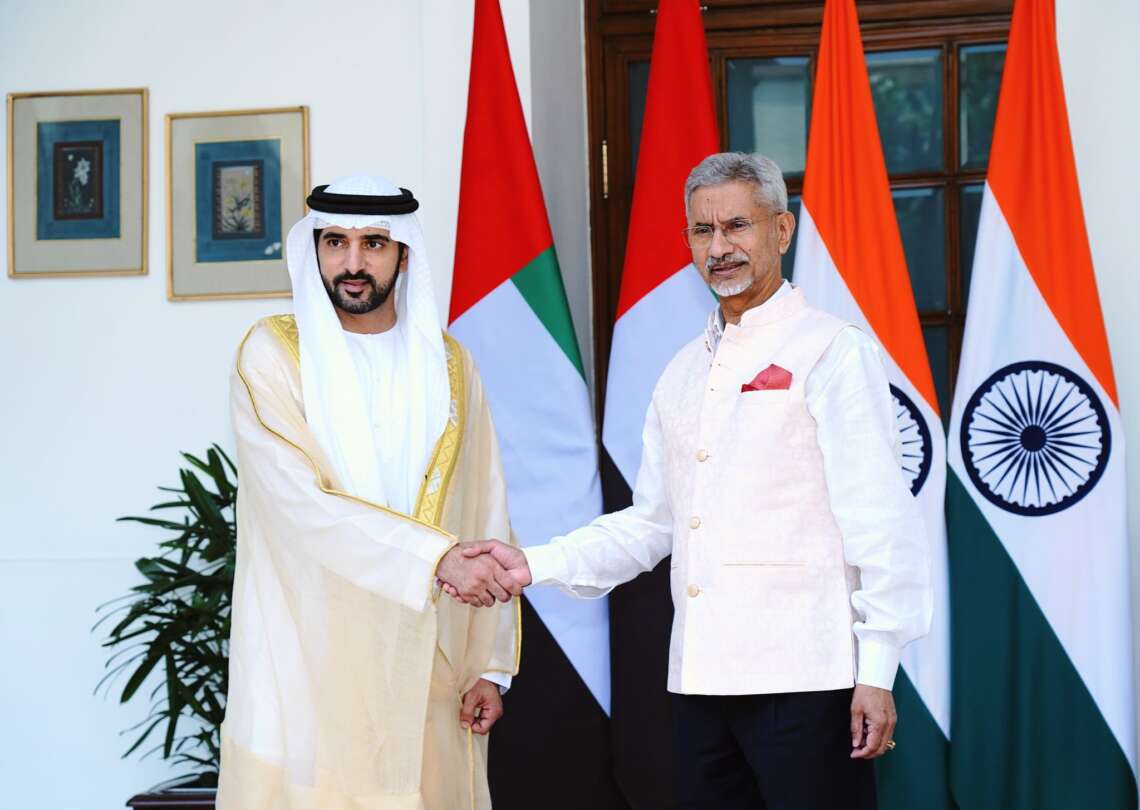
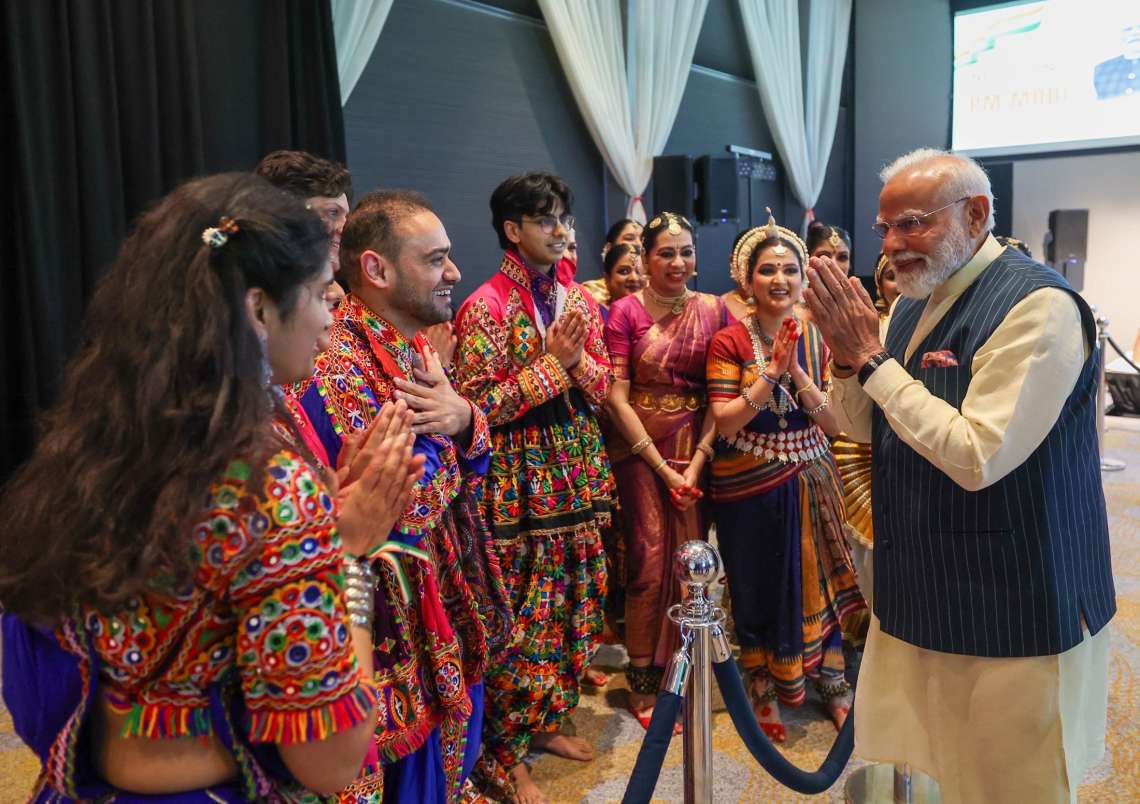
Yet, perhaps the most consequential aspect of the visit lies in the political signalling. The highly personalised reception by UAE President Mohamed bin Zayed Al Nahyan—from airport honours to the fighter jet escort—underscores the extent to which the relationship has been elevated beyond transactional diplomacy. Over the past decade, Modi and Sheikh Mohamed have cultivated a rapport that has translated into faster decision-making and a willingness to pursue ambitious joint projects.
This personal chemistry, however, also serves a broader geopolitical function. At a time of shifting global alignments, both India and the UAE are pursuing multi-vector foreign policies—maintaining ties with the West, engaging with emerging powers, and safeguarding regional stability. Their partnership reflects a shared preference for strategic autonomy, where cooperation is driven by mutual interests rather than bloc politics.