The abeyance is arguably the most measured lever available to New Delhi short of kinetic force, and the least costly to the international order it is accused of destabilising, writes Dr Rakesh Sharma
A year on from the Pahalgam massacre, Western chanceries remain uneasy about one Indian decision above all others. Not the limited air campaign conducted under Operation Sindoor, which fit recognisable patterns of cross-border retaliation. Not the expulsion of Pakistani diplomats. The source of discomfort is the cabinet decision taken on 23 April 2025 to hold the Indus Waters Treaty in abeyance until Islamabad credibly and irrevocably abandons its sponsorship of cross-border terrorism.
For sixty-five years, the 1960 treaty had been the one instrument neither side touched, and its suspended animation is now routinely cited in Western commentary as evidence of Indian overreach. That reading deserves closer scrutiny. Judged against the three criteria Western policy establishments themselves invoke most often, proportionality, legal defensibility and climate realism, the abeyance is arguably the most measured lever available to New Delhi short of kinetic force, and the least costly to the international order it is accused of destabilising.
The Pakistani state has, over four decades, used non-state violence as a substitute for conventional capability against India. The Congressional Research Service’s March 2026 update to its In Focus brief catalogues at least fifteen terrorist outfits operating from Pakistani soil, twelve of them United States-designated Foreign Terrorist Organisations. The Resistance Front, which claimed the Baisaran meadow killings twice on Telegram before its handlers recognised the diplomatic cost, is the most recent addition, listed by the State Department on 17 July 2025 as a Lashkar-e-Taiba front and proxy. The transnational reach is no longer theoretical.
A Pakistani national, Muhammad Shahzeb Khan, pleaded guilty on 8 April 2026 to an ISIS-inspired plot against a Brooklyn Jewish centre. Another, Asif Merchant, was convicted in the Eastern District of New York on 6 March 2026 of an IRGC-directed assassination plot against US political figures. On 2 August 2025 the Gyeonggi Nambu Provincial Police Agency in Seoul detained a Pakistani LeT member working as a market clerk in Itaewon, the first such arrest on Korean soil. Against this record, the suite of coercive instruments the international community has historically endorsed, FATF grey-listing, bilateral sanctions, UN 1267 designations, has produced asymptotic improvements at best. The abeyance imposes a genuine material cost on the one actor, the Pakistan Army, with the capacity to roll up the proxies it has cultivated.
The legal objection, amplified by Islamabad through the Court of Arbitration’s Supplemental Award of 27 June 2025, is that the treaty contains no provision for unilateral abeyance and therefore India’s declaration is of no legal effect. This argument is narrower than it appears. Article IX of the treaty establishes a graduated dispute-resolution architecture: first, the Permanent Indus Commission; then, a Neutral Expert for technical questions; and finally, a Court of Arbitration for matters of legal interpretation, with the last two forums explicitly designed not to run in parallel. In August 2016, Pakistan bypassed the Commission and requested arbitration directly on the Kishanganga and Ratle projects. India, correctly invoking Article IX’s sequencing, sought a Neutral Expert. The World Bank, after a six-year pause, appointed both mechanisms simultaneously in 2022, a decision India has consistently described as itself a breach of the treaty’s object and purpose.

The Neutral Expert in January 2025 affirmed his own competence over the same points, making the Court’s parallel assertion of jurisdiction the duplicative exercise the treaty was designed to prevent. Western international lawyers comfortable with Articles 60 and 62 of the Vienna Convention on the Law of Treaties, on material breach and fundamental change of circumstances, should recognise that India has endured 40 years of terrorist violence sponsored from the Pakistani territory. Pakistan’s breach is not of the treaty’s water-sharing clauses. It is of the customary law obligation, articulated by the International Court of Justice in the Corfu Channel and Nicaragua jurisprudence, not to allow one’s territory to be used for acts contrary to the rights of other states.
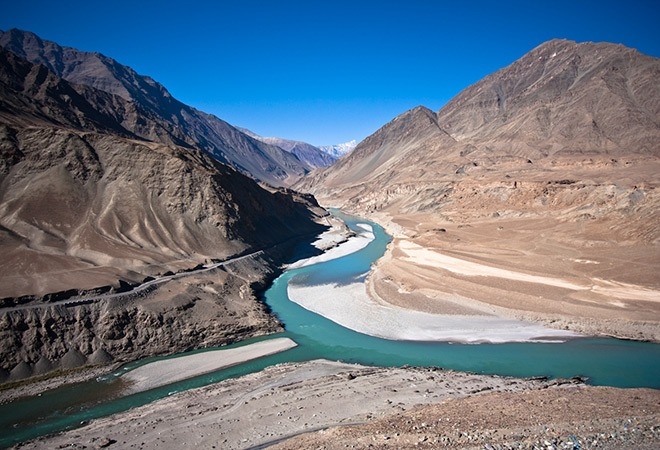
The climate objection to abeyance is often presented as a clincher against India. It is, in fact, the reverse. The 1960 treaty was negotiated in a hydrological regime that no longer exists. Roughly 60 to 70 percent of the Indus summer flow originates in the Himalayan and Karakoram snow and ice. The International Centre for Integrated Mountain Development reports that Hindu Kush-Himalayan glaciers lost mass 65 percent faster in the 2011 to 2020 decade than the preceding one, and up to two-thirds of glacier volume could disappear by 2100 at current emissions. Peak flows are shifting earlier in the year, snowfall is yielding to rainfall, and the International Water Management Institute projects a 20 percent decline in basin water availability by 2050.
The treaty contains no climatic review clause, no adaptive management mechanism, and no real-time data-sharing protocol capable of tracking mass balance. Comparable regimes have evolved. The Rhine framework incorporates adaptive management. The Mekong Agreement embeds periodic review. The Indus alone remains anchored to mid-twentieth-century assumptions. India notified Pakistan in January 2023 and again in 2024, seeking a modification under Article XII (3). Islamabad declined to engage on the substance each time. A state that refuses bilateral modification for two years cannot credibly cast itself as the defender of the treaty’s adaptive integrity in year three.

The final consideration is nuclear stability, and here Western attention has been misallocated. The escalatory rhetoric since Pahalgam has come overwhelmingly from one capital. Former Foreign Minister Bilawal Bhutto Zardari threatened war twice in 2025 if the treaty was not restored. On 10 August 2025, Chief of Army Staff Field Marshal Asim Munir told a diaspora gathering in Tampa that Pakistan would destroy any future Indian dam with “ten missiles” and was prepared to take half the world down with its nuclear weapons. That is not deterrent signalling of the kind Western strategists recognise. It is the open conflation of treaty grievance, conventional asymmetry and nuclear threat, delivered on American soil by a serving army chief. Prime Minister Modi’s response from the Red Fort on 15 August 2025, that nuclear blackmail would no longer be tolerated and that blood and water cannot flow together, restored the correct threshold of Indian deterrent communication. The Western non-proliferation concern, if genuine, belongs at Rawalpindi, not in pressuring New Delhi.