Politicians and economists in Dhaka demand review of agreement criticised for placing heavy obligations on Bangladesh…reports Asian Lite News
A trade agreement signed between Bangladesh and the United States under the administration of former US President Donald Trump is facing growing criticism in Dhaka, with political leaders, economists and sections of the media describing the deal as heavily tilted in favour of Washington.
According to reports in leading Bangladeshi daily Prothom Alo, critics argue that the Agreement on Reciprocal Trade (ART) imposes extensive obligations on Bangladesh while offering relatively limited commitments from the United States.
The newspaper claimed the language and structure of the agreement reflected a significant imbalance between the two sides.

“The trade agreement with the United States imposes obligations on Bangladesh in a one sided manner. In comparison, the United States does not have to do much,” the report stated.
The criticism has focused particularly on the wording used throughout the 32 page agreement. According to the newspaper’s analysis, the term “shall”, which denotes mandatory obligations, appears 179 times in the document, while the more discretionary term “will” appears only three times.
The report further noted that the phrase “Bangladesh shall” appears 131 times, whereas “US shall” appears only six times, reinforcing concerns among critics that the agreement disproportionately binds Bangladesh to strict obligations.
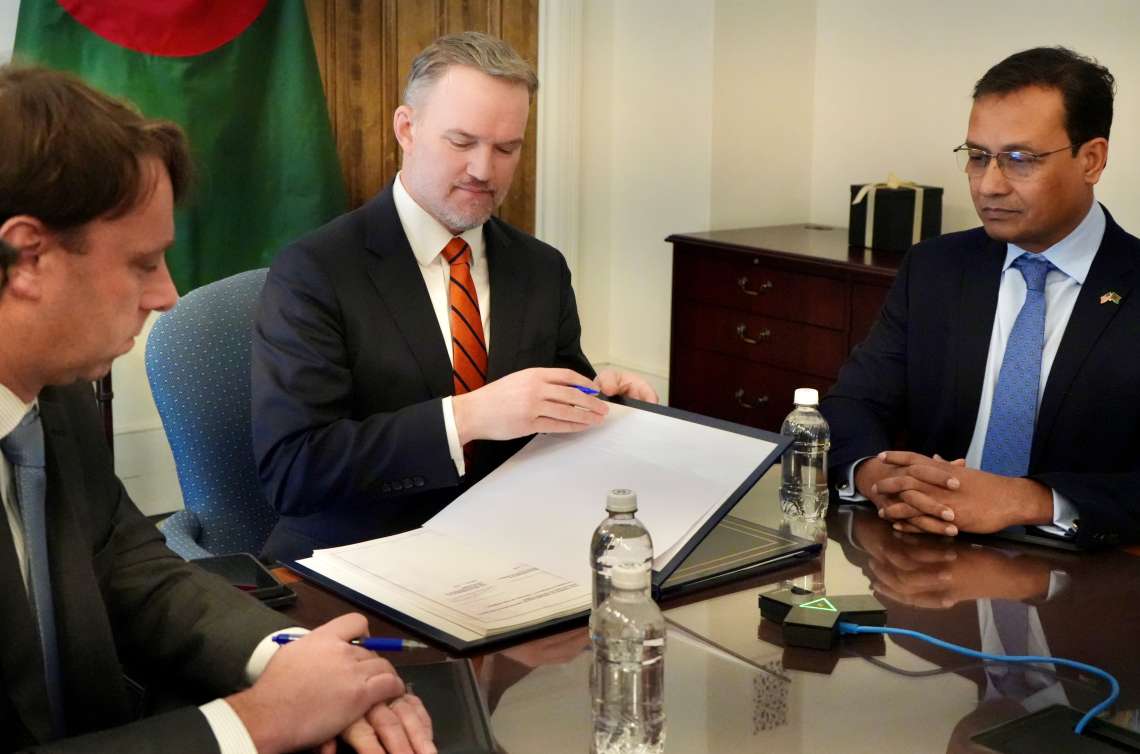
The trade agreement was signed on February 9, just days before Bangladesh’s national parliamentary elections. Soon afterwards, the US Supreme Court annulled the imposition of reciprocal tariffs, further fuelling debate over the agreement’s relevance and long term implications.
Opposition leaders and economists in Bangladesh have increasingly questioned the terms of the deal and called for its reassessment.
Member of Parliament Rumeen Farhana has publicly demanded the cancellation of the agreement while speaking in parliament. Several political parties and civic organisations have also urged the government to scrap the deal altogether.

Economists quoted in the report suggested that Dhaka should reopen discussions with Washington in an effort to negotiate more balanced terms.
Although the agreement has not yet formally come into force, Bangladesh has already started signing import agreements for several American goods under its framework, prompting additional scrutiny from critics.
The report stated that the agreement consists of six core articles, while detailed implementation measures are laid out in annexes that form an integral part of the overall pact.
One of the key sections focuses on tariffs and quotas. Under the provisions, Bangladesh would be required to maintain fixed tariffs on American products and avoid imposing quotas on US imports, while the United States would apply specified tariff rates to Bangladeshi exports.
Another major area of concern relates to non tariff barriers. The agreement reportedly restricts Bangladesh from introducing regulations such as import licensing requirements, inspections, permits, documentation procedures or quality checks that could impede trade beyond tariff related measures.
According to the report, Bangladesh would not be permitted to require import licences for US goods if those products already comply with American or internationally recognised standards.
Additionally, if certification is issued by recognised government or international laboratories, Bangladesh would be unable to impose further conditions or testing requirements.
The agreement also includes provisions aimed at granting preferential market access for American agricultural products in Bangladesh.
However, the report noted that any restrictions introduced for health or safety reasons would need to be scientifically justified and risk based rather than designed to limit trade.
Critics have also expressed concern over provisions related to Geographical Indication protections, arguing that Bangladesh could face limitations in adopting standards that place US products at a competitive disadvantage compared to goods from other countries.
The controversy surrounding the agreement has intensified broader debates within Bangladesh over trade sovereignty, market access and the balance between attracting international economic partnerships and protecting domestic policy flexibility.