External Affairs Minister S Jaishankar urges India and Bulgaria to modernise longstanding ties into forward-looking strategic partnership across diplomacy, trade and global cooperation priorities…report Asian Lite News Desk
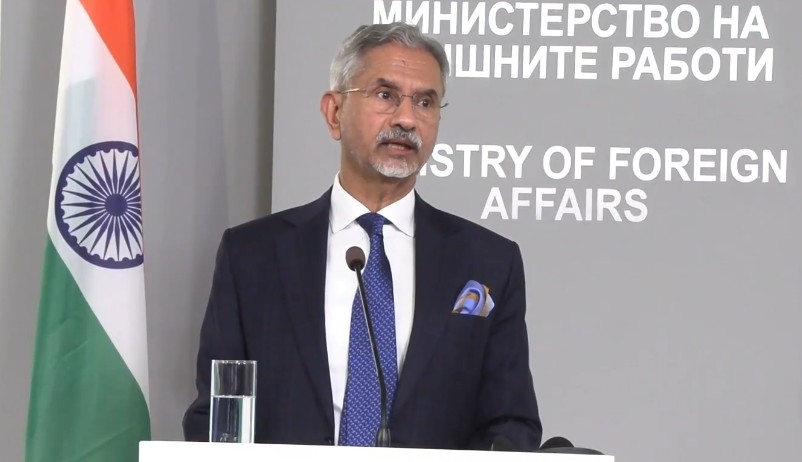
India’s External Affairs Minister S Jaishankar has called for a “refashioning” of India-Bulgaria relations into a modern, forward-looking partnership, stressing that both countries share similar political outlooks and global priorities during high-level talks in Sofia.
Addressing a press conference after meeting Bulgaria’s Foreign Minister Velislava Petrova, Jaishankar said the discussions covered three key areas of cooperation: bilateral relations, India’s engagement with the European Union, and wider global challenges.
“Our discussions today had three dimensions. First, the bilateral cooperation between India and Bulgaria. Second, the partnership between India and the European Union. And third, what our two countries can do together for the world… That is largely what I came here to discuss.”
He underlined that relations between New Delhi and Sofia, while historically strong, needed to evolve in step with changing global realities.
“Where India-Bulgaria ties are concerned, these are longstanding and very comfortable. Our task is to refashion that into a contemporary and forward-looking relationship. Politically, as our talks confirmed, we share many similar approaches and outlooks,” he added.
During his visit, Jaishankar also called on Bulgaria’s Prime Minister Rumen Radev and conveyed the personal greetings of Prime Minister Narendra Modi, reinforcing India’s continued political engagement with the Balkan nation.
A significant portion of the discussions focused on India-European Union relations, with Jaishankar highlighting recent agreements including a free trade agreement, a security and defence partnership, and a mobility framework finalised in January this year. He said these initiatives had the potential to deepen cooperation significantly across multiple sectors.
He also pointed to the wider global backdrop, describing an era of heightened instability and uncertainty in international affairs.
“We all recognise the world is passing through an exceptionally volatile and uncertain phase. This includes multiple major conflicts, concerns about economic security, recent experience of a pandemic, and the recurring threat of terrorism. India has a clear position in respect of all of that. We believe that this is not an era of war”
He stressed that diplomacy and dialogue remained the only viable path to resolving international disputes, while calling for greater resilience in global supply chains and the protection of maritime trade routes.
“The only solution to conflicts is dialogue and diplomacy. Where economic risks are concerned, the answer is in supply chain resilience and in further diversification. It is particularly important that maritime trade is neither impeded nor endangered,” he noted.
Jaishankar also reiterated India’s emphasis on the concerns of the Global South, particularly around energy, food and fertiliser security, and highlighted lessons from the Covid-19 pandemic on the need for stronger international cooperation.
“On behalf of the Global South, India has also repeatedly underlined concerns of energy, food, and fertiliser security. On health security, the COVID period demonstrated the need for deeper international cooperation and showed it in India and Bulgaria as well,” he stated.
Terrorism also featured prominently in his remarks, with the minister calling for a unified global stance of zero tolerance.
“As for terrorism, the world must be clear on zero tolerance. On all these issues, there was a meeting of the minds between India and Bulgaria,” he noted.
Jaishankar concluded that the convergence of views between the two countries provided a strong foundation for deeper engagement in the years ahead, particularly as India seeks to expand its strategic and diplomatic footprint across Europe.