From visas and vocational training to trade and trust, Germany and India place people at the heart of a fast-evolving strategic and economic partnership….reports Asian Lite News
Federal Chancellor of Germany Friedrich Merz has underscored the growing importance of people-to-people ties between India and Germany, describing them as a mutually beneficial opportunity that strengthens both economies and deepens strategic trust. Speaking during his first official visit to India, Merz highlighted the scale of educational, linguistic and professional exchanges, pointing to India as a central partner in Germany’s global engagement.
Merz noted that nearly 250,000 people in India are currently learning German, a figure that reflects not only academic interest but also the expanding pathways for work, study and cultural exchange between the two countries. He said India has emerged as the single largest source of German visas worldwide, with Bengaluru alone accounting for an exceptional volume of applications. According to the Chancellor, language learning, labour mobility and academic exchange are binding societies together in a way that delivers tangible economic gains and serves the long-term interests of both nations.
The emphasis on mobility comes at a time when Germany is grappling with an acute shortage of workers, particularly in blue-collar and skilled technical roles. With demographic pressures intensifying and industries facing gaps in manufacturing, healthcare, construction and services, Berlin has increasingly looked to international partnerships to address workforce challenges. India, with its large and youthful population, has been identified as a key partner in this effort.
The Ministry of External Affairs has said that India places high priority on facilitating the movement of students, apprentices and workers seeking employment opportunities in Germany. Cooperation is expanding in areas such as dual vocational training, where Indian students are trained in line with German standards to ensure faster integration into the labour market. The broader objective, according to officials, is to promote fair and structured migration for employment while safeguarding skills recognition and worker rights.
Bilateral cooperation on mobility and skills has widened across multiple levels, involving central governments, state agencies and private-sector enablers. This multi-layered approach has helped streamline training pathways, language preparation and placement mechanisms, making Germany a more accessible destination for Indian talent while offering German companies a reliable skills pipeline.
Chancellor Merz’s two-day visit to India was marked by a series of high-level engagements aimed at reinforcing the strategic partnership between the two countries. The visit coincided with the celebration of 75 years of diplomatic relations and 25 years of the India–Germany Strategic Partnership, lending added symbolic weight to the discussions.
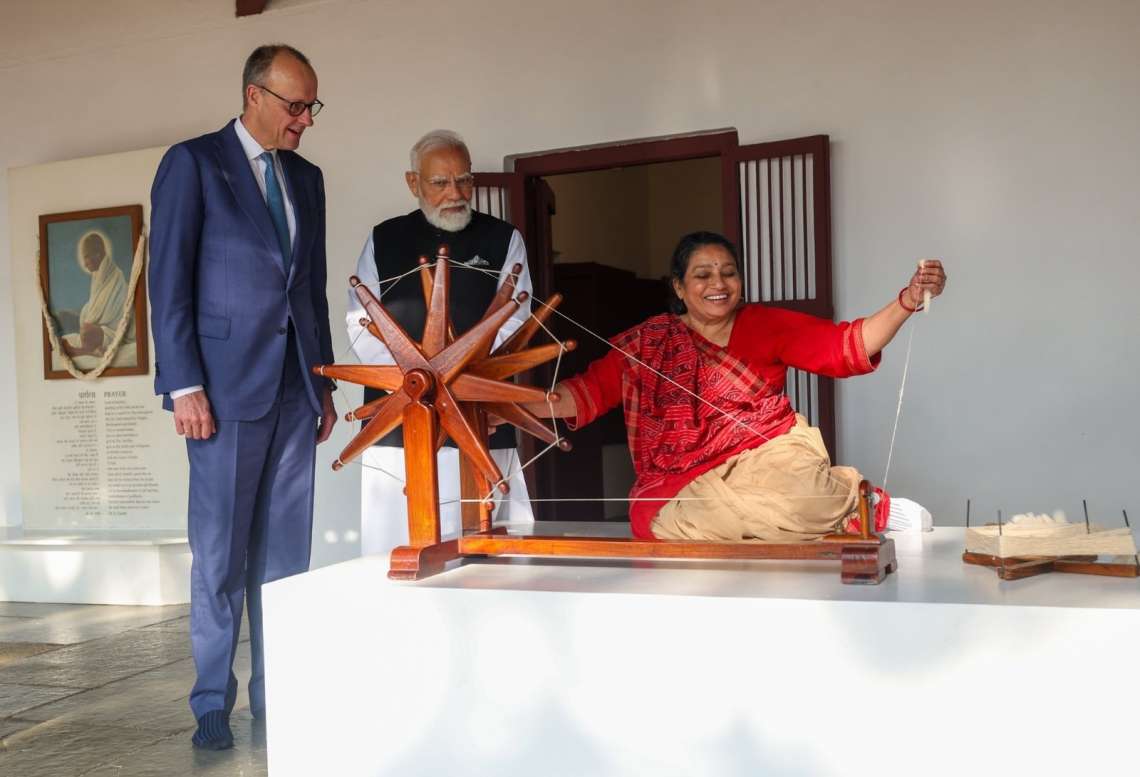
Soon after his arrival, Merz met Prime Minister Narendra Modi and joined him in inaugurating the International Kite Festival 2026 at the Sabarmati Riverfront in Ahmedabad. The two leaders flew kites together, a gesture intended to symbolise friendship, cultural exchange and the upward trajectory of bilateral ties. Earlier, they visited the Sabarmati Ashram to pay floral tributes to Mahatma Gandhi, underlining shared values of peace, dialogue and democratic traditions.
Economic cooperation featured prominently during the visit. Merz attended the India–German CEO Forum, where business leaders from both countries discussed ways to deepen collaboration in trade, investment and innovation. The forum reflected growing interest among German firms in India’s manufacturing base, digital economy and clean energy transition, as well as Indian companies’ appetite for advanced technology and market access in Europe.
At a joint press conference with Prime Minister Modi, Merz stressed that concluding negotiations on the long-pending Free Trade Agreement between India and the European Union is essential to unlocking the full potential of economic relations. Describing India as a “desired partner” and a “partner of choice” for Germany, he said an ambitious FTA would provide predictability for businesses, expand market access and anchor long-term cooperation in supply chains and innovation.
The visit concluded in Gujarat, where Chancellor Merz departed from Ahmedabad airport after receiving a warm farewell from Governor Acharya Devvrat, Chief Minister Bhupendra Patel and other senior dignitaries. Senior officials from the state administration and the Ministry of External Affairs were present, reflecting the importance attached to the visit at both the national and state levels.
Taken together, the visit reinforced the message that India–Germany ties are no longer confined to diplomacy or trade alone, but are increasingly driven by people — students, workers, entrepreneurs and cultural ambassadors. As both countries navigate economic transformation and global uncertainty, the emphasis on mobility, skills and shared opportunity is emerging as a defining pillar of the partnership.