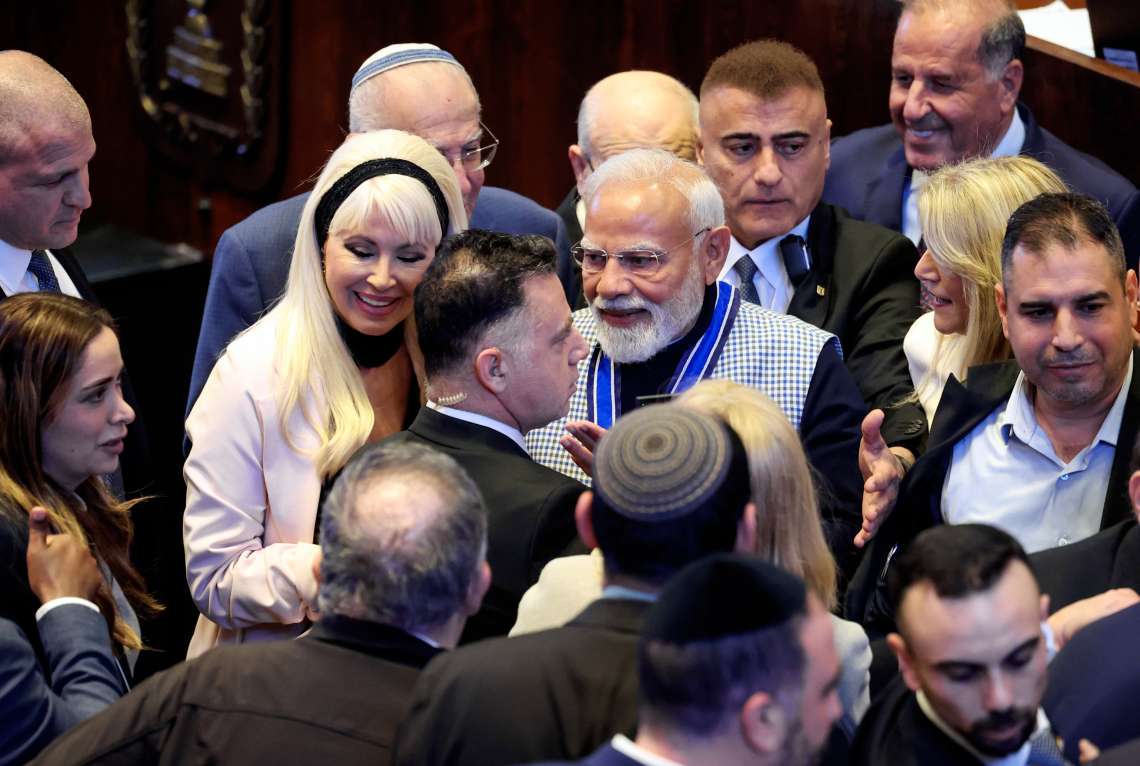
Narendra Modi becomes the first Indian prime minister to address Israel’s Knesset, voicing solidarity with Israel while backing a UN-endorsed Gaza peace plan…reports Asian Lite News
Prime Minister Narendra Modi on Wednesday described the Gaza Peace Initiative as a path towards a “just and durable peace” in the region as he addressed Israel’s Knesset in a historic first for an Indian leader. Coupling support for the UN Security Council-endorsed plan with a strong message of solidarity, he said “terrorism anywhere threatens peace everywhere” and reaffirmed India’s “consistent and uncompromising policy of zero tolerance for terrorism with no double standards”.
Modi’s speech to Israel’s house of representatives came hours after his arrival in the country, where he was received at Ben Gurion airport by Israeli Prime Minister Benjamin Netanyahu and his wife Sara Netanyahu. The address marked the first time an Indian prime minister has spoken before the Knesset.
Referring to the 7 October 2023 attack by Hamas, Modi said, “I also carry with me the deepest condolences of the people of India for every life lost and for every family whose world was shattered in the barbaric terrorist attack by Hamas on October 7 (2023).” He added: “We feel your pain. We share your grief. India stands with Israel, firmly, with full conviction, in this moment, and beyond. No cause can justify the murder of civilians. Nothing can justify terrorism.”
Drawing parallels between the two countries’ experiences, he said India has “also endured the pain of terrorism for a long time” and recalled the 26/11 Mumbai attacks, including the loss of Israeli citizens. “Like you, we have a consistent and uncompromising policy of zero tolerance for terrorism, with no double standards,” he said. “Countering terrorism requires sustained and coordinated global action, because terror anywhere threatens peace everywhere.”
Turning to regional diplomacy, Modi referred to Israel’s signing of the Abraham Accords and said it had been “a moment of new hope for a long-troubled region”, though he acknowledged that “the path is even more challenging” now. In that context, he explicitly backed the Gaza Peace Initiative. “The Gaza Peace Initiative that was endorsed by the UN Security Council offers a pathway. India has expressed its firm support for the initiative,” he said. “We believe that it holds the promise of a just and durable peace for all the people of the region, including by addressing the Palestine issue.”
He called for efforts guided by “wisdom, courage, and humanity”, adding that India joins Israel and the wider international community in seeking dialogue, peace and stability in the region.
The prime minister also highlighted broader India–Israel ties, describing both as “democracies shaped by history and focused on the future”. He said their partnership “not only serves national interests but also contributes to global stability and prosperity”, and underlined the importance of defence cooperation, noting that “in today’s uncertain world, a strong defence partnership between trusted partners like India and Israel is of vital importance”.
Modi pointed to India’s recent economic performance and Israel’s technological strengths as a “natural foundation for a forward-looking partnership”. He said the bilateral investment treaty signed last year would provide confidence to businesses and confirmed that negotiations were under way for an “ambitious Free Trade Agreement” aimed at unlocking untapped trade potential.
He also referenced cooperation in innovation and start-ups, recalling the inauguration of the iCreate Technology Business Incubator in 2018, and said India and Israel would work together through groupings such as the India–Middle East–Europe Economic Corridor and the I2U2 framework.
Concluding on a cultural note, Modi described India and Israel as “ancient civilizations” with philosophical parallels, citing concepts such as “Tikkun Olam” and “Vasudhaiva Kutumbakam”. He drew comparisons between Hanukkah and Diwali, and between Holi and Purim, as examples of shared traditions celebrating light, joy and renewal.