Microsoft’s Satya Nadella, Google’s Sundar Pichai and Micron’s Sanjay Mehrotra joined an elite corporate guest list at the White House….reports Asian Lite News Desk
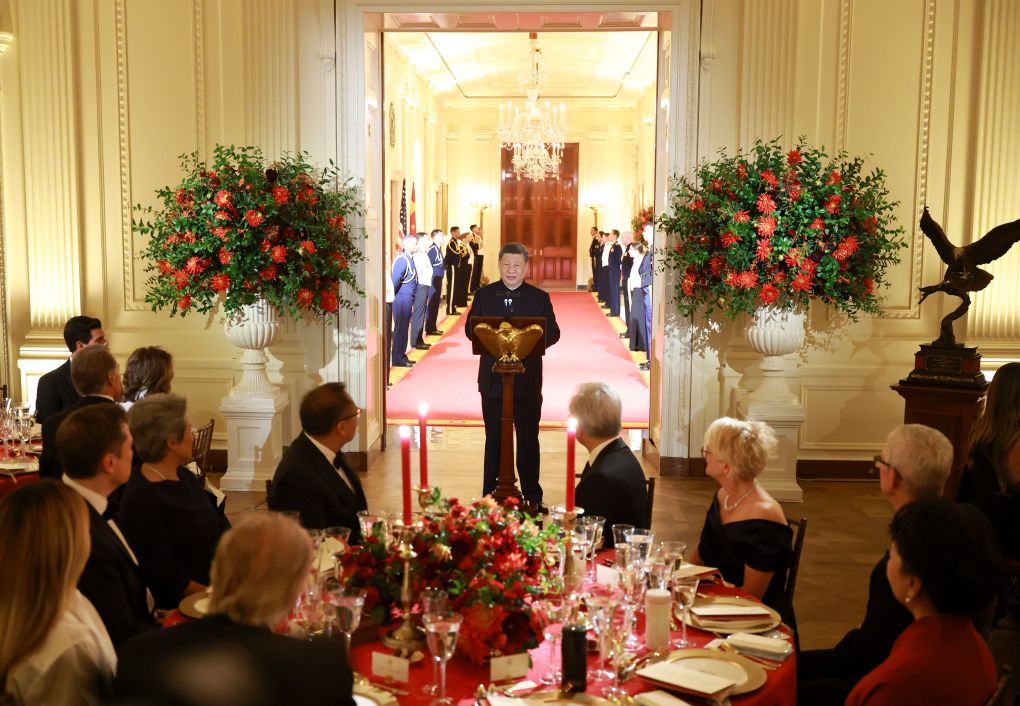
Microsoft chief executive Satya Nadella, Alphabet and Google chief executive Sundar Pichai and Micron Technology chief executive Sanjay Mehrotra were among the corporate leaders invited to US President Donald Trump’s state dinner for Chinese President Xi Jinping at the White House.
The guest list brought together senior executives from some of the world’s largest technology companies as Washington and Beijing discussed potential cooperation on artificial intelligence while continuing to compete over advanced computing, semiconductors and other strategic technologies.
Nadella is chairman and chief executive of Microsoft, while Pichai leads Google and its parent company Alphabet. Mehrotra heads Micron Technology, a major memory chip manufacturer.
US Vice President JD Vance and Second Lady Usha Vance were also among the guests. Sangeeta Mehrotra, wife of Sanjay Mehrotra, was included on the White House guest list.
Other technology executives invited to the dinner included Nvidia chief executive Jensen Huang, Apple chief executive Tim Cook, Meta chief executive Mark Zuckerberg, OpenAI chief executive Sam Altman and OpenAI president and co founder Greg Brockman.
Amazon founder Jeff Bezos, Tesla and SpaceX chief executive Elon Musk, Zoom chief executive Eric Yuan, Qualcomm chief executive Cristiano Amon and Dell chief executive Michael Dell were also invited.
Google co founder Sergey Brin, AMD chief executive Lisa Su and David Sacks, co chair of the President’s Council of Advisors on Science and Technology, were among the other technology figures on the list.
The presence of so many technology executives came as Trump and Xi highlighted artificial intelligence as an important issue in relations between the world’s two largest economies.
During welcome remarks earlier on Thursday, Trump said the discussions would cover security, technology and superintelligence.
“The decisions we make in these areas today can promote peace and prosperity for decades and decades to come,” Trump said.
Xi said China and the US had both the capability and responsibility to manage the development of artificial intelligence.
“Both China and the United States are major powers in artificial intelligence; we have the capability and the responsibility to develop and manage AI effectively, ensuring that its development remains under human control and benefits the people,” he said.
The dinner also brought together executives from banking, manufacturing, aerospace, energy and pharmaceuticals.
JPMorgan chief executive Jamie Dimon, BlackRock chief executive Larry Fink, Boeing chief executive Kelly Ortberg and Lockheed Martin chief executive Jim Taiclet were among the business leaders invited.
General Motors chief executive Mary Barra, Pfizer chief executive Albert Bourla, ExxonMobil chief executive Darren Woods and GE Aerospace chief executive Larry Culp were also on the guest list.
Senior members of the Trump administration attended the dinner, including Secretary of State Marco Rubio, Treasury Secretary Scott Bessent, Commerce Secretary Howard Lutnick and US Trade Representative Jamieson Greer.
Xi was accompanied by a senior Chinese delegation that included Vice Premier He Lifeng, Foreign Minister Wang Yi, Commerce Minister Wang Wentao and Zheng Shanjie, chairman of the National Development and Reform Commission.
The dinner followed a day of ceremonial events and closed door discussions at the White House. Trump and First Lady Melania Trump welcomed Xi and Peng Liyuan at the North Portico shortly after 7 p.m.
The dinner menu combined American ingredients with Chinese influences and began with sparkling wine served during the “Toast to Peace” between then US President Richard Nixon and Chinese Premier Zhou Enlai in Beijing in 1972.
Technology has emerged as a major area of competition between the US and China, with disputes involving advanced computer chips, semiconductor manufacturing equipment, artificial intelligence models and access to computing capacity.
Nadella, Pichai and Mehrotra were born in India before developing their careers in the United States. Their presence at the dinner placed three prominent Indian origin technology executives among political and corporate leaders at a high profile diplomatic gathering.