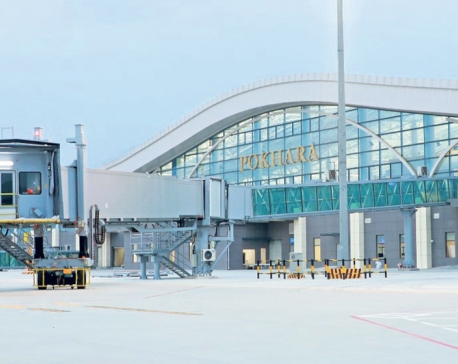
Nepal’s anti graft agency has accused former officials and a Chinese contractor of colluding to grant illegal tax exemptions during the construction of Pokhara International Airport…reports Asian Lite News
Nepal’s anti graft body on Thursday filed a corruption case at the Special Court against a former minister, current and former senior officials, a Chinese company, and its officials over alleged irregularities during the construction of Pokhara International Airport in western Nepal.
This is the fourth case filed by the Commission for Investigation of Abuse of Authority, or CIAA, in the past one and a half years over alleged corruption in the multi million dollar project, which was financed by China.
The airport, built with a loan of $215.96 million from the China Export Import Bank and executed by China CAMC Engineering Co., Ltd., has so far been criticised as a vanity project, with no scheduled commercial flights operating from the facility.
In a statement, the CIAA said it had filed the case against former finance minister Gyanendra Bahadur Karki, along with several former government secretaries, joint secretaries and other officials, bringing the total number of public officials charged to 11.
Karki is the sixth former minister to be named in the Pokhara airport corruption case. Earlier, former ministers Bhim Acharya, Ram Kumar Shrestha, Dipak Amatya, Ram Sharan Mahat and Post Bahadur Bogati were also accused. Bogati has since died.
The anti graft body also charged the Chinese contractor, China CAMC Engineering Co., Ltd., along with Chairman Wang Bo and Project Manager Yang Zhigang, saying they assisted public officials in the alleged corruption.
The CIAA alleged that officials and the contractor colluded to unlawfully grant tax and customs exemptions to the Chinese company in violation of the original procurement agreement.
It said the accused caused a loss of NPR 3.62 billion in government revenue by illegally granting those exemptions. According to the CIAA, the commercial contract between the Civil Aviation Authority of Nepal and China CAMC Engineering Co., Ltd. already included taxes, customs duties and other fees in the contract price, meaning the contractor was required to pay them under Nepali law.
The agency said a later implementation agreement was introduced to exempt the company from those payments, giving it what the CIAA described as a double benefit.