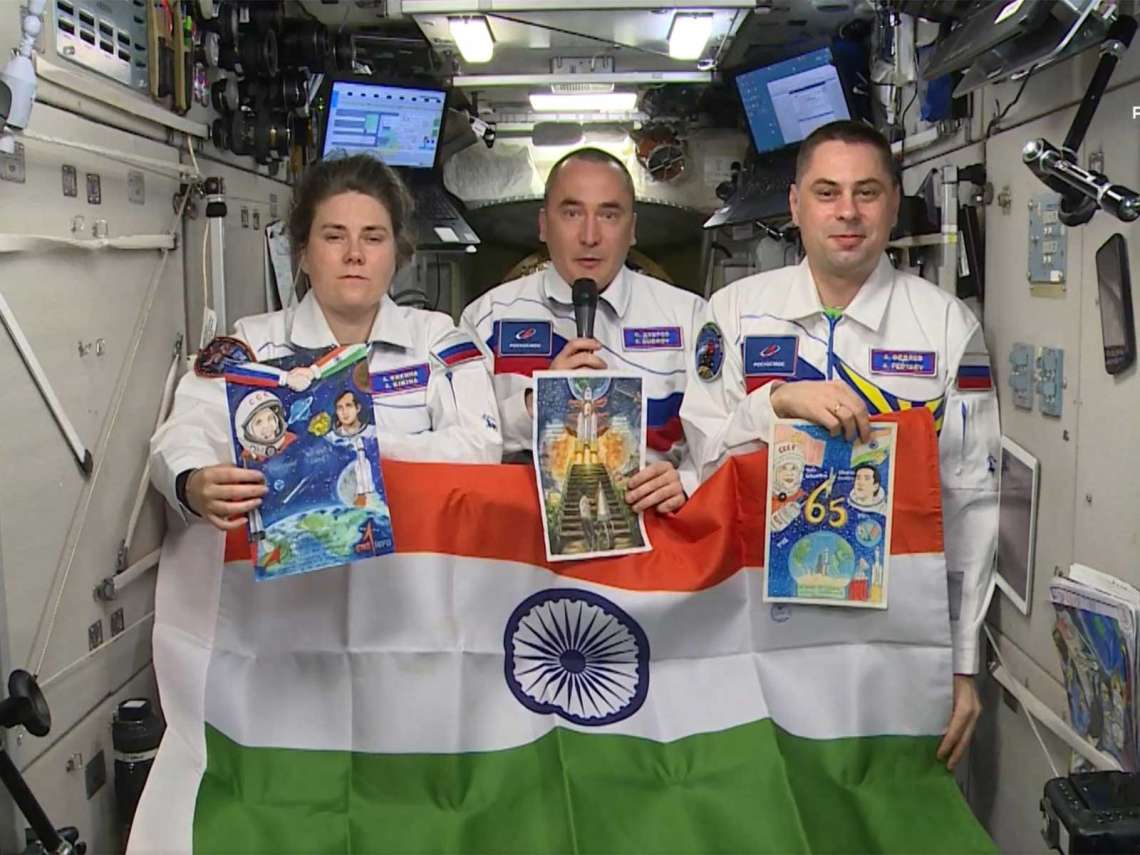
Russian cosmonauts aboard the ISS have wished India ahead of Independence Day, recalling decades of space cooperation from Aryabhata and Rakesh Sharma to Gaganyaan….reports India Daily News Desk
Russian cosmonauts aboard the International Space Station have sent Independence Day greetings to India, holding the Indian tricolour in a message highlighting decades of cooperation between Moscow and New Delhi in space exploration.
With India celebrating its 80th Independence Day on August 15, cosmonauts Pyotr Dubrov, Anna Kikina and Andrey Fedyaev recorded a message from the orbital laboratory, extending wishes for peace and prosperity to the Indian people. The gesture, made hundreds of kilometres above Earth, comes as the two countries continue to maintain a long-standing partnership in human spaceflight and space technology.
Dubrov addressed Indians in the message and recalled the significance of the relationship between the two countries. The cosmonauts also pointed to the history of India-Russia cooperation in space, linking this year’s Independence Day celebrations with important milestones in human spaceflight.
One of those milestones is the legacy of Yuri Gagarin, who became the first human to travel into space in April 1961. Gagarin visited India later that year, in November 1961, at a time when India and the Soviet Union were developing closer ties in science, technology and other fields.
The cosmonauts also highlighted the role of space cooperation in the relationship, which has its roots in India’s early space programme.
India’s first satellite, Aryabhata, was launched by a Soviet rocket from Kapustin Yar on April 19, 1975. Designed and built in India, the satellite was launched using a Soviet Kosmos-3M rocket under the Intercosmos programme. According to the Indian Space Research Organisation, Aryabhata was an experimental spacecraft carrying payloads for X-ray astronomy, aeronomy and solar physics.
The partnership reached another landmark in 1984, when Rakesh Sharma became the first Indian to travel into space. Sharma flew aboard the Soviet Soyuz T-11 spacecraft with Soviet cosmonauts Yuri Malyshev and Gennady Strekalov. His mission remains one of the most prominent symbols of the early India-Soviet space relationship.
The relationship has since moved towards India’s ambitions for independent human spaceflight.
The Russian cosmonauts referred to India’s Gaganyaan programme, under which India is developing the capability to send astronauts into low-Earth orbit and safely return them to Earth. ISRO says the programme involves the development of human-rated systems, crew escape technologies, life-support systems, astronaut training and recovery capabilities.
India’s astronaut training programme has also involved international cooperation. ISRO’s Gaganyaan training framework includes extensive preparation in areas such as spacecraft systems, space medicine, microgravity familiarisation, emergency procedures, survival and recovery operations.
The latest message comes at a time when India’s human-spaceflight programme is gaining international visibility. Indian astronaut Group Captain Shubhanshu Shukla travelled to the International Space Station in 2025 as part of the Axiom-4 mission, becoming the second Indian to travel to space and the first Indian to visit the ISS. His mission also involved scientific experiments developed by Indian researchers.
ISRO has described human spaceflight cooperation as an important element of India’s expanding international space partnerships. In addition to cooperation with Russia, India has developed agreements with agencies including NASA and the European Space Agency for astronaut training, experiments and human-spaceflight activities.
The Russian cosmonauts’ Independence Day message therefore comes against a broader backdrop of India’s growing role in international human spaceflight.
The ISS itself has long served as a symbol of multinational cooperation in orbit, bringing together astronauts and cosmonauts from different countries for scientific research and station operations.
For India and Russia, however, the connection predates the ISS by decades. From Aryabhata’s Soviet launch in 1975 to Sharma’s historic Soyuz flight in 1984 and current cooperation linked to Gaganyaan, space has remained one of the most visible areas of scientific collaboration between the two countries.
The cosmonauts also referred to the continuing importance of the relationship in their message, with Fedyaev holding the Indian flag and expressing a wish for continued India-Russia friendship.
The visual of the tricolour floating inside the ISS adds a distinctive space-age touch to India’s Independence Day celebrations, connecting the country’s historic journey since 1947 with its ambitions beyond Earth.