The exercises come at a sensitive moment as relations between Pretoria and Washington remain strained over South Africa’s ties with states viewed by the United States as strategic adversaries…reports Asian Lite News
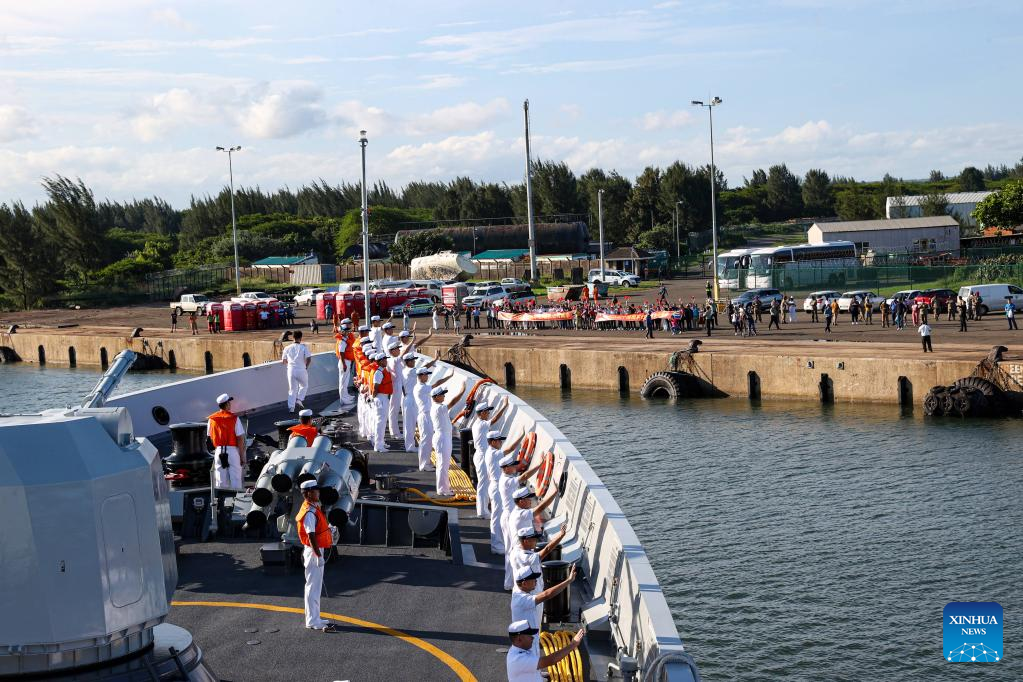
Chinese, Russian and Iranian warships launched the exercises on Friday in waters near Cape Town, marking the latest instance of military cooperation between the three countries and their African host. The drills, led by China and organised under the framework of the BRICS bloc of developing nations, were planned last year and are intended to focus on maritime safety and anti-piracy operations, according to South Africa’s armed forces. Officials said the manoeuvres were also designed to “deepen cooperation” among participating navies.
China, Russia and South Africa are longstanding members of BRICS, a grouping that has increasingly positioned itself as a counterweight to Western-led institutions. Iran formally joined the bloc in 2024, expanding the group’s reach and adding to concerns in Western capitals about its geopolitical direction. It was not immediately clear whether other BRICS members would take part in the drills. The bloc also includes Brazil, India and the United Arab Emirates among others. A spokesperson for the South African armed forces said he was not yet able to confirm the full list of participating countries. The exercises are due to continue until next Friday.
The presence of Iranian warships has attracted particular attention, coming as protests grow inside Iran against the country’s leadership. The Iranian navy’s participation also underlines Tehran’s efforts to deepen military and diplomatic ties beyond the Middle East at a time when it faces extensive international sanctions. For China and Russia, the drills represent another opportunity to demonstrate naval reach and cooperation with partners outside their immediate regions.
Warships from all three countries were seen moving in and out of the harbour serving South Africa’s main naval base at Simon’s Town, south of Cape Town, where the Indian Ocean meets the Atlantic. China has deployed the Tangshan, a 161-metre-long destroyer-class vessel, while Russia’s Baltic Fleet said it had sent the Stoikiy, a smaller warship, along with a replenishment tanker. The scale of the deployment has reinforced perceptions that the exercises are about more than routine maritime training.
The drills were originally scheduled to take place in late November but were postponed for diplomatic reasons. South Africa was hosting Western and other world leaders for the Group of 20 summit around the same time, and officials opted to delay the naval exercises to avoid overshadowing the meeting. Their rescheduling has nonetheless placed Pretoria back in the spotlight, particularly as tensions rise over the United States’ recent intervention in Venezuela and its move to seize tankers carrying Venezuelan oil.
Relations between South Africa and the United States have been under pressure for some time, and the latest drills are likely to deepen that strain. South Africa is the most advanced economy in Africa and often presents itself as a leading voice for the continent, but it has faced pointed criticism from Washington over its foreign policy choices. US President Donald Trump said in an executive order in February that South Africa supports “bad actors on the world stage” and cited its ties with Iran as one of the reasons for the US cutting funding to the country. China and Russia have frequently used BRICS forums to criticise the US and other Western countries, further complicating South Africa’s balancing act.
Pretoria has long maintained that it follows a nonaligned foreign policy and seeks to remain neutral in global conflicts. However, Russia’s growing presence at the southern tip of Africa has previously tested that stance. In 2023, the Biden administration accused South Africa of allowing a sanctioned Russian ship to dock at the Simon’s Town naval base and load weapons destined for Russia’s war in Ukraine. South Africa denied the allegation, but the episode highlighted the sensitivities surrounding its military engagements.
Domestic criticism has also intensified. South Africa’s decision to host Russian and Iranian warships has been challenged by opposition parties, including within the coalition government. The Democratic Alliance, the second-largest political party in the coalition, said it was opposed to hosting drills involving “heavily sanctioned” Russia and Iran. “Calling these drills ‘BRICS cooperation’ is a political trick to soften what is really happening: Government is choosing closer military ties with rogue and sanctioned states such as Russia and Iran,” the Democratic Alliance said.