Takaichi said her government would prioritise economic growth, security and tougher immigration screening as Japan heads to the polls…reports Asian Lite News
Japanese Prime Minister Sanae Takaichi has pledged to make the country “more prosperous and safer” as she made a final appeal to voters on the eve of snap general elections, Arab News reported.
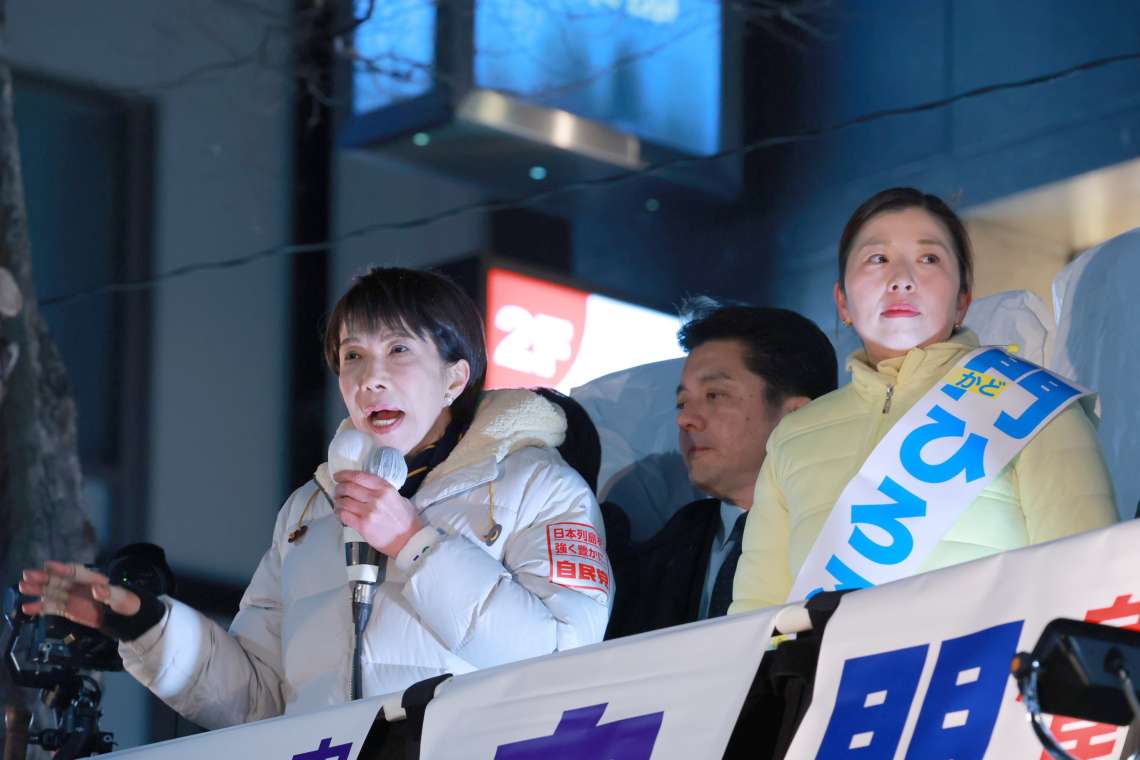
Speaking at a large campaign rally in Tokyo on Saturday, Takaichi said her government would prioritise economic growth, security and tougher immigration screening as Japan heads to the polls on Sunday. Opinion surveys suggest her ruling bloc, led by the Liberal Democratic Party (LDP), is on course for a decisive victory that could deliver a two-thirds majority in the powerful lower house.
“Pushing the button for growth is the Takaichi cabinet’s job. Japan will become more and more prosperous and safer,” the 64-year-old leader told thousands of supporters. She said this year should mark a turning point for the country, transforming public anxiety about living standards and the future into renewed optimism.
An arch-conservative and a former heavy metal drummer who has cited Margaret Thatcher as an inspiration, Takaichi became Japan’s fifth prime minister in as many years after taking office in October. Her rise followed a series of damaging election defeats for the once-dominant LDP, which had left it without a majority in both chambers of parliament.

Despite that backdrop, Takaichi has enjoyed strong popularity ratings, particularly among younger voters. She has developed a reputation as an unlikely fashion icon and gained a large following on social media, helping to revitalise the party’s image, Arab News reported.
A key pillar of her campaign has been a tougher stance on immigration. Takaichi said screening procedures had already been tightened to prevent terrorists and industrial spies from entering the country. She also called for closer checks to ensure foreign residents were paying taxes and health insurance contributions.
Her rhetoric appears to have slowed the rise of the populist Sanseito party, which campaigns on a “Japanese first” platform and made significant gains in upper house elections last year.
Takaichi said her vision was for a Japan where people could live safely anywhere in the country, access medical care and welfare, receive high-quality education and find stable employment. However, she stressed that such goals depended on economic strength.
“Healthcare costs money. Welfare costs money. Education also requires investment,” she said. “So we must build a strong economy.”
Polling ahead of Sunday’s vote suggests the LDP is likely to secure well above the 233 seats needed for a simple majority, though analysts caution that a sizeable number of voters remain undecided. Together with its coalition partner, the Japan Innovation Party, Takaichi’s bloc could reach the two-thirds threshold that would give it sweeping legislative power.
The last time such a majority was achieved was in 2017 under former prime minister Shinzo Abe, who was assassinated in 2022 and was widely regarded as Takaichi’s political mentor.
By contrast, the newly formed Centrist Reform Alliance, made up of the main opposition Constitutional Democratic Party and the LDP’s former partner Komeito, is forecast to suffer heavy losses, potentially shedding around half of its current seats, Arab News reported.
At Saturday’s rally, supporters expressed admiration for Takaichi’s leadership. Yuka Ando, a 17-year-old high school student who attended with her mother despite freezing temperatures and heavy snowfall in northern Japan, said Takaichi had sparked her interest in politics. She described the prime minister as inspiring, adding that her status as Japan’s first female leader made her stand out.
Political analysts expect Takaichi’s decision to call early elections to strengthen her hand. Jeff Kingston, a professor at Temple University Japan, told AFP that she was likely to emerge with a strong mandate that would enable her to pursue ambitious economic and security reforms.
However, Takaichi’s positions are being closely watched abroad, particularly by China. Shortly after taking office, she suggested Japan could intervene militarily if Beijing attempted to seize self-ruled Taiwan by force. The remarks prompted a sharp response from China, including diplomatic protests, travel warnings and joint military drills with Russia near Japan.
Her economic agenda has also unsettled investors. A $135-billion stimulus package and proposals to temporarily exempt food from consumption tax pushed long-term Japanese bond yields to record highs last month, underscoring concerns about fiscal sustainability, Arab News reported.