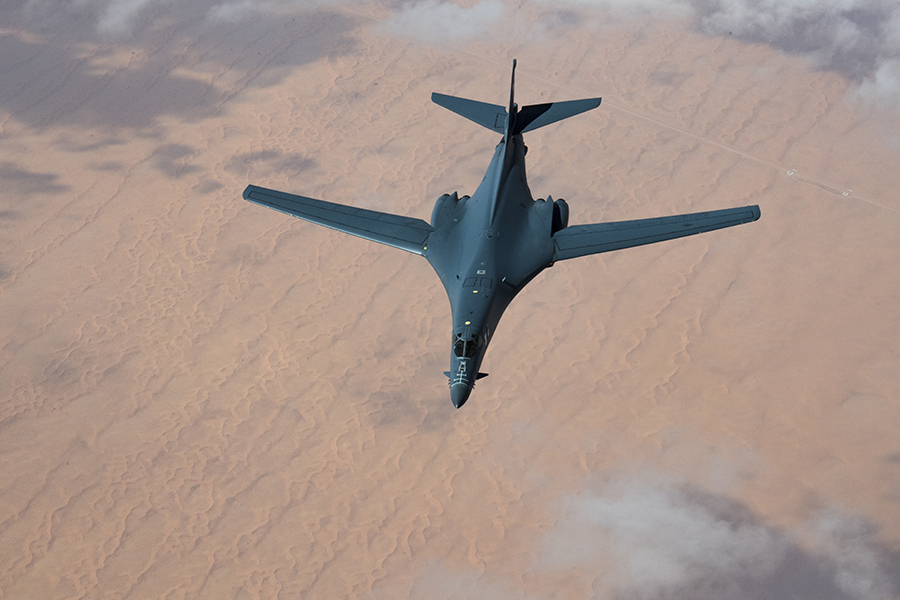
A United States strategic bomber capable of carrying dozens of cruise missiles has arrived at a British air base, underscoring the growing scale of Western military operations against Iran as the conflict in West Asia enters a new phase.
The 146-foot B-1 Lancer bomber landed at RAF Fairford on Friday evening after the UK government authorised the United States to carry out defensive military actions against Iranian missile sites using British facilities.
The decision by Prime Minister Keir Starmer followed earlier hesitation from London over allowing American aircraft to launch strikes from UK-controlled bases as part of the joint campaign being carried out by the United States and Israel against Iran.
Initial reluctance from the British government reportedly caused friction with Donald Trump, who had criticised the delay and said US aircraft were forced to fly significantly longer distances to conduct earlier operations.
The arrival of the bomber comes after US Defence Secretary Pete Hegseth warned that American military strikes against Iranian targets were likely to increase sharply in the coming days.
Hegseth said the tempo of operations was “about to surge dramatically”, signalling a potential escalation in the campaign targeting Iranian military infrastructure.
RAF Fairford, located near the Gloucestershire–Wiltshire border, has long served as a key staging point for US long-range bomber missions in Europe and the Middle East. The base has previously supported American air operations during conflicts in Iraq, Afghanistan and Libya.
Under the latest arrangements, the United States has also been authorised to operate from the remote British-controlled facility at Diego Garcia, a strategically important base in the Indian Ocean that has historically played a central role in long-range bombing operations.
Speaking in Parliament, Starmer emphasised that Britain’s approval for US activity from these bases was limited to defensive actions targeting missile threats.
The prime minister stressed that the UK government does not support attempts to force political change in Iran through military bombardment, telling MPs that Britain “does not believe in regime change from the skies”.
The B-1 Lancer, built by Boeing, is among the most powerful long-range bombers in the US arsenal. Weighing around 86 tonnes, the aircraft is capable of carrying up to 24 cruise missiles and can travel at speeds exceeding 900 miles per hour.
Nicknamed “The Bone” by pilots, the bomber is equipped with advanced navigation systems combining radar and GPS targeting technology, as well as electronic countermeasures designed to jam enemy radar and deploy decoys to evade air defences.
The deployment comes as the conflict between Iran, Israel and the United States enters its eighth day, with both sides intensifying military operations across the region.
Explosions were reported overnight in Tehran following renewed US and Israeli strikes. The attacks came shortly after Trump reiterated that Washington would accept “no deal” with Iran unless the country agreed to what he described as unconditional surrender.
Meanwhile, Britain has also faced scrutiny over its military posture in the region following a drone attack on the UK’s air base at RAF Akrotiri.
The strike caused minimal damage and no casualties, according to officials. However, critics questioned whether the UK had deployed sufficient military resources to protect its installations in the Middle East.
Downing Street rejected those claims, insisting that appropriate defensive measures have always been in place to safeguard British personnel and infrastructure.