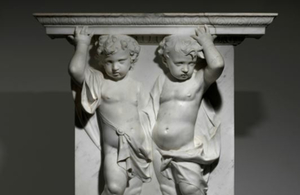
The decision to defer an export licence follows advice from the Reviewing Committee on the Export of Works of Art and Objects of Cultural Interest (RCEWA)..reports Asian Lite News
A temporary export bar has been placed on a rare marble sculpture by Michael Rysbrack, valued at £750,000, in a move designed to give a UK gallery or institution the opportunity to acquire the work for the nation.
The sculpture, depicting two ‘putti’ – childlike figures – supporting a column, was likely created as part of a pair of chimney pieces, possibly for the grand Bedford House in London. Carved from marble and standing more than a metre tall, the piece has been praised for its exceptional quality and remarkable state of preservation despite being nearly three centuries old.
The decision to defer an export licence follows advice from the Reviewing Committee on the Export of Works of Art and Objects of Cultural Interest (RCEWA). The Committee determined that the sculpture met the second and third Waverley criteria, citing its outstanding aesthetic importance and its significance to the study of Rysbrack’s work, eighteenth-century sculpture, architectural and social history, and the representation of children in portraiture.
Culture Minister Baroness Twycross described the work as an example of “remarkable mastery,” highlighting the intricate detailing of the marble figures. She expressed hope that the export bar would help secure the sculpture for public enjoyment in the UK.
Committee member Stuart Lochhead noted that the sculpture was probably designed for Bedford House, one of London’s most important aristocratic residences of the period. Originally forming part of a monumental fireplace, the piece combines scale with delicacy. The flesh and hair of the figures are rendered with notable tenderness, reflecting both technical skill and artistic sensitivity.
Owning sculptures inspired by Classical antiquity was highly fashionable among the British aristocracy in the eighteenth century. Rysbrack’s work drew heavily on ancient Greek and Roman art, and possession of such pieces signalled intellectual engagement with the Classical world. The putti motif, long associated with Renaissance and Baroque art, also took on evolving meanings during the period.
The imagery of children is particularly significant in this case. During the early eighteenth century, new ideas about childhood development were beginning to influence attitudes in British society. Rysbrack himself became a governor of London’s Foundling Hospital, an institution dedicated to the care of orphaned children. His engagement with the hospital coincided with a growing cultural shift in how childhood was understood and represented in art.
Born and trained in Antwerp, Rysbrack built much of his reputation in England. He became one of the leading sculptors of his generation, producing works for prominent patrons and major sites including Westminster Abbey. The putti sculpture is seen as marking an important moment in his career, reflecting both his classical influences and contemporary social concerns.
This is the fourth temporary export bar issued this year. Previous cases have involved an eighteenth-century bust of John Gordon of Invergordon, a £9 million Baroque painting by Claude Lorrain, and an eighteenth-century terracotta dog sculpture by the pioneering female sculptor Anne Damer.
Under the current arrangements, the decision on the export licence will be deferred until 5 May 2026 inclusive. During this first deferral period, UK institutions have the opportunity to raise funds to match the recommended price of £750,000, plus VAT of £150,000, which can be reclaimed by an eligible institution.
If a serious intention to purchase is confirmed through an Option Agreement, a second deferral period of four months will follow to allow the transaction to be completed.
Ministers and advisers have stressed that without a successful domestic bid, the sculpture could leave the country. Supporters argue that retaining the marble group in a public collection would preserve an important example of eighteenth-century artistry and safeguard a work that speaks to shifting cultural attitudes in Britain’s past.