Sellafield has begun using four-legged robots to support inspections in hazardous areas as part of efforts to speed up decommissioning and reduce human exposure to risk…reports Asian Lite News
Sellafield Ltd has begun deploying quadrupedal robots to support decommissioning work at the UK’s most complex nuclear site, using the technology to improve safety, speed up inspections and reduce the need for workers to enter hazardous environments.
Parts of the Sellafield site are highly radioactive, confined or difficult to access, making routine inspections challenging and sometimes risky. The company says accurate, high-quality inspection data is increasingly critical to decision-making as decommissioning progresses, while at the same time the number of situations in which people must enter radiological or industrially dangerous areas needs to be reduced.
To address these challenges, Sellafield has been developing robotic solutions through the RAICo 1 programme and with its supply chain. Four-legged robots are seen as particularly useful because of their ability to move across uneven ground, climb stairs and operate in spaces that are unsuitable for wheeled machines or human workers.
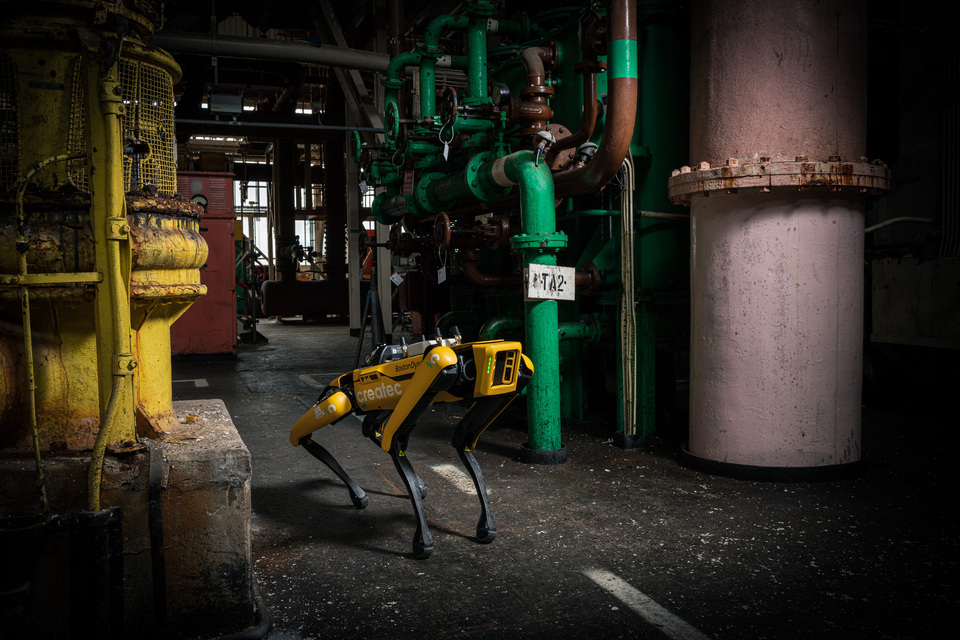
The main platform being used is a customised version of Boston Dynamics’ Spot robot, adapted for nuclear environments. The robot is fitted with radiation-resistant sensors and a range of data-collection tools, including 360-degree imaging, 3D light detection and ranging scanning, gamma and alpha characterisation, environmental monitoring, and photographic and video capture. It can be operated remotely and can live-stream information to operators and specialists based elsewhere.
Sellafield says the robots are being used for tasks such as mapping, routine inspections, environmental monitoring and characterisation. These activities would normally require staff to wear full personal protective equipment and work under strict controls. By replacing or reducing the need for human presence, the company expects to lower exposure to risk, reduce the amount of protective equipment used and disposed of, and allow inspections to be carried out more frequently and consistently.
The work is being delivered through collaboration between several partners. Boston Dynamics provides the underlying robotic platform. Createc has customised and deployed Spot for nuclear applications, supplying and maintaining the inspection systems and supporting on-site trials and operator training. AtkinsRéalis is providing systems integration and operational support, including mission planning and digital integration. RAICo 1, which includes the UK Atomic Energy Authority, the Nuclear Decommissioning Authority, Sellafield Ltd, the University of Manchester and AWE Nuclear Security Technologies, has supported early trials and testing. Within Sellafield, the Specialist Equipment Services team is responsible for managing the equipment and deployments.
Development of the technology has been under way for more than two years. Initial trials took place in 2021 with support from the UK Atomic Energy Authority’s Remote Applications in Challenging Environments team. During 2022 and 2023, further demonstrations showed the robot could navigate complex layouts, collect stable 3D scans and operate safely alongside existing plant and processes.
In 2023 and 2024, a customised Spot robot was deployed for the first time in a C5 highly radiological area, completing routine inspection routes and capturing imagery and radiological data. In 2025, Sellafield and AtkinsRéalis achieved what they described as an industry first by remotely operating the robot from outside the boundary of the nuclear-licensed site in a live-streamed, secure teleoperation trial.
Sellafield now plans to move the robots from trials into routine, business-as-usual operations. The company says this will include expanding their use across priority facilities, improving digital integration with 3D visualisation tools and digital twins, and developing new sensing payloads to support a wider range of decommissioning tasks. The work is also expected to inform a wider Nuclear Decommissioning Authority roadmap for the use of quadrupedal robots across other sites.