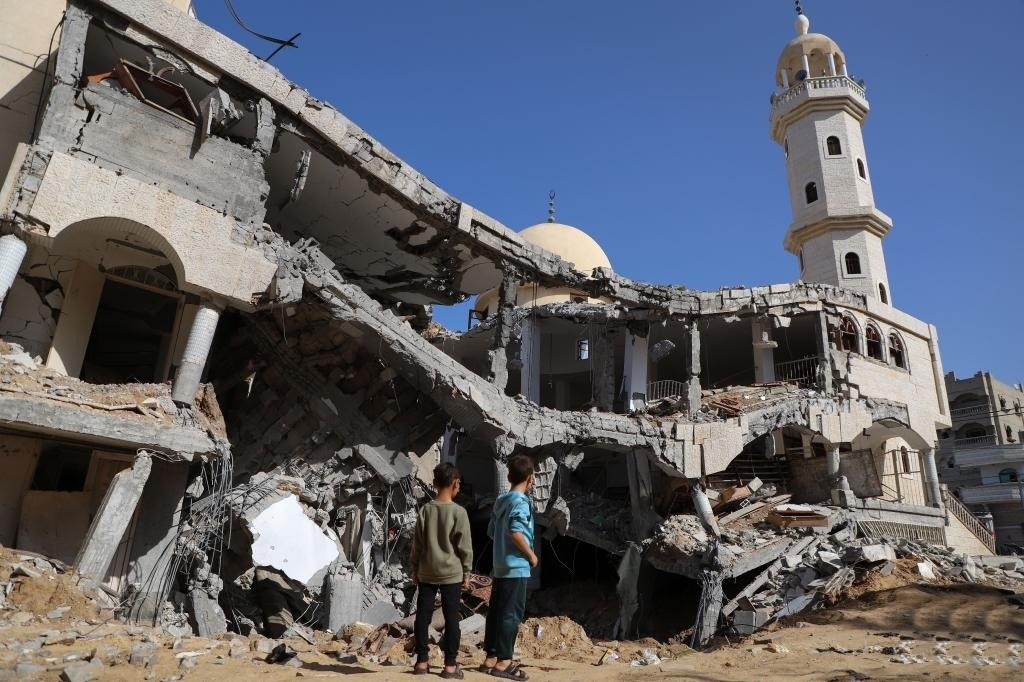
President Cyril Ramaphosa joined a growing chorus of international voices against what many has termed “the genocidal operation” of the IDF in Gaza…reports Asian Lite News
After October 7 following Hamas’s unprecedented surprise attack on Israel, much of the international community rushed to voice its concern about the escalation in tensions, but few took a moment to condemn Israel’s aggression against the Palestinians.
However, as Israel continues to bomb Gaza and attack Palestinians in the occupied West Bank, several governments have started to turn critical of Israel’s actions – some more directly than others. Surprisingly, even the number of nations, condemning Israel’s brutal military oppression in Gaza, doesn’t exceed a two-digit list.
In contrast there are some nations like South Africa, which have vociferously condemned the Israeli brutalities in Gaza on unarmed Palestinian children, youth and aged.
On November 17, the prosecutor of the International Criminal Court (ICC) said he had received a joint request from five countries to investigate the situation in the Palestinian territories.
Prosecutor Karim Kahn said the referral had come from South Africa, Bangladesh, Bolivia, Comoros and Djibouti. South Africa said the request was made to ensure that the ICC pays urgent attention to the grave situation in Palestine.
Though, Israel is not a member of the court and does not recognise its jurisdiction, the ICC can investigate nationals of non-member states in certain circumstances, including when crimes are alleged to have been committed in the territories of member states.
The Palestinian territories have been listed among the ICC’s members since 2015.
Perhaps the emotional connect between S Africa and Palestine exists because of the two prominent leaders of the non-aligned movement i.e. Nelson Mandela and Yasser Arafat, from these two countries respectively, and recalling the experience of apartheid themselves, the South African leaders could better understand the plight of the Palestinians and raise their voice in their support.
The South African government has made its position clear expressing support for the Palestinians amid the on going attacks by Israel in the Gaza Strip, though also condemning resistance group Hamas for attacking and kidnapping Israeli civilians.
“We, who enjoy the freedom from Apartheid, can never, ever be the ones who agree to an apartheid form of oppression. This cannot be tolerated. This brutality should not be accepted.” Foreign Minister Naledi Pandor said in parliament on November 14 while delivering a ministerial statement on the raging conflict.
“These actions remind us of our experiences as Black South Africans living under Apartheid. This is one of the key reasons South Africans, like people in cities all overthe world, have taken to the streets to express their anger and concern at what is taking place in Gaza and the West Bank.” she said.
Taking a proactive action last week, South Africa withdrew all its diplomats from Tel Aviv for consultation over Israel’s assault in Gaza.
The South African government also instructed the Foreign Ministry to take the necessary diplomatic measures to deal with the conduct of the Israel ambassador to South Africa, Eliav Belotserkovsky, whose conduct, they said is becoming very untenable.
Belotserkovsky is accused of disparaging comments against people raising their voices against attacks on Palestinians.
South Africa is among a handful of African countries maintaining diplomatic ties with both Israel and Palestine. Yet, it has strongly advocated for Palestinian freedom and has called for a two-state solution.
Lesiba Teffo, a political scientist at the University of South Africa, commenting on the South African government’s response told Anadolu news agency that South Africa and Palestine have had historic relations for decades and that it is important for them to support the Palestinian cause for freedom.
“Palestine was with South Africa during the struggle against apartheid, while Britain and America never supported us but they were ever supporting Israel. This context is important,” he told Anadolu.
Teffo also said South Africa has been consistent in supporting Palestine over the years.
Dirk Kotze, another professor of politics at the same university, told Anadolu that South Africa’s ruling African National Congress (ANC) has had historical links with the Palestine Liberation Organisation (PLO) since the time of late anti- apartheid hero and first Black South African President Nelson Mandela.
Siyabulela Mandela, the great-grandson of Nelson Mandela in an interview said that despite South Africa being liberated from the senseless violence and oppression, he (Nelson Mandela) was able to recognise the fact that our freedom is not complete until the people of Palestine are free.
Siyabulela, an independent consultant on human rights, peace and conflict resolution, spoke with Global National’s Farah Nasser while in Toronto where he was interviewed on stage at the Journalists for Human Rights annual gala.
He said that his great-grandfather, the first Black president of South Africa, was considered idealistic for thinking that there was a solution to apartheid in his country and people would consider it a miracle if it happened – and then it did.
Last week, President Cyril Ramaphosa joined a growing chorus of international voices against what many has termed “the genocidal operation” of the IDF in Gaza.
The South African Parliament also last week debated whether to cut diplomatic ties with the Jewish state.
Leading parties in parliament, notably the ruling ANC and the third largest party, Economic Freedom Fighters (EFF), favour cutting diplomatic ties with Israel.
In recent years, human rights organisations and legal experts have increasingly described Israel’s policies toward Palestinians as apartheid, adding to a longstanding debate about whether this is an accurate way to categorise the country’s practices.
Human rights groups have argued that the Israeli government’s policies on land access, restrictions on movement, and limitations on the right to vote meet the ICC’s standard and that it has institutionalised racism against Palestinians in order to ensure Israeli Jews remain the dominant group across Israel and the occupied Palestinian territories (OPT), which includes the West Bank and Gaza.
Israel and its allies, including the U.S. and the European Commission, have rejected this assessment.
Overall, it makes one wonder what is holding back the so-called Islamic states from taking any firm step against the Israeli aggression, like South Africa?
Their own selfish interests and their lust for power, as most of them are monarchies and in no way are obligated to uphold the wish of their people, which recent demonstrations in some Arab states have shown.
It would not be wrong to surmise that the current conflict has shown the leopard’s true spots.
ALSO READ-